Five of Swords
Swords — Minor Arcana
Detailed Interpretation
Five of Swords is a strong and palpably negative card. This is often forgotten, categorizing only The Tower, Death, and the Ten of Swords as "as bad as it gets". The Five of Swords holds a worthy place among them. It is dangerous. Its main principle is the lack of principles. The spectrum of its cruel action is quite wide. It is the "Black Mamba" of the deck. Its primary meaning, which makes sense to consider first, is revenge. And only if the context of the situation excludes this, should you move on to the others.
The appearance of the Five of Swords is a sure sign that life is now entering a stressful phase, a situation from which it will not be possible to break free immediately. Surrounding cards may soften its influence, but in any case, it is a period of demoralization, loss and destruction, a struggle against the vicissitudes of fate... one can only try to get through it with the least amount of losses (look at what reserves are reflected in the spread). It can also be Tarot's advice to walk away from a destructive situation, since fighting is either pointless or too costly.
The Five of Swords is perhaps the most "harmful" card of the Minor Arcana of Tarot. It often signifies an exacerbation of a conflict, a nasty scandal, "blows below the belt", treachery, meanness, some kind of intrigue, and hostility. At the same time, the card does not indicate whether all these malicious actions come from ourselves or, conversely, we find ourselves dragged into this unseemly story as a victim. The other cards in the spread can inform about this. However, in any case, the Five of Swords means a "Pyrrhic victory", which will not delight the winner for long. Like many other cards, the role of the Five of Swords can vary somewhat depending on a person's personality traits. Strong, aggressive, and combative natures are more likely to find themselves in the role of the offender rather than the beaten one. The situation is problematic in any case, but one swallows the poison of defeat, and the other – the poison of victory. In this case, it is exactly poison, not nectar, and the victor's wreath is also woven from thorns.
One of the old meanings of the card is "empty victories", "bitter successes". And this is still its "bright" side. The darker one is "destruction, loss, dishonor". Modern interpretations sound no better - an unhappy, tragic situation, heavy loss, grief, blackmail, compromising material. In essence, this is the only Tarot card that is associated with such words as disgrace, ignominy, and shame.
These are situations of revenge for hire, to "humiliate" and "teach a lesson". Banzhaf and Akron define it as the "Spirit of Humiliation". There are also such grim meanings as violence, murder, kidnapping. The card can also reflect situations such as a group beating (five against one, taken by surprise) or gang rape (for example, in a company where such behavior was not expected at all). But in ordinary life, its meanings such as insult, the collapse of plans, and loss are more likely to manifest.
The Five of Swords can portend encountering a challenge and the need to communicate with people clearly not on your level – either lower or higher, but either way, it brings little pleasure. In general, it says that the querent is facing some kind of struggle, the outcome of which is unclear; the losses, in any case, are obvious, and the win is doubtful. The other cards in the spread can suggest whether the game is worth the candle. Sometimes the Five of Swords points to a moment when you need to walk away from the current situation, at least retreat temporarily. As the resulting card of the spread, it sometimes indicates a rejection (voluntary or forced) of what the question was asked about. We simply recognize the limits of our capabilities or become convinced that this is a hopeless situation, in which we do not need a victory.
Either cruel and vindictive ("I'll tear them apart!"), or actually "torn apart" and broken, humiliated and insulted.
In a person more inclined to the role of the aggressor, the card reveals a desire to heat up the atmosphere, cause pain, blatant destructive behavior, a thirst for destruction, suppression of a potential opponent (who can rise up and take revenge). The desire to win an argument at any cost, dismissively smear them on the wall, settle scores.
This triumph is fraught with a moral hangover and regrets about what was done. For a person for whom the role of a victim is more typical (at least in the given situation) – a fear of painful situations and experiences, a fear of enemies, dishonor, deception, cruelty, meanness, heartlessness, and in the worst case – a real collision with all of this. Both sides of the Five of Swords' state are vividly played out in the image of the severely injured and revenge-prone Bride played by Uma Thurman.
The Five of Swords can provoke irrational fears up to "panic attacks", but this is only the flip side of the thirst for destruction.
A Five of Swords person is distinguished by an extremely developed skill of driving their neighbors to the wall. "Grinding to powder", "walking over heads" - this is all the Five of Swords. Where the Five of Wands is described as "elbowing one's way" and "getting bumps", the Five of Swords will "walk over corpses". Sometimes, as a result, a person not only acquires a bad reputation but also truly degrades.
Stubbornness in defending wrong decisions. Pointless lies.
Change in the direction of life's path, breaking of worldview (swords relate to thoughts, and this meaning often surfaces).
The metaphysical power of the Five is always aimed at destruction, at sweeping away from the road everything that hinders its movement. The Five of Swords is purification, cutting off all that is superfluous in an attempt to overcome the earthly (symbolized by the four). The Five of Swords symbolizes an attempt to go beyond the boundaries of the Four of Swords, leaving the sanctuary. It wants more perfection and more freedom.
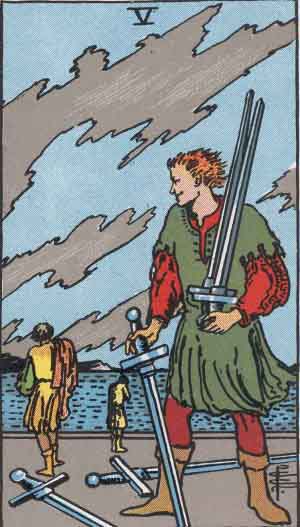
To turn a life tragedy into a process of fruitful learning is one of the greatest challenges the human spirit can face in its earthly journey. This is a clash of internal intentions and thoughts among themselves, which can lead to original conclusions, or it can leave you with nothing. The card depicts three figures: one (the winner) carries three swords, another (in the background) is defeated and crying, but the third walks away undefeated (they retained the right to choose - when to go into battle, and when to retreat).
The sign of Aquarius symbolizes the development of thought, which makes the secret clear and tears off all masks of reality. Emotional penetration into problems develops thought, and the freedom of creativity, revealing the striving of thought, expands the horizons of the world and makes it clear and bright. Venus rules the first decan of Aquarius. And this decan symbolizes such qualities as clarity of mind, ease of perception, inventive talents, and... the collision of one's own impulse of thought with life (Venus), - which naturally, by and large, ends with the victory of life and the defeat of thought. However, Venus is primarily subjective creativity, and therefore creativity in the sphere of art, which does not provide a reliable answer to the emerging questions of consciousness, but still creates a basis for these answers to be found.
On a deep level, the Five of Swords says – hail, pain! You are deep meditation. Hail, suffering! You point the way. Hail, defeat! You open eyes to the truth and lead to deep knowledge, to which happiness does not lead. He who has not suffered knows neither himself, nor the path, nor the destination.
This card corresponds to the mysticism of the Passion of Christ – flagellation, spitting, the torments of imprisonment, the fear of execution.
Light and shadow (advice and warning)
The advice of the Five of Swords is simple: fight with all your might and by all means, without fear of showing yourself not from your best side. Sacrifice relationships if defending your interests requires it. Do not give up your positions, do not avoid conflict, and dot the i's and cross the t's. Leave the battlefield yours, without being afraid to lose someone or something. The end justifies the means, and therefore you must fight for yourself and your righteousness. If necessary, show sharpness and coldness, acknowledge your irritation and anger, blow off steam.
Warning: right now, even the smallest conflict is fraught with very far-reaching consequences. Useless destruction, cruelty, abuse of power. It is not the time to make new enemies - it would be better to figure out what to do with the old ones. At the same time, there is no point in harboring plans for revenge.
Harsh conflicts and a power struggle. Disputes and debates where vulgarity, tactlessness, hostility, or at least negative thinking reign. A cold war in a heated atmosphere, or the end of a battle when someone manages to pin down another. Cruelty and deception, the presence of a clear winner and loser. These are ultimatums and battles in which victory comes at a high price (degradation through the destruction of others). Situations where a lack of principles becomes the main principle. The need to communicate with people not on your level. Often this card means the cessation of communication, the "severing of diplomatic relations."
The Five of Swords serves as a "mirror" of a situation where a person is trying to overcome rigidity and inertia within themselves, as well as in their surroundings. Naturally, such attempts are not painless: overcoming the inertia of rest and inaction will take a lot of nerves.
An uneven career, "walking over corpses," where victories are followed by defeats, and ups alternate with downs.
Violent organizational changes with scandals, violation of laws, throwing out dissenters - a sort of "night of the long knives". Organizational activity brings destruction to the environment. Failed projects, dangerous development trends (for example, going too far in the struggle for leadership).
Traditional meanings: defeat, failure, collapse of plans. A great loss. The battle is won, the war is lost.
Loss, damage, ruin. Unprofitable deals. Major losses. Disputes and disagreements over money issues, what is called, harsh showdowns. Financial failures. Social degradation. Bankruptcy.
A card of being driven to the wall, of playing with fire.
"We played with fire in this kind of game: either he dies, or I die." And right here – absolutely no fair play. The victory costs too high a price for both together and for each individually. The Five of Swords brings the power of pain and fear. Tactlessness, treachery, and vulgarity are "added to taste." Its element is hatred, ultimatums, and declarations of war, the relationship of opponents, antagonists. As an indicator of the essence of a relationship, the card says that everyone wanted to win, to push the other to the wall, to take revenge, to have their own way, regardless of causing pain. These are mutual reproaches and insults, slander and false accusations, vulgar discussions when people sometimes cannot believe their ears, listening to their own words. "Falling from grace".
It points to an unhappy, or even tragic situation. The theme of conquest, aggressive victory, and humiliation is strong in the card, therefore its traditional meanings are dishonor, insult, disgrace, and violence. "Honor" for one and "dishonor" for another - one makes triumphant notches, the other cries to themselves or aloud, not knowing how to live on. Rape, as well as being driven to suicide and rash actions, also go under the Five of Swords.
The card indicates the end of a hard battle that cost a lot of effort to both the victor and the vanquished (a "Pyrrhic victory"). It can also mean leaving, parting with someone. Traditional meanings are grief, a great heavy loss. In practice, it is more often a breach of trust, treachery, betrayal, a "blow below the belt". All sorts of situations of emotional blackmail, snarkiness, coldness, hostility, neglect, heartlessness, and a readiness, by and large, for any nasty things.
The Five of Swords describes the situation in a relationship when the balance is clearly lost, old wounds are touched and bleeding again, the situation does not renew itself, and fear and cruelty are present. Hostile attitude, anger, pressure. At least one of the partners acts from a position of strength. One generally cannot speak of relationships – under the Five of Swords, what can be considered human relationships usually shatters into pieces. In a sexual sense, the Five of Swords is responsible for causing pain, violence, sadistic manifestations, cruelty, and heartlessness.
A partner described by the Five of Swords is a stubborn, vindictive, unpredictable, and cold person in a relationship; hurting someone costs them nothing. Often, the experience of suffering has made them this way. Now they are possessed by unkind intentions, for the realization of which all means are good from their point of view. In the worst case, this is a criminal capable of a lot.
However, in Crowley's opinion, the Five of Swords with all its treachery and betrayal is merely the consequence of a "bad peace", a cowardly avoidance of conflict.
Health is at risk.
Wounds, trauma.
Nervous and physical exhaustion.
There are some serious risk factors present that contribute to the development of a disease. This could be an extremely unfavorable state of the environment (the person is constantly encountering either some chemicals, or hypothermia, or there is an increased risk of injury, and the like).
The reversed meaning of the Five of Swords changes little - in this position it is no better than in the upright one. Six of one, half a dozen of the other. Mary Greer writes that something like "funeral grief" is added to it. It can also be remorse, pangs of conscience, a desire to make amends... so to speak, to survey the battlefield and gather the shards, to save at least something. But this is more of a desire than a real possibility.
One of the interpretations speaks of the possibility of winning at a high price, turning the situation in your favor. But overall, the dominant opinion is that in the reversed position, damage and trauma are still inevitable, but the outcome is already clearly a losing one, meaning the prognosis is unfavorable. Defeat, loss, confusion. Treachery, crimes, and behind-the-back actions can be revealed by this card. Betrayal, a blood feud, a crushing defeat.
Depression, suffering, sadness, mourning, funerals. The loss of a friend.
With favorable surrounding cards - perhaps the enemies have temporarily retreated, or there is a desire to at least temporarily bury the hatchet.
In any position, the Five of Swords is unfavorable for any undertakings.
With The Emperor – following rules, submission to the law, the card is considered to weaken the destructive influence of the Five of Swords
With Justice – a righteous fight
With Temperance – cooperation, the card weakens the influence of the Five of Swords
With The Devil – insurmountable addiction, life-threatening blackmail
With the Five of Wands – lack of coordination, confrontation
With the Seven of Wands – conflict, mentality of a fighter against everyone
With the Seven of Swords – dishonor, distancing from others
With the Four of Cups – hostility
With the Six of Cups – innocence and kindness, nobility of thoughts (according to Guggenheim)
With the Page of Cups – loss of a loved one. Pedophilia, a sexually abused child.
Crown of thorns
St. Bartholomew's Day massacre
"The end justifies the means"