Four of Wands
Wands — Minor Arcana
Detailed Interpretation
A happy card. Its main meanings are goodwill and prosperity, notable and well-deserved success and recognition, an excellent environment, "the arrival of happiness." It brings harmony, self-confidence, balance, and the enjoyment of the results of one's labor. It signifies peace and rest, a situation where no troubles or difficulties threaten you. The hardships are behind, you can relax and enjoy life. Often, it describes a situation where something is done, useful experience is gained, but there is no desire to go any further.
You just want to enjoy what has been achieved. The card invites us to joy and fun—life is beautiful! Sometimes it states plainly that a well-deserved celebration, a merry party, some kind of "going out," or simply a vacation awaits us. Its domain includes family holidays, banquets, alumni reunions, formal assemblies, garden parties, and picnics. But it also happens that it simply brings appeasement and peace. In this card, one feels freedom, release from responsibility, the completion of a task. And even if it concerns tasks, they are rather pleasant activities for the soul than righteous labor by the sweat of one's brow.
The Four of Wands is never an accidental or unnoticeable card in a spread. It is its decoration and will largely determine the overall meaning of the divination. There is an opinion that in an upright position, it gives a favorable answer to almost any question. This card is the guardian of highly positive and powerful energy. It is exactly the Four of Wands that appears in the personal spread for people who are generally considered lucky. If this Arcana repeatedly appears during a reading, complaints about life are not accepted!
This is a sign, if not of transcendent luck, then of the favor of destiny, when it is sometimes relatively easy to bypass or overcome difficult situations. Sometimes it points to unexpected luck, but more often its meaning leans towards the proverb "all's well that ends well." It speaks of the stable development of a business and promises ultimate success. It often marks some quite fateful milestone in life (graduation, engagement, etc.).
The realization of plans, a worthy completion of what was started. This card often indicates the "legalization" of what is happening—this can be the legal registration of a business, receiving a diploma, marriage, or the conclusion of an important contract. It is believed that the Four of Wands describes the highest point of development for something into which a lot of effort has been invested. But it also opens up opportunities for the development of new beginnings.
One of the traditional meanings is a successful arrival somewhere or returning home, reuniting with dear people.
Positive and optimistic.
The benchmark of practical psychology—the full development of opportunities and abilities, social demand, confidence, openness, the ability to trust others and enjoy their trust. It removes any internal contradictions, grants—for a while—the feeling of "happiness that lasts forever."
The Four of Wands brings a sense of security and inner serenity. These are happy times. Now the person feels free from any obligations and conditions that do not suit them, and parts with the past without regret. In general, Fours are introverted cards. The owner of the Four of Pentacles is withdrawn, the dweller of the Four of Cups is detached, and there is no need to even mention the sleeping beauty of the Four of Swords. But the Four of Wands is considered something of an exception. Its tone is openness, hospitality, new encounters, going out, friendly gatherings, and parties.
It corresponds to a period of peace and quiet, during which we open ourselves up to life and its joys. We are confident in our own safety, and therefore ready to leave the "fortress walls" and go out into the outside world. This means communication, entertainment, pleasures, new acquaintances, a feeling of deep interconnection with other people, and social demand.
And yet, the Four of Wands is not the Three of Cups. It encourages the establishment of boundaries so that the situation remains beautiful, and provides a striving for stability and structure. It simply carries a strong emphasis on the desire to rest after righteous labor, to enjoy a calm, harmonious life, a situation of prosperity and comfort, and pleasures that money can buy. Mental stability and a desire for order. Harmony, peace, tranquility, rest after a won war, enjoying the fruits of one's labor.
The person of the Four of Wands is satisfied with themselves and their place in life, knowing they have earned it. Sometimes this is an enthusiast of their craft or idea, a "walking advertisement" whom other people eagerly follow. Like no one else, they know how to inspire and encourage.
This is a period of transition to another level of development, to a more joyful and free standard of living, when a person parts with their past without regret. These are all rites of passage, where a person is welcomed into a new egregore, into a new company. The energy of this card carries both the embodiment and the limitation of creative power. Some project materializes it, but simultaneously sets the course and the framework. Within the domain of this card is a well-balanced dynamic and energy, but this balance is created through a very clear social structure.
The Four of Wands symbolizes mental stability, disciplined thought, a desire for order, a feel for structure, finding like-minded people, a sense of belonging to a certain tradition. The theme of Aquarius resonates here, but also some manifestations of Saturn (the second ruler of this sign). As Banzhaf and Akron write, energetically the card expresses the idea of the cosmic order or the origin of the world: the initial creative impulse (one) found fruitful polarity in two, expressed itself in three (a metaphor for conception), and anchored itself in the space of four in the form of material embodiment. To realize "in the beginning was...." is to turn to the past, to perform religare ("religion"), to return back.
One of the profound keys of the card is "Love all that is created by God." The Four of Wands suggests that something is already so complete internally that it seems to cast itself into a certain form, much like the phenomenon (unexpected materialization) of a miraculous icon. Another meaning is invention (an idea moves from the mental plane to the material one). The card also symbolizes a situation where several people in different parts of the globe simultaneously arrive at the same idea.
The third decan of Aries is traditionally associated with Venus, hence its second name - "Love." An impulse of energy embeds itself into matter, and in search of recognition begins to interact with it. Personal enthusiasm collides with the objective laws of life. The objectivity of external existence directs a person to search for their place in society and to creatively explore the paths of truth and justice: it makes them reflect on what a just social order should be. This decan is more material than the previous two, and the impulse of love here can reach the point of passion. At the same time, it is oriented towards socially useful labor, as the most natural realization of internal aspirations.
This is a card of established and ordered harmony, naturalness and joy, satisfaction and peace, and yet stable development—in the family and at work. The ability to resolve conflicts and reconcile contradictions that seemed unthinkable (hence, for example, the meaning of success in negotiations). There is also its own "danger"—allowing stagnation, because useful experience has been gained and you want to enjoy what has been achieved; there is no desire to go any further (the trap of the card is resting on your laurels, the belief that peace has come forever). Its mystery is the rest of Alexander after conquering Babylon.
General meaning: the primary result is achieved, there is something to congratulate yourself for. Valuable experience has been gained, which must be analyzed and preserved in order to move forward. But there is a clear lack of drive for further projects, a satisfied contemplation of what has been achieved (life has stabilized, and amen to that). Here it is necessary to consider the completion of one stage as the release of energy for the next.
Light and shadow (advice and warning)
The advice of the card is to throw a party, enjoy the luxury of human communication with friends and loved ones, show hospitality, or go out. You are highly anticipated somewhere! Sometimes the card indicates that it is time to take a well-deserved break—take a vacation. One also recalls the advice of Josephine from the unforgettable "Some Like It Hot" - "Pour on the charm!"
The card warns that too much time is being spent on entertainment, hangouts, parties, and pleasant rest, and too little on work. This is the case where there is a time for work and a time for play. The desire to go with the flow, rather than solve problems and bear responsibility; resting on one's laurels. Escapism, as well as "various unsavory excesses." Also, under this card, a person overestimates their abilities and their significance. The Four of Wands reminds us that being a party animal is not a profession, and non-stop socializing merely creates the illusion of being in demand and prevents one from facing the truth.
Successful completion of a task, a celebration marking the successful end of a project (or some stage of it), pride in one's achievements. Generally, this is NOT a card of work—it signifies a temporary release from responsibility, usually voluntary and desired. This is similar to the state after successfully passing an exam, when no one temporarily thinks about textbooks anymore. Of course, there will be other exams ahead, but for now—sing and dance, drink and celebrate! There is joy and peace in the soul.
At the same time, this is a celebration for a reason—pleasing visible results have appeared. If we talk about the organizational environment, this card corresponds more to somewhat pompous events and ceremonies, festive meetings, rather than work processes as such.
"A proper vacation just like everyone else"—carefreeness, peace, tranquility. A prosperous pension, retiring.
If it still is about work—success in your career, achieving stability, successful implementation of started projects. Newly found prosperity. Team spirit, effective and cheerful cooperation from which people get pleasure. Labor is perceived as art, routine tasks are done without stress, genuine goodwill and an atmosphere of mutual trust reign all around.
The essence of the Four of Wands is the harmony of human relationships in some formalized and structured situation. Its essential feature is that no one holds a grudge or harbors hidden motives. If there are any professional problems, they are solved successfully and by mutual consent.
If it's about a project, it's an intelligent idea, well-founded and creatively implemented. The conclusion of contracts. Under the Four of Wands, it is often possible to overcome or simply bypass virtually insoluble situations, and also to achieve the desired results effortlessly in any area of interest to you. Sometimes the card describes a situation of patronage or protection, in which personal connections work strongly.
Successful negotiations, presentations, receptions. A warm welcome, high appreciation.
The card is considered to be related to design, home and workplace decoration, magazines like "Home and Garden."
The classical meaning is "newly found prosperity," the card of the nouveaux riches (people who have recently and suddenly become rich and haven't really had time to get used to it yet, and they achieved it through their own efforts, not through "hereditary" means). Material prosperity, stability, financial well-being. Positive resolution of issues related to business, investments, sponsorship, and so on. Receiving a fee. Good profit. Worthy reward.
A material outlook on life arrives. Spending on oneself and one's desires, a general situation of prosperity and comfort. Pleasures that money can buy. Being in an excellent environment.
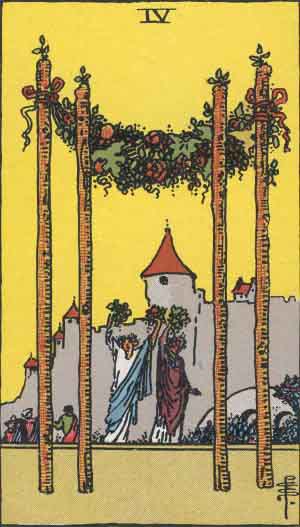
This is one of the best cards in readings for housing issues. Its meaning is a good house, an excellent place to live. The numerical value is associated with reliability and durability, the four wands on the card correlate with the four corners of a house. The purchase of real estate. Cultivating a plot of land.
It is believed that the Four of Wands largely reflects the energetic law according to which we attract people who complement us at the level at which we ourselves are.
Happiness, stability, optimal development of relationships. Sexual satisfaction, good compatibility. A prosperous life together, harmony in the family. Lively sympathy and heartfelt warmth. Joint entertainment, going out, vacations, having a great time. Prosperity at the hearth.
This card shows a readiness to meet halfway, to demonstrate affection, to take initiative, to open up one's feelings, to give gifts, to invite guests over, and the like. Those who have been hiding in their own shell can completely "come out into the light" under this card, without fear of trouble, and make promising acquaintances. At the same time, this card is associated with a return to family roots (this meaning works most strongly for wanderers and travelers), to the home harbor (the 4th house in astrology), where one can find peace and restore balance.
Romantic relationships, a wedding celebration, getting married. A happy event. The Four of Wands is a very "matrimonial" card. The four pillars with a floral garland on the Arcana in the Waite deck symbolically relate to the marriage canopy and strong bonds. Fours bring order to everything—thus the institution of marriage brings order to the romantic relationships of people. This Arcana always shows that something is already so internally complete that it seems to mold itself into a certain form. For example, people who are sympathetic to each other intend to move in together to share a life. Or a happy couple lived together and finally decided to formalize their relationship.
Interestingly, this card sometimes represents the "happy divorced"—people who perceived the dissolution of their marriage as an escape from captivity and a release from oppressive chains and obligations.
In questionable card surroundings, the Four of Wands can hint that the relationship exists more "for the public" than in reality, and is a kind of "PR effect." This is true both for global stars and for those whose public consists of mom, dad, and a handful of classmates.
Good health, recovery
In rare cases, the card indicates pregnancy and childbirth.
A reversed card can speak of an unwise expenditure of strength, undermining health with a lifestyle that is too merry, as well as the inevitable processes of gradual aging, fading, loss of tone, and menopause. One of its classic meanings is "faded beauty."
In old interpretation books, it is indicated that the card, even in a reversed position, retains its positive meaning of happiness, satisfaction, prosperity, and beauty. And modern interpreters are naturally wary of this—it can't be that simple if the festive tent is turned upside down! It's as if a party that held high hopes took place, but the querent was left out in the cold. One of the traditional meanings is "unfulfilled romantic expectations," as well as generally unfulfilled dreams.
One of the typical modern interpretations is "not the time for a party." There is still some obstacle, something that prevents bringing the matter to an end and truly becoming free. Besides, it is possible that the people you would like to have fun with are feeling completely different. This could also be a case where a banquet is coming up, the thought of which is more depressing than joyful, and during which we only think about how to get out of there as quickly as possible (the same can apply, by the way, to cultivating garden plots).
In a reversed position, the card can indicate a temporary inability of a person to feel the joy of life, trust in friends and loved ones, and thus, possibly, advise postponing one's plans until peace of mind is restored. One of the traditional meanings is a "complete loss of tranquility."
In the upright card, the motive of outward propriety, elegance, and orderliness is strong. The reversed one can destroy conventions and pull off masks (family holidays and general meetings of people who haven't seen each other for a while often create fertile ground for this; all sorts of past sins, unexpected vices, and other "terrible secrets" surface, as in Priestley's "Dangerous Corner").
An event may not fit the stereotypical ideas of how it should be (for example, a non-traditional wedding). This card can be a warning that one cannot rely on a happy coincidence; the situation is actually very shaky.
The upright card carries the energy of completion; the reversed one can report that the project needs refinement. In something that seemed already completed and brought to an end, gaps and shortcomings are suddenly discovered, and it is impossible to put a period (this can be a "pleasant" discovery, for example, for a degree candidate who finds out that an already bound thesis must be reprinted from scratch due to technical slips and blunders that crept in).
There is an opinion that in a reversed position, the card means instability, haste, fuss. Laxity, an inability to mobilize oneself for something. This can be an unwillingness to work, laziness, or perhaps a lack of faith in one's capabilities. A meaning like "spoiled beauty" brings to mind a failed plastic surgery intended to "improve the facade," but which actually made it worse than it was.
The reversed Four of Wands also means incomplete (broken off in an Aquarian way) love relationships, incomplete happiness. With confirming cards—a made decision to live separately, division of property, divorce. Also, this is not a situation where you can expect an early proposal of marriage.
This can be both a lack of outside help, guardianship, patronage, as well as ingratitude. A feeling of insecurity (a theme that resonates acutely at the societal level nowadays in the form of a complete absence of guarantees). It is believed that the card may indicate the need to sell real estate.
With Wheel of Fortune – a feast, a merry holiday
With Strength – elation, inspiration, euphoria
With The Devil – dependence and lack of freedom, which outwardly may look respectable
With Ten of Wands – a heavy burden and being in an oppressive situation, the card "beats" the Four of Wands
With Three of Cups – celebration, spirituality, happiness
With Four of Cups – apathy, indifference
With Reversed Ten of Cups – troubles that caused quarrels in the house.
With Two of Swords – reconciliation.
With Six of Swords – the card weakens the meaning of the Four of Wands, while at the same time promising a quiet haven.
With Reversed Ace of Pentacles – finding money.
With Two of Pentacles – merry parties, carefreeness