The Fool
Major Arcana
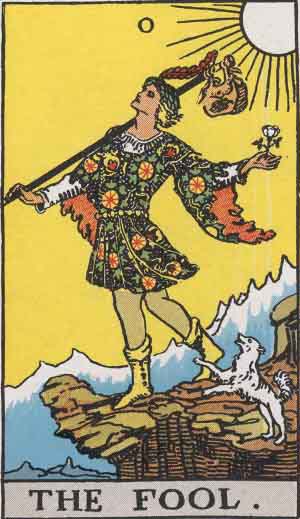
Detailed Interpretation
The Fool always warns of something entirely new that is about to burst into one's life, creating chaos — though as a rule there is nothing dangerous about it (except in cases where other cards directly indicate otherwise). The beginning of a new life cycle, any new ventures, some radical step. This is a crossroads of life paths, a new spiral of development, pure untapped energy. The person senses that the road they have set foot on is not easy, that there are troubles and dangers along the way, yet something tells them these will somehow pass them by and everything will be fine and work out for the best.
In general, the presence of The Fool in a spread is always a very powerful sign — the person usually cannot even imagine what it carries. An unexpected turn of events, a surprise. Anything can happen. The card points to circumstances that are unexpected, unplanned, and capable of overturning the current state of affairs.
It also indicates the need to make important decisions (in past positions it may point to a choice already made, and now the person is dealing with the consequences).
Moreover, we are free to choose any direction, go wherever we wish, do whatever we want. This is a fortunate opportunity! Such freedom is not often granted to us in life, and The Fool as an indicator of the present is a kind of blessing — right now there truly is some chance, a "blank page."
The Fool shows the very beginning of some new project in life (the goal is still far away).
It often represents a specific person in the spread (and the querent can usually easily guess who it is).
Travel.
Impulsive, thoughtless actions. One can say with confidence that The Fool is light at heart. There is vigor in him, spontaneity, vital force, and freshness — a state well known to passionate travelers and pilgrims. He is young, inspired, open to life. The difficulty of interpretation lies in figuring out whether this is a wise fool or, so to speak, a natural one. This card can indicate both a stubborn refusal to grow up and, conversely, the wise simplicity acquired through long experience — that lightness we usually arrive at only at the end of a very difficult path.
It happens (and according to the spiritual meaning of the Major Arcana, it should be so) that this is a very wise Fool, like the jester at the court of a medieval monarch. The person does not possess great knowledge, but is capable of deep understanding of what is happening ("out of the mouths of babes comes truth"). The Wise Fool is very perceptive, incorruptible, and practically impossible to deceive (he will outplay anyone). He possesses energy, optimism, idealism, originality, and an unusual way of perceiving things. A touch of madness, a sense of being guided from above (the conventions of this world hold no authority over The Fool). A desire to spend time on inner journeys, receptivity to the heights of mystical experience. Carelessness regarding one's own safety.
The Fool can also be a trickster, a prankster. One way or another, he lives only in the present; he is candid, sincere, spontaneous, very mobile, and sometimes prone to escapism, to avoiding life's problems, to evading contact with reality. And this is where he crosses the line where he becomes a fool with a lowercase "f" or an outright idiot.
To understand whether The Fool is right in his behavior, one must look at the surrounding cards. They show the outcome. One thing can be said with certainty — whether this person is reckless and foolish, or wise and fearless, they are behaving radically! Fearlessness in the face of the unknown, readiness to leap into any abyss.
For personality, The Fool shows qualities such as naivety, sensitivity and sensuality, reckless courage. Immaturity, infantilism. A readiness to be open and curious, cheerful and carefree, to enjoy life rather than think too much — to do foolish things and wholeheartedly rejoice in them.
Impulsiveness, eccentricity, the capacity to reach a state of frenzy. Irrationality and carelessness. Frivolity and eccentricity (partly a mask). Unexpected escapades. "Going mad" is his normal state. A freedom-loving spirit and disregard for consequences. Intuition and penetrating vision. There is not even a whiff of "normal routine" in his life. He is fickle, undisciplined, an intemperate lover of pleasures, ready to throw himself headlong into adventures. Sometimes he acts absurdly and recklessly, "like a fool."
In the worst case, the card can mean thoughtlessness, whims and caprices, absurd extravagance and exaltation, and in extreme cases — frenzy, abnormal obsession with something, a fixed idea, complete eccentric inadequacy. A confusion of thoughts, a total absence of logic and discipline, chaos, inscrutable paths.
On a deeper level, The Fool is not only the "inner child" but also the inner hero! The Fool embodies the Hero, recklessly moving toward his destiny. Yet it is precisely he who receives The World at the end of the journey. He uses neither reason nor any other means to illuminate his path. But what appears to the outside observer as blind movement into an abyss, into the grave, is in reality a path to transformation so far beyond the limits of this world that all the clever ones cannot even imagine it.
Initiation, consecration, and the beginning of a new path. A stage in spiritual development that symbolically corresponds to the beginning of a great adventure and the accompanying inspiration. A period of entering the unknown — with joyful wonder and without any specific expectations. This is one of the cards of karma, of being guided ("I submit to fate"), of Uranian walking under God. Those who have a strong Uranus in their horoscope know what this means. As is well known, the dominance of a higher planet in a horoscope always produces an overly intense rhythm of destiny. The Fool does not radiate well-being in the sense that flatters the Ego. But he radiates the well-being of a soul unattached to conventions, dwelling in free wandering, as it should be in this world (in Christ's words — "be passersby"). In the occult sense, The Fool embodies the Archetype of the Soul — restless, reckless, in its own way blessed, naked and destitute, going wherever its eyes lead (to the horror of the reasonable and self-serving ego). A kind of return to true spiritual health, which may not look like social well-being. The Fool is Uranically antisocial. But at least he is on the road, as one should be. He wears a jester's garb, "respectable people" laugh at him, but he is not in the least afraid of this. He will laugh at anyone himself, and being barked at does not faze him.
In principle, The Fool is capable of anything (that is why he is the joker), but in practice he accomplishes very little. He is a divine genius capable of creating the Universe and destroying it, but... the Universe does not yet exist, and therefore The Fool is only a zero, nothing, absolute emptiness that can become anything at all, and the absolute freedom of that becoming: in this nothingness, in the potential, everything is contained. Uranus tells us that God creates the Universe easily, accidentally, and unintentionally — and such is the spontaneous Nature of human genius. Most often The Fool is depicted carrying a small bundle on a stick over his shoulder and balancing with it on the edge of an abyss. In this bundle lies that "everything" and "nothing" that compelled The Fool to set out on his journey. In theory, it contains the united life experience of all humanity, corresponding to the collective unconscious.
Ancient interpretations consider the card terrifying: "The symbol of a blind man who has made himself a slave to matter. His knapsack overflows with his delusions and senseless deeds. The broken obelisk — the ruin of his works. The crocodile (in Papus's cards, a crocodile appears instead of a dog) — an emblem of inexorable fatality and... inevitable redemption and retribution for what has been done, since nothing in life happens 'just like that' — and everything must be paid for." Incidentally, another reference to astrology and Uranus is fitting here — the planet of irrepressible demiurgy, of creation (according to myth, Saturn had to sever with his sickle from father Uranus that which creates, so that the world would finally cease its chaos and at least some stability would reign). Uranus rules Aquarius. We live in the Age of Aquarius, in a very "Uranian" time, and are far better adapted to the manifestations of Uranus and The Fool than our ancestors who lived in more predictable and dense times. This is why interpretations, compared to the ancient ones, have shifted to more positive and creative ones. And even though creation is a violation of the primordial order of being — and therefore an abyss lies before The Fool — it is still dictated by higher laws.
In the occult sense, the zero card The Fool is likened to the material Universe. But it, like the mortal human body, is nothing other than a garment, a motley costume befitting a jester, beneath whose clothing, however, lies the divine substance, for which foolishness is merely a shadow. The Fool's number is 0. Legend has it that in ancient times people gave their lives for "the secret of the number zero." Multiplying any number by zero yields zero — why is this so? Zero was defined as the number of perfection, where "DUALITY COMES INTO EXISTENCE." This is the duality of androgyny. The Fool is an androgyne; within him there is both masculine and feminine at once, and neither one NOR the other EXISTS (in The World card, both ARE present, but no one gave their life for the secret of the number 21). According to the Kabbalistic book Zohar, God is where He simultaneously finds man and woman. Perhaps He finds them within the human being itself — "He created man, male and female He created them" — and this refers to a single being. The Fool is the one whom God created and "found."
The very beginning of some enterprise, one based more on "good luck" than on detailed sober calculation (though with great faith, if not in ultimate success, then at least in meaning).
Difficulties with planning, analysis, and forecasting the objective situation for the future. But there is certainly activity and enterprise.
Under The Fool, a process of spontaneous unfolding of creative abilities takes place, and as a rule the person has no control over it at all — they cannot contain it, channel it into any narrow direction, or limit it with frameworks. They create "as the spirit moves them." Problems begin when the result of the creative work must look a very specific way (for example, on commission). So for people who earn their living through creativity, drawing The Fool can, strangely enough, turn out to be a heavy trial. One ought to work, the client is waiting and tapping their foot, but the worker, fearing nothing, absolutely "inconsistently" dances on the rooftops of the world, outside the system. Going against this flow is practically impossible. There is an absolutely spontaneous "foolish" behavior, an absence of discipline. The Fool knows no limitations and lives by intuition. Reliability, discipline, thinking through consequences — these are completely not his things. He is as if possessed; he is seized by a kind of passion, a fixed idea, in which he is not afraid to behave absurdly and recklessly, disregarding all limitations. Avoidance of responsibility.
Sometimes it means a lack of professionalism, absence of preparation and knowledge, but usually good receptivity. In principle, this is the "everything from scratch" card. It strips away all claims to possessing knowledge and life achievements, and also strips of meaning any clinging to proven methods and familiar ideas. The complete (sometimes creative) chaos of a beginner. At work, this means a multitude of ideas but irresponsibility, ignorance, chaotic plans, and a clear lack of professional experience (combined with an unwillingness to listen to anyone's advice). Scattered energy, dissipation of forces. There is still much to learn.
A wealth of abilities but weak implementation ("a person of great potential" who came to nothing due to the absence of discipline and consistency — as is well known, system beats talent). Carelessly made promises, with fulfillment that may be problematic. The Fool symbolizes not particularly reliable (though not malicious) partners. In the worst sense — glaring frivolity, unreliability, infantilism and immaturity, carelessness and negligence. Sometimes one must remember that The Fool's favorite activity is playing the fool, and his favorite ritual is doing nothing (in the pragmatic sense).
For business, The Fool is not particularly favorable. Under this card, a businessperson would be better off temporarily disappearing to an exotic country rather than immersing themselves in business affairs. With unfavorable surrounding cards — a foolish enterprise.
The Fool is one of those who can exist for twenty years without any means of subsistence and outlive everyone who had such means, while practically not even noticing any of it. Well, what can one say... He is an eagle! Birds don't need money. Love in a cottage is paradise too — another fitting phrase. In The Fool's case, having a cottage is already very, very good (traditionally this Arcanum is an indicator of the homeless).
Immaturity and naivety in matters related to money. Extravagance, recklessness, inconsistency, eccentricity. Frivolous handling of money.
Not entirely prudent investments (the matter has not been studied carefully enough, not all the data has been gathered, there are some unclear details).
Nothing has been decided in the situation yet. It may be necessary to start everything over. The state of affairs is generally unserious and shaky (if the question was about something that presupposes seriousness and solidity).
In general, The Fool's task is to distract a person from the material, to teach them not to attach too much importance to it.
When describing the nature of a relationship, The Fool points to a sincerity free from any prejudice, to a free relationship (The Fool's spirit is one of being unburdened and unburdensome), carefree flirting (feelings are given away thoughtlessly, left and right), the joy of spontaneous intimate experimentation (the kind of situation where both are giggling, saying "we're acting like fools," but it is fun and pleasurable), and trusting one's instincts.
Unforeseen circumstances bringing unexpected relationships. Traditionally, The Fool is considered a harbinger of the beginning of a romance. It truly indicates the start of a new life phase. But what this phase will be and how it will affect the querent's life — that is still a question, and the other cards will offer invaluable help here.
Under The Fool, a person "goes mad," and in love this sounds promising, but what it looks like is another question. There will be no time to consider where these relationships are heading, although eroticism and the force of desire are guaranteed. Instinctiveness and fantasy, the capacity for any whim (including in sex). Unbridled sensuality, blind passion, reckless infatuations — this is all The Fool. Under The Fool, one can quite easily "dive in headfirst" and "go off the deep end" (a delightful prospect for those who are married).
Under this card, one can set off to seek love at the ends of the earth (most fairy tales describe precisely such a plot — the Hero's Journey). For the sake of his guiding star, The Fool "dresses in rags," spits on social conditioning, and sets foot on the path, fearing nothing.
Just as easily, under this card one can frivolously (at least outwardly) "go off in all directions," "wherever one's eyes lead" (also a prospect that inspires no peace, but peace is simply not what The Fool is about). With corresponding surrounding cards, The Fool brings breakups, departures, and not at all in jest. This may seem like a desperate and doomed state, but in reality the person is absolutely unshakeable, unstoppable, and cannot be halted by arguments, pleas, or threats.
Under the Zero Arcanum, alienation, antisociality, and nonconformism manifest, so it fosters lone wanderers even more effectively than The Hermit. One can still gradually get along with a Hermit partner; with The Fool — you will break a serious sweat. It is, in general, a feat. He is characterized by inconstancy and fickleness. Hoping that the wind will blow his sails toward the altar is somewhat rash. What matters to him is enjoying himself, and structuring relationships (and sorting them out) does not interest him in the slightest. He is open to life and all its joys; seriousness, responsibility, and worries hold absolutely no appeal for him. He is not afraid to do what he wants, regardless of how absurd or dangerous it is. And what is strangest of all — he has no choice. This is how he is guided; this is how he goes. The Fool belongs to no one (including himself). But he is truly free from prejudice, loves what is, constantly refreshes relationships, and as a rule demands absolutely nothing.
Sometimes under The Fool, a renewal of the relationship occurs with the arrival of a child — the beginning of a new stage when existence is completely restructured.
Usually a feeling of youthful vigor, liveliness, and vitality.
A careless attitude toward health, but as a rule without consequences (though the other cards will tell more about this).
In terms of mental health, The Fool traditionally describes mental disorders, a loss of social adequacy. In combinations with unfavorable cards, The Fool (including reversed) can mean mental illness (neurosis, psychosis, mania, delirium, alcoholic or narcotic delirium, a feverishly excited state). But not everything that is considered madness truly is madness. It may be a highly Uranian state of the psyche, facilitating karmic redemption.
Let us recall Ivan Bezdomny — was he mad? And the Master?
Advice: act in this situation in the most reckless, most "foolish" manner of all possible ones. Give yourself more freedom, rid yourself of former patterns of behavior and thought. Do not refuse the opportunity to begin a new life, choose a new direction for your development, do whatever you please. Move boldly forward, even if it is unknown what awaits. "We'll think about it later." Trust fate. Finally make a decision — for once, freedom of choice is granted! This happens not at all often in life. Cast aside doubts and hesitations. Do not look back, forget about the past, and look to the future with a light heart. The unknown is not so frightening, especially compared to what is well known but causes considerable suffering. Do not take everything so close to heart, learn to laugh at yourself, develop a sense of humor. The Fool says: life is largely a game, and we are sent to earth to perfect ourselves and rejoice in everything that may come our way.
Shadow: escapism, a desire to flee from reality and its problems. Rejection of truth. It is not the time to embark on adventures and "play the fool." It is time to grow up and take responsibility.
Speaks of restless impulsive activity, of rash actions, sometimes purely demonstrative, often with accentuated egoism and infantilism (like a teenager harboring the thought of suicide to annoy someone or prove something). Sometimes this card symbolizes a person tirelessly seeking a change of environment and activities, starting many things but bringing nothing to an end. It symbolizes carelessness, a waste of energy, time, and effort. The problem is not solved. Great negligence is allowed in something important. The choice may turn out to be bad, the decision fatal, the undertaking erroneous. Unreadiness to open up to the future, clinging to the past, lack of freedom, or, if a surprise, then certainly an unpleasant one. Some blocked beginning (perhaps not really wanting to). Reckless behavior dictated by nothing else but escapism and fear.
With The Magician — risk of losing one's mind. With The Lovers — a herald of new love, the appearance of a new partner. Traditionally with Justice, Judgement — (the connection here is more by name) getting entangled in some legal matter out of foolishness. A more plausible interpretation together with Judgement — a clear rebirth, a feeling of being uplifted, a great new beginning, a completely new bright chapter in life. To a somewhat lesser degree but carrying a similar sense of uplift: The Fool with the Three of Wands. With The Hanged Man — an indication that the person has found themselves in a difficult situation. The most important thing to get out of it is to keep quiet, make no unnecessary moves, and try to wriggle free without making a fuss. With The Devil — cynicism and truly unhinged, "thoughtless" actions with bad consequences. Obsession with a minor (or even major) demon, literally or figuratively. The Fool and The Tower — a serious warning of danger (an incident caused by inattention, carelessness, recklessness, or negligence). With The Star — innocence, purity, "not of this world," a thoroughly cosmic being. The Fool and the Seven of Cups — classic escapism. With the Nine of Cups — fears are unfounded, even if they arise. With the King of Swords, the Five of Wands (Five of Swords) — fears are justified; danger of physical violence and danger in general. The Fool and the Seven of Swords — a great rogue. The Fool and the Five of Pentacles — precisely the case where a person favors a love condemned by all (and possibly ruins their life for it, going off the deep end). With good cards — undeserved good fortune. The vibrations of The Hierophant, Death, and the Two of Swords weaken the influence of The Fool.
The Spirit of God hovering over the waters (Genesis 1:2), the primordial chaos at the beginning of time. The archetype of the child proper, in Jung's sense. The Ouroboros, the Serpent biting its own tail, symbol of Zero. The books of Richard Bach and Paulo Coelho. Chicot the Jester in Dumas. Pierre Bezukhov in Tolstoy. Holy Fools (yurodivye).
The famous phrase: Don't worry, be happy.
A poem inspired by Native American wisdom: I am growing older knowing That my disappearing youth Hides itself in my uncertain wisdom Growing younger all the time
In a dilemma, The Fool points to the great importance of this choice (even if the question appears trivial on the surface).
In my experience, this is a Uranically unpredictable yet fortunate and consequence-free falling out of the wheel of the planned. I am sitting in a thoroughly socially unacceptable manner and happily engaged in what I love. The soul wanders, "and nothing will happen to it." Better not to talk to it about discipline and obligations. It does absolute foolish things, yes, and experiences the genuine joy of life amidst this chaos. Inspiration, creative spontaneity — and come what may. The card says that the archetype of the soul has broken free, and the only thing left is to trust it entirely and embrace the madness. It does not govern its own path, yet the path itself carries it forward, against all logic. For me, this is a good card. It embodies being outside the system, ecstatic sacred time. "Step away from the conventions of the world and be who you truly are." The main downside is that The Fool is antisocial. When it appears in a spread, it means the soul is wandering and roaming — and doing so outside of engagement with pressing everyday problems. This is not always timely. In some decks, the card aptly describes the state of the 12th house being activated in the horoscope — the unproductive state of an "overheated reactor," when common sense (the dog!) starts nipping at one's heels and demanding a turn toward the "little birds" (the simple joys of a healthy life), rather than charging headlong toward crocodiles, under stones that sit still... under which, as is well known, no water flows (neglected affairs).
Note: In Waite's deck, The Fool does not stand at the beginning at all — but between Judgement and The World! Mathers places it at the very end, after The World. Case and most other authors consider its place to be at the very beginning, before The Magician. As to its placement, everyone makes their own judgment.