The Tower
Major Arcana
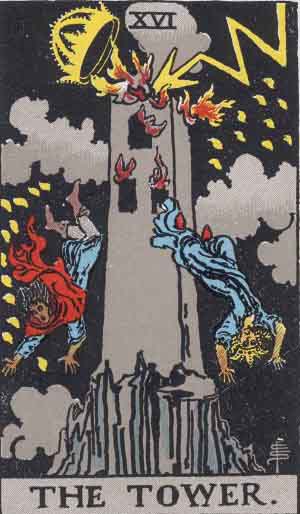
Detailed Interpretation
For The Tower, which is traditionally considered the harshest card of the Major Arcana, oddly enough, one might spend a long time searching for its keyword. Many cards in the Tarot deck herald "changes." The Fool, Wheel of Fortune, Death... And what about the Six of Swords? Do they not all promise changes? In short, it is not "changes."
The suddenness of these changes? The strangest thing is that The Tower might not be unexpected at all! The situation, like an abscess, has been brewing for a long time. It is that "end of the world" that was expected. Perhaps even highly anticipated! So it is not "unexpectedness."
Liberation? Again, The Tower will not be the exclusive bearer of this meaning. Judgement, The Sun, The Star... and a number of other cards also bring liberation.
And so it turns out that the keyword is "crisis." Or even "a critical attack." An explosion or breakdown after a preceding buildup. In a certain sense, this is a punishment for what came before. Through it, the Exorcism of The Devil (the previous Arcana) takes place. The ancient name of The Tower is the House of God. This is worth thinking about. It is the House of the Devil (as the card was called in medieval Italy), transforming under the strike of heavenly lightning into a place of God's presence. Through The Tower, liberation comes from false aspirations that do not contribute to development, by destroying what a person believed in and fervently strived for. There is a loss of achieved equilibrium that was based on false foundations. The Tower is the orderly of evolution; it heals our lives of everything that poisons it, destroying stagnant situations that hinder growth. At the same time, the blows of fate may seem just as tragic and incomprehensible as they do to a child being dragged to the doctor to have a bad tooth pulled. Few people perceive these cleansing operations with enthusiasm, but they are nevertheless necessary.
The Tower shows that the walls behind which we hid (or hid something) are crumbling. One period of life is replaced by another, and this happens very rapidly, and therefore not without pain. In the simplest sense, the card symbolizes the end of the existing situation under the influence of external forces, and it is unexpected and very fast. This can be simply a reactive restoration of order like a cleanup, or a total collapse of the current situation (at least in the area of the question being asked). The Tower tears a person out of limiting circumstances, disrupting the long-standing state of things. Sometimes this fully aligns with the expectations and even the desires of the querent, so The Tower is not always so bad. Next to positive cards, it reports the disintegration of existing evil, foreshadowing the end of a dark streak in life and deliverance from a heavy burden. It is time to enter the future to the roar of the debris of the past.
It is another matter if all this does not correspond to either expectations or desires at all. Then it is a bolt from the blue, a kind of painful revelation that undermines the very foundations on which we stood, a fundamental breaking of former views on life. It is important that the "blow" itself is delivered by forces that one shouldn't even try to cope with. Another essential point is that there is no sense in trying to restore what has been destroyed by The Tower; it is useless.
In different positions of the spread and depending on the situation, The Tower changes its scale and meaning. It can mean external destruction and internal turmoil. For the future, it serves more as a warning that what we have long considered stable and safe may suddenly be shaken. Fundamental changes are brewing; there is a smell of a thunderstorm in the air. As an indicator of the past, it says that the obsolete has collapsed and will not be reborn. Sometimes it is about internal things—ossified beliefs or life principles, and sometimes the target is something more tangible, but in any case, under The Tower, it is precisely those structures and conventions that we have already outgrown that fall apart. In fact, the old breaks because the time has come, something new is already ripening, something more creative, alive and vital, and the old has outlived its usefulness, and to resuscitate it is a waste of time and effort. When the shock passes, we discover that we have gotten rid of the ballast.
Under The Tower, we clear away the debris, throw out the old and unnecessary, and destroy obstacles. Sometimes it says that we are in an extremely intensive process of transformation, something has shaken and rocked us, we have felt a breakthrough to something important, and space has been freed up within us for something new. We are burning with some idea, feeling, or desire, breaking one thing, rushing to another, experiencing shock and liberation. This is the finding of an inner truth that has languished hidden within us for a long time. This process is like a bolt from the blue or a river bursting a dam. It can be such a powerful and vivid experience that to "pull oneself together" and turn to the daily routine is almost impossible (the notorious "losing one's mind").
Traditional meanings of The Tower are unexpected frustration and the collapse of plans, in the worst case—complete failure, troubles, suffering. Catastrophic changes in the affairs of the querent, destruction of home, business, marriage (depending on the topic of the question and the surrounding cards), sometimes—imprisonment. In a purely everyday sense, The Tower often means a conflict, even a scandal, however, it is a thunderstorm after which the air becomes cleaner. Involvement in some actions of an aggressive nature, in difficult and/or dangerous situations is possible.
In rare cases, The Tower foreshadows a triumph, but even then it is rather a "Pyrrhic victory," which is won at too high a price.
Under The Tower come unforeseen destruction, crashes, breakdowns, accidents, sometimes—attacks. On a global scale, it reflects wars, natural disasters, explosions, terrorist acts, revolutions, the collapse of a regime, the destruction of the existing order. Plane crashes, shipwrecks.
It is believed that The Tower, appearing in a spread, determines the meaning of other cards in a negative direction.
"Thunderstruck."
Most likely, the person is in shock. They are knocked out by some news or event, and everything they had planned before and hoped for has suddenly changed. Maybe they are decisively trying to free themselves from something and are acting as a destroyer, but then again, there is a reason for that.
The Tower is a stress test that reveals all our weak spots. The fall of erroneous beliefs under the pressure of reality, the overthrow of values that provided us with confidence in the future and a sense of security (in the emotional sphere, professional, financial... spiritual, finally). The image of The Tower can mean structures through which a person tries to protect themselves from growth, from the world, from the activity and diversity of life. In a certain sense, the Sixteenth Arcana depicts a prison consisting of rigid ideas that are impenetrable to change and yet raised high. Within its gloomy walls, unused forces, undiscovered emotions, and paralyzed energy are locked away. They accumulate and press ever harder. A person becomes cramped within themselves, but they stubbornly force themselves to crouch, just so as not to grow out of a fear of pain (and life). In essence, this whole structure is a vain attempt to stop the process of growth, change, and transition from one state to another. And now, the reality conditioned by a limited outlook is subjected to destruction. The Tower of views towering to the sky (and that area of life where the person considered themselves reliably protected) unexpectedly staggered and flew apart along with the old picture of the world. This is often perceived as a catastrophe, since precisely those structures that formed the very basis of our confidence are collapsing, but in fact, it is a well-deserved crisis, the impossibility of remaining in outdated positions. Under The Tower, nothing other than the creation of conditions for further growth occurs. It is the pain standing on the path to rebirth.
We all go through the experience of The Tower many times. Man is imperfect, and his knowledge of the world is always only partial. We all, to some extent, shield ourselves from our surroundings in order to gain stability and peace. Disillusionment with one's illusions, hopes, and rational constructs will not bypass anyone; the only question is how often one's positions are revised (here the main role is played by openness and interaction with the outside world, in general with forces that surpass one's own "I"). If a person does not do this for a long time (and we lay the bricks of our perceptions every day one way or another), then they manage to pile up a very tall construction, and then they risk simply ending up "buried" under its rubble—they will have to dig themselves out for a long time, and this experience will leave its scars. It is a special worldly wisdom to understand that the walls of your tower are more your enemies than friends. And still, the sensation of falling can simply be terrifying. Sometimes through it passes "righteous anger" and the fury of destruction and liberation, but more often it is a loss of orientation, existential terror, a staggering realization that you are not the person you imagined yourself to be, that you are grasping at thin air, like the falling figures on the card.
For a person suffering from acute pain under The Tower, it is important to remember that they are not alone. There, from above, Someone is looking at them, sees everything (that's why He struck, because He sees...) and will not leave them under any circumstances. Even apparent losses are valuable gifts from the Universe, and times of crisis and despair often become the most fruitful phases of growth. By looking at yourself honestly, you can truly break free and move on. As noted by a modern Western tarot reader, "By accepting the upheaval, you will be able to advance along your true path, and sooner or later The Star of hope will shine for you. The alternative is to drag yourself through the mud as a passive victim, wondering where you are and how you got here." The action of The Tower is very vividly seen in Priestley's "Dangerous Corner," where the main character discovers that the entire edifice of his life was an illusion, and where the issues of deception and self-deception are shown brilliantly. And one more thing that must definitely be remembered in "tower" times—the most important, the most valuable, and the most essential cannot be destroyed. The Tower does not destroy that at all. It burns the garbage (even if we are ready to pull it out of the fire with our bare hands at that moment).
A Tower person has an extremely restless character; they are simply a powder keg. They suddenly burst onto the scene like lightning, and just as suddenly disappear, which also leaves the sensation of a bolt from the blue. They eternally crave change (at least unconsciously), they feel cramped in the framework defined by life, and because of this, something is always happening to them; they themselves and the people around them receive regular "shake-ups." They are dynamic, confident, thrillingly unpredictable, and always ready to take a risk. The Tower brings upheaval and turmoil into the lives of those whom fate throws them together with; they are living doom. At the same time, the person's spirit is unbending, it is difficult to break them, and their own life, full of sharp turns, serves them if not as a lesson, then as hardening. A Tower of any gender is often distinguished by an explosive temperament and an inability to maintain good relationships with others. This is a born duelist who always asks for trouble. In the worst case, they are a brawler, a scandalmonger, and a brute, or even a criminal. Historically, The Tower corresponds to tyrants and dictators (who are sooner or later overthrown, if they do not manage to die before then). Under The Tower come both megalomania and the punishment for pride. Anyone else's nerves would have given out ten times over, "but he, the rebel, asks for the storm, as if in storms there is peace." However, they possess the gift of freeing other, less tough and radical people from what oppresses them—one-two, doors are kicked down, phones are ripped out, suitcases are packed, and to hell with them anyway, with the things, and here you are already flying "as a stowaway" in an unknown direction, without even trying to guess how it will all end. With The Tower, the phrase "see Paris and die" ceases to be a mere figure of speech.
In a spiritual sense, The Tower symbolizes the consequences of the fact that "the devil beguiled" a person; they accepted The Devil's offer, even if they try to deny it. The Sixteenth Arcana describes the destruction of the vibrations of the Fifteenth. The Tower is something sent down by God (a blow, punishment, revelation, the collapse of illusions). Contrary to modern interpretations, in a deeper sense, under The Tower, one doesn't so much "lose one's mind," but strictly the opposite—it "sets one's brains straight." We receive a reminder from the Universe that we are not omnipotent (even if we have gained power), that human will, no matter how strong it is, compared to the Will of God, is secondary and limited. The Tower warns: do not imagine yourself to be the Lord God, do not imagine that "man himself is in control." What you are currently striving for does not contribute to evolution and is not part of God's plans. Therefore, you will be set on the true path; the constructs of your limited mind will be overthrown. The Sixteenth Arcana is the mystery of the overthrow of all that is false, non-viable. Symbolically, it depicts the fall of Lucifer, the Morning Star, cast down from heaven "like lightning" by the host of the Archangel Michael. Sometimes it is also associated with the fall of man and his expulsion from paradise, although generally, this whole structure bears little resemblance to paradise... Probably the closest to the Sixteenth Arcana is the famous myth of the Tower of Babel, a symbol of vanity, which the Lord did not allow the arrogant people to finish building. Allegory: something not entirely real falls under the pressure of Divine intervention. Therefore, The Tower addresses a person with a warning: the task you have set cannot help but destroy the one who solves it. And does it even make sense? What you are building at the very least ignores the laws of God, and maybe even violates them. It is in essence the fall from grace, so expulsion from paradise will necessarily follow. This building cannot be finished, although much has already been done. A Uranian blow will follow, putting an end to this matter in one fell swoop. From this Uranian lightning, the sun of a new truth may shine forth. Divine revelation instantly destroys all delusions, leaving nothing of them.
Astrologically, in The Tower, the influence of Mars (cosmic energy in its crude materialistic form) is tangible, as well as planets such as Pluto (globality and mass character, "nowhere to hide"), Uranus and Saturn (sudden destruction and renewal). The Tower can mean both the blind destruction of forms and the fall of the decrepit. Mars is the personal moral principle of a person, dominating destiny, giving physical strength, spiritual impulses, and hope for immortality. But the hope for immortality comes to a person only when they "fall from their Tower of Babel" and nothing else remains for them but this hope. In a mystical sense, astral battles, magical wars, and exorcism correspond to The Tower.
The Tower also corresponds to the mystery of the Phoenix, resurrected from the ashes renewed. This is the ability to be reborn, to change radically after cleansing crises (moving from the seductions of The Devil to The Star). The card often depicts a golden radiance or other substance bursting out in a stream from the breach formed by the blow, which symbolizes the potential forces being released. In the Masonic tradition, the tower symbolizes the pillar of Jachin and the primal fire, "with which everything begins, and with which everything ends." Also, the stones of The Tower symbolize the callousness and rigidity of the human soul, the stagnation of consciousness. The images of the figures falling from The Tower differ in different decks. Sometimes one is a king, losing his crown on the fly, and the other is a beggar in rags. This is a hint that no one will escape cleansing crises and the revision of views in life. The Almighty Fate is completely indifferent to the place a person occupies in the hierarchy of this world. Sometimes it is a man and a woman, then what is meant is rather an association with the fall of man and the retribution for giving in to the temptations of the previous Arcana. Sometimes The Tower is associated with the "flaming sword" at the entrance to Eden. The exile here is reflected in the form that a person falls into the lower world and brings upon themselves the illusion of materiality.
The Tower is the axis of the world, which embodies spiritual evolution directed towards divine heights. Esoterically, this Arcana also depicts the mystery of the interaction of thought (representation) and word. The human soul, in order for what is created inside to be manifested outward (the word to be spoken), turns deep into itself. But the spoken word destroys the previous inner integrity, and by speaking, a person ceases to understand the meaning of what was said and to creatively touch the essence of things. Hence the phrase, paradoxical at first glance, "A thought spoken is a lie." When a person grasps the true power of the word, they mostly remain silent (an example of this are the ascetics who practice silence).
The card may merely warn that the building is shaky, the forces are not as great and the understanding not as full as it seems, and as a result of the abuse of God's gift, misfortune can occur. A typical example: the catastrophe of a person who plays with magical forces beyond their power and understanding, or a psychic who exaggerates their capabilities and (semi-unconsciously) profits from people's misfortunes. The Tower has long been considered a card of edification for the seeker of occult knowledge. It says that having been tempted by the opportunity to rule this world instead of striving for wisdom and spiritual growth, you will lose everything you managed to gain. The reason is in the incorrect use of power. Not that you manifested it in principle, but where you directed it. Walking the spiritual path, it is not THIS world that a person should try to conquer. At this point of searching, there is still a temptation to evaluate oneself in the terms of this world—by the impression made on others, by earthly position and status. But if you exchange spiritual growth for obvious material achievements, you will lose everything, and in the Hermetic sense, the Sixteenth Arcana is about this. YOU EITHER APPROPRIATED POWER YOU DID NOT POSSESS, OR RUSHED TOWARDS A GOAL YOU HAD NO RIGHT TO. It symbolizes the collapse of presumptuous intellect that encroached on mastering Secret Knowledge.
Shocking changes. A suddenly made decision to change jobs (or even professions). Dismissal "like a bolt from the blue," leaving with noise and a crash, "slamming the door." Quarrels, stress, the destruction of business relations.
Professional failures. Defeat in competition. A grandiose collapse. Sudden closure of a project. Company bankruptcy.
It suddenly turns out that the plans are unrealistic, not calculated for human strength, and therefore doomed to failure. Fiasco. Situations in which a person feels that all their hard work was in vain, and the meaning of life has also disappeared somewhere. Loss of prestige and influence, career collapse, dismissal from a position, removal. A disaster as a result of abuse of power. A risky endeavor, an unreliable business, an unstable enterprise. Professionally, The Tower mostly applies to the military and athletes. It can also be an indicator of professions related to clearing space, destroying the old (and this can also be radical psychotherapy).
The Tower can literally indicate some house or building, as well as the danger coming from them. Fire, destruction, robbery. A suddenly made decision to change one's place of residence.
Financial structures built on the principle of a house of cards. A dubious foundation of a business; if the past comes to light, all sorts of upheavals will begin ("Don't worry, we're all going to jail!"). Bankruptcy, financial collapse, economic crisis. Destruction of a business, financial losses. Need, poverty, hardship, destitution. A broken deal.
Here, as in everything else, The Tower brings a breakdown and liberation. And whether a person feels more of the "breakdown" or more of the "liberation" is another question.
Sometimes The Tower is simply a conflict, and sometimes an indomitable sexual impulse, sometimes one turns into the other... but in any case, it is an explosion and the release of long-accumulated and suppressed feelings. If something was just kept under wraps, curbed, endured, kept silent about, waited on, then The Tower is the hour of the explosion. The wraps are torn off, the reins break, patience snaps; in short, the margin of safety runs out, sometimes completely treacherously. The direction of interpreting The Tower can sometimes be guessed exactly by whether this period of "nuclear deterrence" preceded it, whether the clockwork was ticking. The previous nature of the relationship can also provide a clue. If the situation felt like a dead end, and the relationship (or lack thereof) strongly reminded the person themselves of a prison, The Tower is "kicked the door down and walked out." Sometimes it is experienced positively, roughly like a person condemned to life imprisonment experiences the unexpected destruction of the prison in an earthquake—they get out to freedom without feeling any nostalgia for the ruins.
The Tower can mean the collapse of a previous relationship that seemed stable and unchanging, or a very severe test of love or friendship, after which the opinion of loved ones changes. The old words "a crash as a result of wrong judgments and abuse of free will" are absolutely accurate, and one can fully feel to what extent this is true only after going through all the twists and turns of The Tower. Another of its meanings is a "cleansing storm." And one more is "ashes." Which of them is closer to the truth in a given case remains to be seen.
Marriage crisis, divorce. Under The Tower, certain "revelations" often occur—a long-hidden truth bursts out, a sudden understanding of the true essence of events arises. This can be the realization of one's own dissatisfaction with a marriage, and the fact of adultery, and other unexpected blows ("everything was turned upside down"). Under The Tower, secrets are revealed and illusions are dispelled.
The sudden loss of a spouse, knocking the ground out from under one's feet. In my experience, there was a case where The Tower indicated sudden widowhood, the death of a spouse, and the person, in staggering realization of their vulnerability, was left with a small child in their arms; they had to build a completely new life.
Partly, the card indicates tyranny and oppression (the context of the spread is important); the situation can also be dangerous, threatening, fraught with violence.
The Tower carries considerable sexual energy. The lightning sometimes takes the form of the zodiac sign of Scorpio, and the tower itself is seen as a phallic symbol. It symbolizes the mighty orgasmic power of emotions that have long been restrained, but have finally gained freedom. Therefore, sometimes a sudden love passes under The Tower, which "leaped out at us like a murderer in an alleyway, and struck us both at once! As lightning strikes, as a Finnish knife strikes!" The upright card is associated with erection and ejaculation (reversed, accordingly, with problems in this area; there is also an opinion that it may indicate the secret birth of a child). Under The Tower, sex is possible that is spontaneous, very passionate, unexpected for the person themselves, and sometimes violent. Sometimes a passion passes under it that fairly destroys the lives of the people captured by it. "It was everything"—but to open their eyes and look around after this atomic explosion is simply terrifying for them...
For a lonely person living with a feeling of complete stagnation and tired of loneliness, The Tower is an almost optimistic card. It says that something will happen! It is not a fact that it will be a great happiness, but in any case, a boring and calm existence will end, and it will be possible to break out of the dungeon of numbness. It happens that a person is ready to take a risk, simply to overcome inertia, and they are not even very frightened by the prospect of being left with nothing (however, the energy of The Tower is such that the other person's belongings will hardly remain intact either).
A modern tarot reader, writing under the pseudonym Almaz, said the following about The Tower: "The card can represent a period when a person decides to do what they have never done, following the principle: now or never. Those who married the wrong person leave; single people fall in love and tie the knot; women who have never had children use their last chance to conceive a child, and those who have worked for years at a boring job quit and walk to the Himalayas. For the sake of happiness and growth, everything standard must go, so that what has slumbered so long in the depths of our being awakens to replace it."
Illnesses of the "bolt from the blue" type. Fractures, traumas accompanied by acute pain. Accidents, wounds. Burns. Shock. Sometimes, sudden healings occur under The Tower; the disease is "driven out" and "eradicated," but this usually also shakes the body to its foundations. Surgical operations. Radiation and chemotherapy.
Symptoms of the body freeing itself from toxins pass under The Tower—high fever, vomiting, all kinds of skin rashes. Hemorrhages, abscesses, suppurations, appendicitis attacks, ruptured cysts.
Heart attack, myocardial infarction, stroke.
Age crisis.
Nervous breakdown, severe frustration. Panic attacks.
Mental disorders, rather of a psychopathic than a neurotic nature (an old joking definition: a neurotic is someone who makes their own life miserable; a psychopath is someone who makes others' lives miserable). A state of affect.
Ruined health (for example, as a result of radiation exposure).
In exceptional cases—death (catastrophe, accident).
There is an opinion that the reversed position softens the effect of The Tower: what has been built will not be destroyed to the ground. It becomes less ominous and catastrophic. This can be chaos that is not so strong, but instead, everything will last longer. Or it is simply a delay of a change that will still have to be faced. It can also be a misfortune happily avoided at the last moment. But still, usually, the reversed Tower also brings anxiety and pain.
In the reversed position, the card speaks of a strong dependence on existing circumstances, which at the moment cannot be changed—opportunities are limited, individuality is oppressed. A person walks in their own footsteps along the same path, lives in the old rut, maturing towards a fundamental developmental crisis, ignores warning signs, and clings to the status quo. They put off necessary changes, softening a situation that is ready to explode. Sometimes, under the reversed Tower, a person stubbornly denies a crisis, friction in a relationship, or even violence being perpetrated, as if it does not exist. The card also advises not to rush into destroying old relationships and ties; it is better to settle the matter peacefully, avoiding scandals and conflicts.
Traditionally, it is considered to have a narrow meaning: tyranny, oppression, captivity. Deceit. Disgrace. Harassment, persecution. In the French tradition, the reversed Tower symbolizes imprisonment, since according to legend, it was exactly what Napoleon drew on the day of his departure for Saint Helena.
With The Fool – danger due to inattention, carelessness
With The Magician – retribution for permissiveness
With The Empress – selfishness and the risk of being left alone; danger of bankruptcy
With The Emperor – the need to defend one's interests, to protect one's conquests with difficulty
With The Hierophant – spiritual searches took a wrong path; crisis of faith, possible involvement in a sect or falling under the power of a homegrown "guru"
With The Lovers – the need to rapidly make a crucial decision
With The Chariot – a stern warning of an accident, a mishap on the road. If no journey is foreseen, then cards of control, victory, triumph in struggle.
With The Hermit – loneliness due to an unjustifiably high conceit
With Wheel of Fortune – large and unexpected changes will occur in life
With Strength – extremely strong and not particularly benevolent people will appear in the environment
With Death – "the rapid impact of powerful forces." Accidents, injuries, painful incidents. Traditionally, this combination is a harbinger of imminent disaster, literally or figuratively.
Temperance – weakens the effect of The Tower.
With The Star – whatever the upheavals, one should not be sad, everything is for the best. The serenity and peace of The Star calm the storm of The Tower.
With The Sun – health problems, depression. Also, this combination is considered a warning not to borrow or invest money. Another meaning is a bright flash of insight, a revelation.
With Six of Wands – approval, pride, success.
With Five of Pentacles – very hard times, especially financially.
With Nine of Pentacles – "a heap of problems" (according to Guggenheim)
Finger of God
Descent of the Holy Spirit
Ragnarok (the fiery end of the world in Germanic and Scandinavian mythology)
The Fall of Sodom and Gomorrah
Ruins of Babylon
Dance of Shiva
"To suffer is to clothe oneself in immortality."
"Surely the Lord is in this place; and I knew it not. How dreadful is this place! this is none other but the house of God, and this is the gate of heaven." (Genesis 28:16-17)