Two of Wands
Wands — Minor Arcana
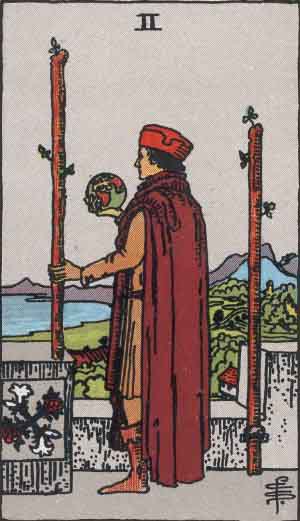
Detailed Interpretation
The Two of Wands can hardly be called a favorite card among tarot readers—it is not easy to interpret.
Traditionally, there are two practically opposite interpretations: one connects this card with "initiative and confidence," the other with "indecision and indifference"; one speaks of luck and power, the other of misfortune and collapse. One explanation for this contradictory tradition is provided in the section exploring the deep meaning of the Arcana. In any case, regarding this card, everyone will find their own personal observations useful.
The most positive interpretation of the card is harmony between past achievements and plans for the future. In a positive surrounding spread, the Two of Wands can be interpreted traditionally—as conquest and power, a carte blanche in gaining strength. The querent has enough power, influence, and resources to carry out everything planned. It should be added that the Major Arcana resonating with the Two of Wands are considered to be The Magician, The Emperor, The Sun, and The Chariot.
It is also quite a common opinion that the Two of Wands foreshadows the arrival (appearance) of something unexpected. Something is about to happen that the querent did not include in their plans. Unforeseen obstacles or problems, a sort of "we didn't expect this." Coupled with The Moon, for example, this makes sense—some unaccounted, unnoticed factor will reveal itself. At the very least, it will surprise; at worst, it will seriously complicate matters. This could be, for instance, unexpected opposition from people from whom it was not anticipated, the discovery of certain rules no one knew about, and so on; other cards can provide a clue.
A positive surrounding for the Two of Wands can foreshadow an unexpected but profitable set of circumstances.
Most often, this card indicates the presence of a new opportunity regarding which the querent is hesitating—whether to take advantage of it or not. It is accompanied by indecision and uncertainty. Sometimes the card reacts to people deciding where they should be in a purely geographical sense.
Another common meaning of this card is a threshold, a crossroads, some sort of intersection in life. Due to a loss of future motivation for new actions, it is difficult to make a decision. A person finds themselves on the threshold of something, arriving somewhere or leaving somewhere, and they are overcome by a reluctance to take the next step in the chosen direction. It is as if they are looking at a turbulent stream they need to enter, one foot is seemingly already raised, but there is absolutely no desire to take this step, and the person would gladly stand on the shore a while longer.
This "threshold" could be a matter the person simply cannot commit to because they do not want to deal with it, or a relationship they are not particularly eager to enter. As Banzhaf writes, "a sluggish declaration of one's intentions in the absence of a genuine desire to act."
The Two of Wands can signal difficulties with making a choice or a decision. Moreover, the problem is that the person does not like any of the solutions; none of them truly satisfy them (hence the visible "neutrality," "timidity," "cowardice," etc.). Delaying the final answer. Sometimes the card indicates that the decision is not that important; in reality, almost nothing depends on this choice.
There is also an opinion that the Two of Wands means the planned goal is quite achievable, but will require serious effort and time. At the same time, the conceived goal usually relates to the realm of intellectual or creative work—writing a dissertation, finishing work on a book, a play, a painting, a project, a plan, and the like.
In traditional interpretations, the card has a negative reputation: quarrel, scandal, contradiction, incompatibility. Parting, loss of a loved one, departure, or the absence of something or someone; hence sadness, sorrow, grief, regret. Surrounding cards can help determine the direction of the interpretation.
Indifferent.
Creative flight delayed. "O, muse, where art thou?"
Some authors emphasize the high-energy characteristics of this card, and although at the moment they seem doubtful to us, we will mention them anyway. This is personal power, a flow of activity and worldly desires, a feeling of omnipotence, firmness and courage, masculinity, decisiveness, belligerence, but also impatience and a lack of endurance. Pressure, demonstration of business acumen, convincing people of one's talents. Perhaps for someone, the Two of Wands manifests itself exactly like this. Its best meaning is good intentions, faith in the success of hatched plans, expecting the results of one's actions.
In our experience, it more often describes other states after all. The person stands apart from what is happening, as they do not quite imagine how to act now. They are possessed by a desire to keep away from everything and do not strive to make decisions, because their heart is not in it. Dissatisfaction with what is happening. A feeling of annoyance, an absence of happiness. In some ways, this is similar to the melancholy of the Four of Cups, but there is a difference. In the Four of Cups, the person does not see what constitutes their happiness. In the Two of Wands, they see everything, but what they see does not make them happy... for some reason.
Traditionally, the Two of Wands is an indicator of a strong, influential person, a master, a "conqueror and achiever," a highly fulfilled individual possessing great opportunities. They let nothing get the upper hand over them, the sea is knee-deep to them and the whole world is at their feet, but... at this moment they are tired of themselves and not very interesting to themselves. Just as in the previous stage of development nothing could distract them from fulfilling their goals, now nothing can bring them back to it.
This is a person who knows and has experienced all of this—the burning and the willpower, the desire to fight and the readiness to take risks, the fierce forward movement and spontaneous self-expression (and perhaps even reckless aggressiveness and the demonstration of their power), but... right now the strength of the current has weakened, and they have no desire to ask for trouble. This is a card of an unexpected internal block (this is exactly how people usually experience the loss of enthusiasm, inspiration, and taste for life). Sometimes—a thought hovers "somewhere out there," searching for something lost in parallel spaces.
Through the Two of Wands runs a persistent tension, hiding vague internal suffering. The will balances between a creative and destructive impulse, as well as between suppression and prohibition—and burnout and aggression. Banzhaf and Akron emphasize spontaneous volition, a state in which it is more important for a person to express their power than to achieve a specific goal. As a result, they choose (without any strategic thought) new paths where something interesting awaits them, although fraught with destruction. This is a variation of "there is rapture in the battle"—a person engages in altercations and confrontations for the sake of pleasure, they just need some "action." This meaning is felt more in the Crowley system.
The person of the Two of Wands remains an individualist, no matter what you do with them. They do not particularly listen to the opinions of others and always act in their own way. It is difficult to be around them, as they are a dictator by nature, a Solus Rex Incognito. Unconsciously, they always look down on those around them, and not particularly attentively at that. A more detailed explanation of this phenomenon is in the next section.
This is the "depression of achievement."
In an allegorical sense, the Two of Wands depicts the so-called "lament of Alexander" ("When Alexander surveyed the limits of his kingdom, he wept, for there was nothing left to conquer"). You got everything you wanted, but you feel not so much joy as a loss of spirit about it.
This allegory is very helpful in understanding the seemingly vague and contradictory descriptions of the Two of Wands: "an obvious success that turned into a disappointment," "wealth, luck, and power that do not bring happiness." Symbolically, the card speaks of immense power, simultaneously creative and destructive (like creating a huge empire—but by what means and at what cost!).
In the days of the Ace of Wands, the person fiercely overcame any obstacles; only a bullet to the heart could stop them (and even that is not a given), but currently, this unbridled thirst for advancement and achievement has turned into burnout. This cannot exactly be called a state of "being left with a broken trough" (from the old fable), but... this broken trough is rather somewhere inside, and that is where it has cracked. Banzhaf writes about this: "The sadness and loss of vitality in one who managed to achieve everything desired, but no longer finds the resolve within themselves for new actions." This seems strange, because the Two of Wands is, after all, the very beginning of the Path of this suit! From where, why? How can one get tired of achievements having taken only the first step? As in all other cases, to understand the meaning of the card, one must remember what precedes it and what follows it.
The lesson this Arcana speaks of is that the Ace of Wands represents VERY vast energy, a massive flow. And when this fervor exhausts itself, a person feels weak and bewildered for a time. "Well, what now? What to do next?" A sense-making and ordering impulse of enormous power (the Ace of Wands) has dried up. Before you can be inspired by new prospects (Three of Wands), you have to go through the stage of the Two of Wands, when your heart is not in anything.
The Two of Wands is also interpreted as the prison of one's own conquests and acquisitions. So much of everything, achieved everything you desired, the empire of life is enormous... what next?
The friction of polar forces. It is believed that the spiritual test symbolized by this card is the ability to relate to other people. In that specific worldview, where the world itself is something lying at your feet, another person and their feelings are usually not perceived or considered at all. They are simply hard to notice; here the heart must simultaneously turn into binoculars and a microscope. Therefore, on a societal level, the Two of Wands symbolizes a person with pronounced ideas, desires, and ambitions, who is forced to seek a compromise with other people endowed with their own ideas, desires, and ambitions.
Regarding astrological correspondences: "The first decan of Aries symbolizes the movement from the depths into the open space—fierce, ready to overcome all obstacles, and irrepressibly striving for victory. This decan, just like the whole sign of Aries in general, is ruled by Mars, and the fiery impulse, reflecting the essence of this sign, is a symbol of every beginning. But this impulse is not yet strong or protected, and therefore vulnerable: it has not yet adapted to the existing world.
This is a new role for which a script has not yet been written. This is uncertainty in a new position due to a break with past experience, a blinding by one's own impulse due to an inability to see oneself from the outside. Therefore, to make a new correct decision, it is important to rely on past achievements. Turning to the figurative path that the Idea takes in its development, at the level of the Two of Wands, it (the Idea) seems to gather strength, expands. It is about to separate from the Creator and become realized."
In an occult sense, the card can also be interpreted as a threshold between life and death, a portal, a gate leading to another world, renewal through destruction. Such rare interpretations as righteous anger or rebellion against restrictions may also be connected with this.
Light and shadow (advice and warning)
Advice: to step aside for a while, maintaining a neutral position, and not to make a final decision until there is true certainty that it is right. Then to determine which goals should be pursued first and foremost, and transform the tension into enthusiasm and deliberate actions.
Warning: do not delay making a decision for too long.
It is believed that the Two of Wands can also encompass the founding of companies and the benefits of previously started activities, the conclusion of important agreements or deals, and the development of action plans. The card is favorable for a career, strengthening one's position.
Expansion of the circle of professional communication, business meetings, cooperation, finding a likeminded person. This is a good and honest business partner. Even if they are not particularly experienced, they are reliable.
The key problem of this card is the alignment of ends and means, as well as the correspondence to the position held. A lack of energy and persistence, the need to implement what was planned while overcoming difficulties. Firmness and courage are needed here. The trouble is that the mood of the Two of Wands disposes one more to sit with folded hands than to fight for the realization of one's dream. It is sometimes difficult here even simply to define the goal, tasks, or area of action. But perhaps this is exactly where one should begin.
The necessity of choosing between two proposals, neither of which is truly inspiring. A professional task that does not arouse particular enthusiasm (despite the fact that the assignment could be quite interesting).
Aloofness, a certain depressive indifference to further achievements. Indifference (up to lethargic), apathy, a loss of life energy, a desire to stay away from the flow of events. A lack of decisive action, an inability to get inspired and pull oneself together, there is some task that the heart is not in.
This card also describes the problems of a leader who must reconcile their ambitions with social reality, with their environment. At best, a constructive compromise; at worst, a struggle for power. Surrounded by negative cards - the failure of an enterprise.
There are interpretations that connect the Two of Wands with wealth, luck, and power. In a negative card environment - the possibility of financial losses. In general, this card speaks of a fairly stable and safe financial situation, an abundance of resources. A constant influx of small amounts of money.
Construction, successful resolution of housing issues.
The need to demonstrate independence in solving monetary issues - the card is interpreted as a special warning "not to sell out," not to strive to gain support at the cost of one's own dignity and convictions.
For relationships, the Two of Wands is a sad card, speaking of indifference, the absence of love and desire.
If the Three of Swords is a broken heart, then the Two of Wands is a cold heart.
This does not rule out dates or sexual intimacy, but... It speaks of an indifferent attitude, a lack of real interest in the partner. Sometimes this is simply a temporary cooling off, a "rest" for the psyche from a period of passionate infatuation (according to the Ace of Wands). The most typical scenario, perhaps, indicated by the Two of Wands, is a person standing on the threshold of a new relationship that does not really inspire them. As if there is no reason to refuse, but at the same time, no reason to agree.
A detached, neutral position amidst internal tension (especially if it involves the presence of two partners simultaneously, two contradictory forces and impulses). The card frequently falls during a period of tension in some kind of "triangle." The situation is unsatisfactory, but on the external level, the person is completely indifferent, because they do not see what can be done to fix it. The result is self-removal, a visible neutrality, and it looks as though the person is firmly determined to remain in exactly this position.
This does not mean the person does not care; rather, the very presence of a third party always causes an outflow of energy, experienced as indifference towards the partner, as apathy and the loss of all inspiration. It also happens that neither of the partners is truly appealing, hence the lack of desire to "choose" and make any "decisions." Most likely, this is the origin of the traditional interpretations of the Two of Wands—"empty words, unreliable promises." Also—failure in marriage, a partnership that does not bring happiness and satisfaction.
However, some authors see this card completely differently. For example, Banzhaf and Akron emphasize the strive and readiness for conquest, "the desire to take what no one can give—that is, everything at once," and in general the position of an idealistically minded egoist who sees only themselves in everything.
It is believed that the card rather symbolizes a creative collaboration in which the partners inspire each other. However, when it comes to intimate relationships, the Two of Wands manifests itself when they noticeably lack emotional richness (this is how colleagues might communicate, but not lovers). The relationship lacks warmth, a "spark," depth... something important. Sexual dissatisfaction, intimate disappointments.
At best, this is a marriage based equally on calculation and mutual respect. One of the traditional interpretations states that at this stage, the partners must overcome their fear and somehow indicate their intentions, thereby laying the foundation for the development of the relationship.
Loss of strength. Apathy, lack of life energy.
Postpartum depression. The beginning of professional burnout.
Agoraphobia (fear of open spaces).
An incorrect balance of power in an organization, creating the grounds for abuse of power.
This could be a situation where the querent has a lot of responsibility but little authority. Demotions, and occasionally dismissals, fall under this card.
Sluggishness and dependence according to some interpretations, excessive excitement of feelings according to others (apparently, this depends on what meaning is considered dominant for the upright card). A great surprise, sudden changes, surprises of fate. Troubles, restrictions, obstacles (for example, the need to return from a journey prematurely due to some difficulties). Confusion, agitation, disappointment due to the dishonesty of partners (especially if cards related to deception are present in the spread). If the upright card signifies a self-realized (and even to some extent, tired of themselves) personality, then the reversed one symbolizes a socially "worn down" state, a diminished position, lack of realization, insufficient potential to fulfill one's dreams.
If in the upright position it is "the ruler who governs everyone, but is governed by no one," then in the reversed position the card can be an indicator of a ruler governed by everyone, while they govern no one, including themselves. The inability to correlate oneself with those around, to achieve agreement and mutual understanding (dictator complex). The possible necessity of recognizing someone's authority.
With The Magician - amplification, the cards are considered almost duplicating. Personal power, gaining might.
With The High Priestess - it is believed that The High Priestess weakens the action of the "dominating" Two of Wands, because she brings passivity and remaining in the background.
With The Emperor - amplification, great authority.
With The Hierophant - difficulty expressing one's opinion, conformism, following the collective.
With The Chariot - personal power, a leader's talent.
With The Devil - abuse of power.
With The Sun - life energy, greatness.
With Nine of Swords - powerlessness, fear of taking active actions.
Reversed with The Devil - fright, misfortune.
Reversed with Ace of Cups, Three of Cups - a pleasant surprise.
Reversed with reversed Ten of Pentacles - involvement in a game of chance (from ancient interpretation books).
Lord of Dominion The Flame of Desire ASTROLOGICAL SIGNIFICANCE: Sagittarius, Capricorn, the planets Jupiter and Saturn, as well as Mars in Libra, in Aries The first decan of Aries from March 21 to April 1. Occult key: Possession, Dominion