Ace of Swords
Swords — Minor Arcana
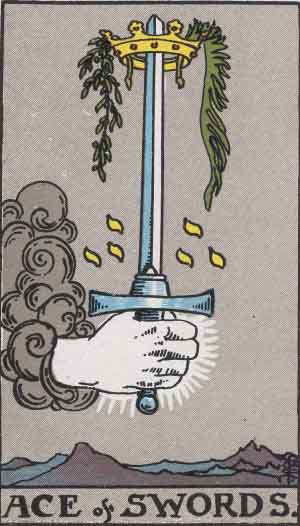
Detailed Interpretation
Initially and in its most direct sense, the Sword is a card of military potential. It represents a sufficient amount of strength for energetic beginnings, immense determination to act, the start of a successful struggle, and a readiness for growth and detachment from one's original existence. It is a situation where the person has clarified a great deal for themselves and now knows exactly what they want to do next. Enormous power can now be wielded in any chosen area. It is an indicator of power—physical strength, willpower, power acquired through position and intellect, or by virtue of circumstances. The Ace of Swords never indicates the weakness of anything, and in a spread, it can clearly point to an escalation of force in the matter at hand.
The need to immediately solve a problem (and sometimes a moral dilemma; the person must choose the principle by which they intend to be guided in this situation).
The Ace of Swords is a conscious act of will, the ability to clearly separate what you desire from what you do not desire. One of the most important meanings of the card is a limit, a boundary, an extreme, and one must try to understand how this manifests in the given situation. This could be about setting boundaries or drawing a line under something. The Ace of Swords is often a rather harsh decision made from a position of power, will, and reason, in defiance of sentiment. In a spread, it can mean gaining clarity in something, whether it's solving a complex task, clarifying a relationship with a partner, or overcoming doubts. It is no coincidence that in Latin, the word "to cleave" (secare) also means "to understand" or "to solve" a problem (remember the Gordian knot).
Absolute success. The triumph of personal power, of authority over circumstances. This triumph can apply to any aspect of life: work, love, financial matters, the spirit, or any engaging pursuits. This Ace is not just a beginning, but also an indicator of what has been conquered, the triumph of proclaimed views and accepted decisions.
Overall, the Ace of Swords, along with the Ace of Wands, is the most "energetic" card of the Minor Arcana. Just as with the Ace of Wands, an initiation can take place through the Ace of Swords, meaning a connection to something new.
Courage, strength, initiative. Seriousness, rational and firm behavior, extreme mobilization of forces, the start of activity. This is a kind of new resource that a person suddenly discovers within themselves. The attainment of rational, cold-blooded determination, balance, and clarity. Brilliant intellectual abilities, logical thinking, the ability to make successful decisions, reliance on rational premises, analysis, and foresight.
Taking correct, precise actions in a situation that threatens to become entangled. Authority, power, and self-confidence when facing difficulties. Immense willpower. The victory of the Sword is always the elimination of convenient half-measures, laziness, and self-pity. Being "on the crest of a wave." The ability to call a spade a spade, which might be perceived by others as cruelty and heartlessness, whereas the person themselves is interested in nothing but objectivity and justice.
Even when up to their neck in a situation, they are capable of looking at it from the outside and seeing it in its true light. They are absolutely unafraid of difficult decisions (which makes them rather "difficult" themselves). This is a card of inner honesty, strictness, and firm principles.
Originality of thought, inspiration. Honed and insightful perception can also be a professional skill (most often found in experts and consultants across various fields). Quick-wittedness, awareness.
"It is not the time to pray to the cup, but to take up the sword" (the eternal drama of spiritual knightly orders). This is a card of martial courage, of war for faith and principles; its motto is "victory or death." Another crucial lesson of the Ace of Swords is the inextricable link between victory and suffering.
The Ace of Swords is the element of air in its purest form. It personifies thought and the capacity for judgment, ideas and ideology, and speaks to the ability to formulate and put one's convictions into words. The Ace of Swords corresponds to the higher Mind, that power of cognition which leads to clarity, consistency, and the ability to make decisions. In contrast to the following card (the Two of Swords), which symbolizes the power of doubt, here the work of the mind is carried out in its purest, brightest, and most liberating form.
Clarity here is achieved by separation (cleaving with a sword strike) and penetration (blade into flesh), and as a rule, without anesthesia. The sword is an important magical symbol (a magical dagger, a ritual knife). As a symbol of protection, it is depicted pointing downward. Sometimes, if the point is directed upward, it is crowned: this is the symbol of the "sword of God." There are debates about how a sword "should" be properly depicted on a Tarot Arcana—pointing up or pointing down, going so far that those who have a sword depicted "incorrectly" must interpret the upright as reversed, and the reversed as upright... brrrr.
Esoterically, the Ace of Swords is viewed as the Seed of Power and as the environment that has received this seed, and it conveys a clear concept of the boundary between the seed and the environment. The seed is maximally separated from the environment. It has not yet sprouted into it. The environment might destroy the seed, or the seed might actively influence the environment.
Light and shadow (advice and warning)
Advice: all the sharpness of mind at your disposal should be directed at penetrating to the core of the problem, without losing sight of the bigger picture. Do not ask others for help. The solution is in your hands alone.
Obstacle or trap: a sword in the service of base interests. Violence as a way to solve all problems. A tendency to overcomplicate everything. Destructive forces, destruction, cold reason destroys everything. Self-destruction, an overly harsh approach. Excessive coldness and calculation. A conscious or unconscious desire to "beat everyone" and leave them behind.
The emergence of a new idea, project, or passion. Historical meanings of the card include conquest, the triumphant success of force, a stunning victory. An excellent prospect for obtaining a higher position, career growth, satisfying ambition. Accepting a challenge of some kind. A decisive breakthrough in a certain matter. Deliberate, determined, and effective actions. A clear choice of priorities. The ability to work for the future, to see a plan through to the end.
The Ace of Swords is excellent for the start of education and all kinds of admissions—to academies, institutes, associations, and even simply to a job. That is, a person begins a new cycle as a conqueror (where others have failed), they have achieved the desired position and feel a sense of euphoria from their power.
Usually, the Ace of Swords destroys all illusions, helping to see things in their true light, and allows for a clear and adequate assessment of the situation. It is the indicator of mathematicians, experts, auditors, and all sorts of appraisers and inspectors whose professional task is to see things "as they are." Law, medicine, finance, the education sector.
Work related to the processing and transmission of information, requiring constant maintenance of good intellectual shape. It undoubtedly covers scientific work, mental labor demanding an analytical search for correct solutions. All kinds of conferences, commissions, symposiums, seminars (and work requiring participation in all of this). Discussions during which the essence of a problem is clarified, an analytical approach to the matter is required, along with clear argumentation of one's ideas.
As the beginning of the Air element, the Ace of Swords has a special relationship to pilots and aviation.
Prosperity.
Making unambiguous and final decisions in these matters.
An opportunity to improve the quality of life by accepting a challenge.
In personal relationships—a clear and crisp clarification of the situation, without any compromises, the end of one thing, the beginning of another. Situations where a partner is set very firmly and strictly, is ready to clear the air and punish, disapproves of behavior, does not see the need to hide their opinion, and is ready to PUT A STOP to all of it.
Usually, the Ace of Swords speaks of a direct discussion of painful issues, getting rid of illusions, and solving the problem (sometimes through severing ties and parting ways).
Sometimes (usually for people of "this suit") in a relationship spread, the Ace of Swords predicts that passion has literally burst into an otherwise ordinary and customary life, or this is to be expected very soon. This might seem strange—Swords are customarily associated with a cold mind, a sober head, and "heartlessness."
But in the realm of relationships, the Ace of Swords symbolizes an impulsive, primal force, intense "conquering" emotions, extreme feelings related to a situation or a person (all-consuming love and equal hatred, or, as Guggenheim said, "this is a card of exceptional power, both in love and in hate"). Here, the love of the Count de Monsoreau in Dumas' novel comes to mind ("When he confessed his love to me, it seemed to me that he was confessing his hatred"). These are not feelings that a person can express harmoniously and affectionately in polite society. There will be no sweet cooing here—rather, victory over resistance.
The emotions patronized by the Ace of Swords are capable of igniting a fire that will burn down all obstacles on the way to the goal, causing a lot of damage along the way (it will be good if the goal survives...). Here, as they say, the imminent gleam of a dagger can be sensed. Perhaps this is due to the fact that Swords are generally a cold suit, and when, for once, a single emotion appears on the horizon, it fills everything with the totality characteristic of this suit. And this force at some point (usually this happens very quickly) begins to seek an outlet outward (see the Two of Swords).
Passionate masculine love under the Sword is a complex, unyielding, uncompromising feeling that is much harder to accept than the Cup (although escaping from these "nets" is highly problematic). It does not cancel out a calculating mind and only multiplies the pressure of the will tenfold. It may seem "cold," but in reality, it subjugates life itself.
The Ace of Swords is an indicator of sexual initiation, male potency, fertility, and fecundity. For a man, the Ace of Swords can mean insemination, the birth of a child. Practical observations say that for a woman, an upright Ace of Swords is quite often associated with a tough decision to terminate a pregnancy, as well as with childbirth (essentially also a termination), whereas in a reversed position it can mean fertilization and pregnancy.
Vitality, robust health, energy, self-creation.
With unfavorable surrounding cards, it can indicate the onset of an illness, usually associated with hypothermia, an accident, the presence of a "stabbing" pain (for example, an ulcer), or a surgical intervention (of course, if this is presumed as a possibility in the context of the situation).
Reversed – self-destruction, undermining of vitality, up to a lethal outcome.
Mary Greer writes beautifully about the instinctive biological law of "fight or flight": the upright Ace of Swords says: "Fight!", the reversed: "Flee!"
The first and foremost thing the reversed Ace of Swords indicates is a weak will and an inability to make decisions, a flight from problems, and sometimes humility in the highest sense: a person has realized that in this situation neither logic nor aggression will be of any use, therefore – "not my will, but Thine be done." It is no coincidence that when reversed, the SWORD IS A CROSS.
The upright Ace of Swords means the resolution of a problem or a "delivery from a burden" (for example, the birth of a child or a plan). If it appears in a spread in a reversed form, it means that the problem is not being resolved, the "delivery from a burden" is not happening, there are no prospects for victory; perhaps the task has no solution at all. A fiasco, a failure. Fear of punishment (under the "Sword of Damocles").
The reversed position of the card can mean an attempted initiation, moving forward under conditions that have not yet fully formed. That is, the environment sort of crushes the undertaking and ambition, but, in any case, the Ace of Swords means some kind of test of strength. The querent will either "fail" or win some sort of victory, but with catastrophic consequences for themselves. The approach of a catastrophe, a blow. The beginning of strained relationships and conflicts with others and oneself. Sometimes it can mean parting with someone or a blow of fate.
Possibly – a reluctance to absorb information, learning difficulties, something is blocking intellectual energy (other cards will hint at what it is).
Empty talk that changes and solves nothing.
In a reversed position, the Ace of Swords turns its energy upon itself, thereby symbolizing destruction, illness, destruction in all its manifestations, undermining of vitality, illnesses, self-destruction.
In the worst-case scenario, the reversed Ace of Swords can mean a lethal outcome, however, this is a very rare occurrence, and here at least the Arcana accompanying such a prognosis must manifest.
Heavy thoughts, anger, projection of one's aggression onto others. Sometimes (see above) – conception, pregnancy.
With the Ace of Wands – colossal courage and personal power.
With the Ace of Cups – unusually strong love, depth of feelings.
With the Three of Cups – the prospect of getting out of straitened circumstances.
With the Ace of Pentacles – abundance and prosperity.
Siegfried.
The sword with which Alexander cut the Gordian knot.