Two of Swords
Swords — Minor Arcana
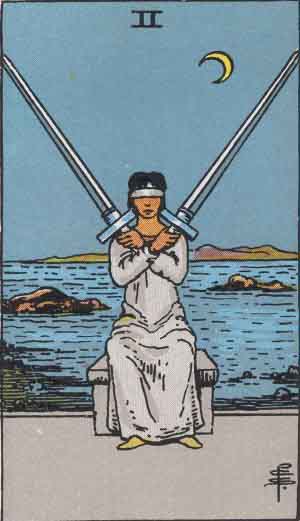
Detailed Interpretation
Interestingly, just as many books attribute the meaning of trouble to the Two of Wands, while practicing tarot readers consider it neutral, in the case of the Two of Swords, books often assure that "the card is generally favorable," but practicing tarot readers consider it rather negative.
In traditional interpretations, it is considered a fairly favorable card, with meanings such as harmony, firmness, balanced strength, compensating factors, agreement, deliberation of decisions, accuracy of judgment, and a realistic assessment of the situation. It is attributed to "peace of mind," a "sense of justice," a "balanced mind," and "well-thought-out plans." In a conflict, it indicates that the confrontation will not last long and will not be strong enough to truly interfere. The choice will be based on a careful weighing of all pros and cons.
But more often, the Two of Swords reveals its other meaning – biding time and endurance in a difficult situation. There are some unresolved problems, and the tension cannot be reduced with the current balance of power. This might be the calm before the storm of the Three of Swords. We are unable to understand what would be the best course of action or what to choose. It is unknown how events will unfold. The situation is ambivalent and uncertain. The Two of Swords speaks of a person's uncertainty about what is happening, the suppression of emotions, and the search for a solution. The card appears when the querent is in a kind of mental paralysis, unable to make decisions and act with confidence.
The lack of a decision is due to the fact that there are two opposing points of view on the issue, and the person is not ready to accept either of them. The two swords can symbolize two factors that have baffled the querent. To clarify them, two more cards can be drawn.
The best that the Two of Swords can offer is balanced and rational thinking in a hopeless situation, the development of a certain equilibrium, and reaching a somewhat constructed compromise. In a positive card surrounding, it promises careful, step-by-step analysis, precise thinking, and the ability to articulate conclusions. The problematic aspect of the Two of Swords is that the equilibrium found could turn out to be either a truly clever and delicate balance of power in a difficult situation, or a complete dead end, a stalemate.
Most often, this card indicates that a person is trying to cope with their feelings (especially fear), suppressing and hiding them, including from themselves, and is trying to find inner balance, deliberately ignoring what unsettles them for the time being.
For the future, the card foretells participation in some negotiations, an attempt to soften or pacify a difficult situation. Old interpretation books mention that this card can be read as a formidable defense for the querent if they are seeking help.
In a negative card surrounding, old interpretations foretold "dangerous times demanding courage; a duel, but without a fatal outcome." Today, in an unfavorable spread, one can expect discord, the collapse of an alliance, or a clash.
A refusal to see anything, and this is not necessarily a real problem – but rather what the person perceives as a problem. A state where we cannot see the forest for the trees or actively evade resolving certain issues. Sometimes a person truly adopts an ostrich policy, hiding their head in the sand and refusing to pay attention to what is happening around them to avoid excruciating pain (the next card is the Three of Swords), but still, it's not that simple here.
Under this card, a person closes themselves off from some excessive influence (of another person or situation) so as not to let themselves be confused. The Two of Swords is often described as tension and sadness, and it's not that this is wrong, but... it's very important to understand that these are not the emotions of Cups. We are dealing with Swords, after all! And they describe a state in which, by and large, no one can either help or hinder the person. They refuse help and ignore attempts to interfere.
This is how an actor might feel tuning in behind their screen before a dramatic performance – right now, they need neither colleagues, nor the audience, nor the director. This is one of the cards of self-defense; it manifests a striving for peace and balance, a desire to withdraw and concentrate, to put one's thoughts in order. Under the Two of Swords, we are not so much looking for a way out of a difficult situation as we are restoring control over our inner world, calibrating our assemblage point.
This is necessary to begin with, because as long as we are rushing about, torn apart by doubts, contradictions, and frightening thoughts, no decision is out of the question. In this state, a person seeks peace and quiet, and quite explicitly defends themselves from anything that might disrupt them (first and foremost – from emotions). This defense explains the temporary blindness to one's surroundings and the inability to act actively, which is felt in the Two of Swords.
The card depicts a lone male or female figure in a simple tunic. The person sits on a solid, cubic pedestal, emphasizing the firm foundation of their beliefs and the steadfastness of their position. They will not get up from this pedestal or start acting, no matter how much circumstances push them to do so, until they decide for themselves that they are ready for it. The card reflects temporary inaction, outward passivity, but on the other hand, great inner mental work.
This is emphasized by the night, the moon (sometimes waxing, sometimes waning), and the stormy sea (but even calm water reflects the element of emotions in any case). However, the person has turned their back to this element and even blindfolded themselves. The blindfold symbolizes concentration on the inner world, but also a lack of a clear vision of the situation, a certain "blindness." Their posture is a posture of defense. They do not want to see anything and demand to be left alone. They do not intend to be guided by their fears stemming from external impressions.
The figure's posture in canonical cards emphasizes perfect balance, even though the eyes are blindfolded. The source of balance is exclusively internal, not external sensations. The person firmly grips two swords in their hands. Sometimes they are pointed up, sometimes down, sometimes in different directions, and sometimes the swords are crossed, which heightens the impression of conflict and self-defense. These are weapons, but for now, they are not aimed at anyone. When the assemblage point is flawlessly calibrated based on principles rather than external impressions, the person will stand up, take off the blindfold, and begin to act.
But for now, they refuse to do so in order not to make a mistake. At the same time, the main efforts are directed towards restoring inner peace before moving on to any active deeds. But this consumes all their energy – not allowing terror to overwhelm them, calibrating and preserving a specific inner state. As a rule, this is suppressing a crisis in the bud – a struggle to prevent the situation from getting out of control and turning into a conflict. To do this, the person on the card refrains from sudden movements, centers on themselves, and does not allow dark and destructive forces to influence them, throw them off balance, or deprive them of objectivity.
In general, the main question the Two of Swords poses is: WHAT are you closing your eyes to? It's one thing if a person goes deep within themselves for a valid reason, doing the inner work of self-reflection in reality, building readiness for current situations. From the outside, this work might look like an ostrich policy – after all, there are so many things to do, they need to be dealt with urgently! But everything is correct in the Arcana – the person does not succumb to the turmoil; they draw from within themselves, from their spiritual world, the energy and strength to reorganize the situation.
It is sometimes necessary to regain control over one's spiritual world before taking active steps in the external world. And it is quite another matter if a person wishes to protect themselves not only and not so much from external pressure, but from their own thoughts and feelings, which frighten and irritate them!
The person is cold, distrustful, skeptical, and self-reliant. They will measure seven times before deciding there is no need to cut anything. In the worst case, they reject both their own and others' self-expression, and leave any feelings, whether love or anger, to die on the outskirts of the soul. A characteristic feature of a Two of Swords person is that the question "How are you feeling?" makes no sense to them (unless they have the flu).
Feelings don't really exist for them; it's just a way of speaking, and they aren't even fluent in it. The task of showing emotions and expressing feelings outwardly is something in the realm of mission impossible. But they know how to cooperate on an intellectual basis. On the one hand, there is nothing in their life that would seriously embarrass them. On the other hand, they constantly experience anxiety regarding the most ordinary things, and they learn to suppress this anxiety so as not to lose control.
This is a great inner labor that absorbs a lot of strength, so the person may seem to run out of energy for many things – among them could be close communication, truly productive intellectual work, and much else they might want to do. That is why they are called "indecisive" – meanwhile, making decisions is all they are busy doing.
This card indicates situations in which a person is gripped by strong, literally gnawing doubts or fear of facing something unpleasant. Sometimes it is a desperate attempt to strain all one's intellect to develop a position and find a path to a solution.
However, genuine conviction arises only when we realize the problem on the level of feelings as well. And this area of the subconscious (on the card - the symbols of the sea and the Moon) turned out to be cut off from everything else. The crossed swords are the boundaries of the intellect, blocking its access to it. Tormenting doubts and ignorance of what to do come to the fore precisely because the person has "turned their back" to the sea and the moon, that is, to the sources of deep intuitive knowledge. The Two of Swords forms the opposite of The High Priestess, to whose affinity it is reminded by the sitting position of both.
The highest goal of the Two of Swords is the achievement of inner balance based on the acquired knowledge. It strives for a state in which external forces will not be frightening to it due to the balance of internal poles. This is the card of the spiritual warrior, gathering strength before the painful open battle of the next Arcana. The cliffs depicted in the background, washed by water, symbolize problems waiting in the wings.
The Two of Swords, following in order after the Ace of Swords, develops and complements the meaning laid down in it. We have already noted that the Ace of Swords is a "primal" and impulsive force that seizes a person during a period of infatuation. But this force at some point (usually it happens very quickly) begins to look for a way out. In other words, any passion must necessarily be "poured out" from the soul: otherwise, a person simply will not be able to live normally. However, the outside world (or the object of this passion), as a rule, exerts a certain resistance to this energy. And it is precisely from the resistance of the environment and the active energy of the Ace of Swords that the impulse of the Two of Swords is born.
A check occurs: is the desire really strong? The will, encountering an obstacle, either overcomes it or fades away. The impulse that is set by the Ace of Swords, that is, the Force (or Seed), meets the resistance of the Environment. This is like a vector directed towards another. Thus, a collision situation is formed. If the impulse does not fade and passes this first test, then the possibility of moving forward will open up.
Born from the source of Archetypes, a thought (Ace) enters reality, where everything is divided into polarities (Two). To understand the world, a person mainly uses the concept of dialectical dualism – everything is the unity and struggle of opposites. This is characteristic not only of Western thinking, prone to intolerance and rigid structures, but also of Eastern thinking, where there is also a desire to reduce existence to a universal formula like "Yin/Yang". At a deeper level, the Arcana reflects the drama of the human mind, incapable of grasping that holistic source from which it originated and trying to restore balance through the simultaneous vision of polarities.
Regarding the astrological correspondence, we found the following excerpt: "The first decan of Libra is an impulse that prompts thoughts to leave the maternal depths of the subconscious and, going beyond the framework of the natural soul, to rush towards the new. This is a thinking detached from the flesh of Being, dissecting the world into two parts, weighing the possibilities 'for' and 'against' and deducing a logical conclusion. The blindfold symbolizes concentration on a person's inner world. Inner truth grows out of reconciliation with oneself and the readiness to accept knowledge. The figure depicted on the card sits on a cubic seat (the firm foundation of their beliefs) in a posture of perfect balance, holding two large swords in their hands with the points up.
Crossed Swords are contradictory thoughts that give impetus to the work of consciousness. But a conscious free choice is carried out only at the moment when a balance is achieved between two possibilities and nothing interferes with the choice. In the background of the picture is a smooth surface of water: emotions are in complete peace and under the control of reason. The first decan of Libra is characterized by good taste, refinement of thought, and perfection of style.
It is also characterized by sympathy, courtesy, delicacy, and a striving for subtle relationships, and it is ruled by the flexible Moon, which feels nuances well and knows how to adapt and identify with a partner. The Moon endows those born in this decan with moral purity and allows them to be a 'perfect judge' in the sphere of human relationships," but it (the Moon) also gives this decan a certain indecisiveness arising from the fear of destroying the old."
Venus is realized in the Two of Swords, therefore two main themes are heard in this card: Taurus and Libra. The alliance will last as long as it is profitable. And it will provide at least objectivity and impartiality instead of open antagonism and rejection, unity for the sake of common goals, or at least the understanding that these common goals exist and are achievable.
Light and shadow (advice and warning): Advice: take nothing on faith. Question everything. Tune in critically and examine the state of affairs "through a magnifying glass," without fear of seeing something unpleasant. Give yourself time to think and "separate the wheat from the chaff," and facts from speculation. Do not take the side of either of the conflicting parties. Leave the person or problem alone, do not interfere.
Warning: do not turn a blind eye to what is happening. Minor contradictions run the risk of turning into serious problems over time. At the same time, honest analysis is needed, not just doubts. It is necessary to overcome your fear of an unpleasant situation, step away from passivity and indecision, turn on your reason instead of fear, and move on to concrete actions.
A dubious business, a project that is constantly in question. Negotiations "around and about," in which both sides are afraid to show their cards (and to see others' too). Any information seems questionable. Ignorance of what to do next, a feeling of a dead end. Disbelief in one's own strength, perhaps due to a lack of recognition and appreciation.
Lack of clarity, uncertainty of prospects. Instability of the professional situation. Stalling in moving up the career ladder.
A stalemate associated with a difference of opinions. In the best case – making a compromise decision and temporarily resolving some conflict. An attempt to fairly settle opposing opinions.
Cautious conduct of business, careful planning of every step. Doubts about whether to do this work at all ("Do I even need this?"). Difficulties with concentration, difficulties in analyzing problems.
Sometimes it can describe unity, but still it is rather a fragile alliance of competitors who know each other's worth than the friendship of colleagues. Swords are not the best suit for human relationships; harmony here is conditional, superficial, and limited. This is a card of the balance of power in a tense situation (typical for a situation of the unspoken existence in an organization of two groups, differing greatly in their approach to business).
Under this card, an interruption of studies is possible.
For some reason, the card is considered to have relation to drawing, artistic talents, and capturing images.
A split, differences in business and financial matters. Delays in payments, postponed deals are not excluded. In documents related to money, there may be their own "hidden pitfalls", so they need careful analysis.
Relationships under the Two of Swords are in question – in every sense. They are not particularly strong, and the person asks themselves various questions about them, which can be expressed in endless internal dialogues with themselves or the partner's shadow. Distrust of the partner – and maybe of oneself too. Hesitations, skepticism, gnawing doubts. As a rule, there is no certainty in anything – neither that these relationships should have been started, nor that there is a point in continuing them, nor that they should be ended... in general, it is completely unknown what should be done next. Sometimes a refusal to admit the problem also manifests itself (it is no coincidence that the character on the Two of Swords usually is blindfolded). This may be a lack of recognition from the partner, or it may be the reverse situation – an unwillingness to appreciate them properly.
The most positive meaning attributed to the Two of Swords in the field of relationships is the unification of previously incompatible points of view, an alliance to achieve some common goal, based on mutual benefit. The ability to make concessions, to reach a compromise. It is believed that in a negative card surrounding, the Two of Swords predicts the collapse of this alliance or at least brewing problems in it. Generally speaking, swords are not the best suit in human relationships, and here we can talk about the emergence of more or less friendly interactions between those who under other circumstances could easily tear each other's heads off.
The Two of Swords can describe improved diplomatic relations between two enemies: for instance, people who couldn't stand the sight of each other can start communicating under it, rivals can conclude a non-aggression pact. As a rule, there is some common goal here. This could well be the behavior of divorced spouses during a joint walk with a child. Sometimes emotional courage and openness, a kind of harmony, even intimacy can manifest in such relationships (especially if there are favorable Cups cards in the spread), but still, there is always a smell of gunpowder near this couple. However, there are situations when objectivity and impartiality, replacing bias and antagonism, are already a huge step forward.
Venus is considered the patroness of the Two of Swords, and this planet does not need a special introduction – it is most closely connected with relationships. However, in this case, an endless series of disagreements is hidden behind their outward appearance, because the partners actually have completely different life prospects (at least at this stage of development). In practice, it should be noted, the Two of Swords more often describes the relationships of rivals than any others, and such concepts as "balance, harmony, peace" have a rather weak and conditional relation to it (a fictitious peace).
Therefore, it seems that Banzhaf and Akron, speaking of "a wonderful relationship model capable of overcoming the strongest storms," still greatly overestimate the potential of the Two of Swords. It is rather a delicate balance of power in a tense situation.
In general, under the Two of Swords, a person tends to keep their heart unreachable and impregnable. They deny both their own feelings and the feelings of the other, do not accept them. Describing a partner, this card says that they are ready to "turn a blind eye" to the other's antics, but are completely unsure of anything. Although the traditional meanings of this card are "agreement, friendship, tenderness, intimacy, union, passion". Regarding this Arcana, it absolutely makes sense to collect real observations!
In the upright position, the card relates to vision problems. The position of the hands on the card, protecting the chest, is also associated with problems of the respiratory or cardiovascular system. One of the meanings of the reversed Two of Swords is the fading of vitality in a person.
The first and most common interpretation is that a decision has already been made (and it very well may be that it was by someone else for the querent), the period of rest is over, and the time has come for active deeds. If the current situation is not suitable, the person is ready to become a troublemaker, to disrupt the existing balance. As Mary Greer writes, "You can open your eyes and see the truth, but it will be that you are living a lie." It makes sense to intervene in the situation, to take action.
The second points to the risk of encountering deceit, betrayal, infidelity, treachery, and dishonest behavior. This is "loyalty to two masters" with all the ensuing consequences. Inconstancy or duplicity on the part of a seeming partner, ally, or at least secrecy. This can also mean falling for the hook of scammers, meeting with some crooks, encountering fakes, some inconsistencies, in the worst case, a robbery. Duplicity of a seeming ally, "fake" friends.
Erroneous, incorrect ideas. Imposture. Divergence, rupture, collapse of an alliance.
Another traditional meaning is lies, slander, gossip that damages reputation, in a milder case - ill-considered statements that introduce tension into some relationships, tactlessness.
A poorly functioning head, difficulties with concentration, an inability to see both sides of an issue, something is being missed.
The Fool – weakens the Two of Swords, bringing openness, ease, and defenselessness
Justice – helps to open eyes and admit the truth, from which the Two of Swords defends
Wheel of Fortune – forces an awakening to activity, leaving the static wait
The Star – softens the effect of the Two of Swords, instilling hope and dispelling fears
The Moon – strengthens the Two of Swords, misunderstanding of reality, self-deception
Nine of Wands – reinforces the motive of self-defense
Seven of Swords – emphasizes the escape from the truth
With the Four of Pentacles – a hopeless situation, blockage
Hermes as a symbol of the paradoxical nature of the human "I".