Three of Swords
Swords — Minor Arcana
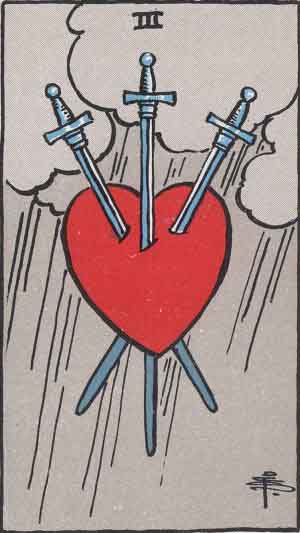
Detailed Interpretation
The Three of Swords always brings to light issues of incompatibility and excessive harshness in communication. The card is generally bleak; it foreshadows a tense and unpleasant time. With it, a multitude of quarrels and anxieties, bitterness, and conflicts of interest enter one's life. This is a card that tests your emotional resilience (pardon the bluntness, but it's accurate). It brings an unpleasant life lesson. If Cups are the "suit of the heart," then Swords are the "suit of the head."
Naturally, in relationships, feelings often push rational considerations into the background, but the Three of Swords gives a signal and slashes through the fog of emotional idealization, bringing a certain collision with "how things really are," and this truth of life causes painful feelings. That is why a bleeding heart is depicted on the card of the "head." Perhaps some final answer will have to be given, and doing so will be very difficult.
The main meaning of the Three of Swords is a choice made contrary to feeling (a person has to give up, renounce something dear to them). However, whether this is cowardice or, conversely, a step forward can only be understood by knowing the background of the question asked and checking the other cards drawn in the spread. Hence, there are some differences in authors' interpretations. It is one thing when feelings (not necessarily one's own! quite possibly someone else's) are brutally suppressed by reason, and quite another when, by the power of reason, one manages to break free from the captivity of some addiction or dependency. It is a step that, although painful, is necessary.
In old interpretation manuals, the card was considered to indicate a painful parting, departure, or separation. Well, if the Six of Swords or the Eight of Cups showed up nearby, that is entirely possible. Swords act in case of necessity, but farewell and separation are a necessity that causes suffering to the heart.
Some modern authors believe that the Three of Swords in a spread can also simply indicate the absence of something valuable and important for the querent within reach (what exactly, other cards can suggest). Its meanings, aside from discord and grief over unrequited love, include elimination, alienation, and absence.
Unpleasant news (this meaning becomes practically one hundred percent certain if there are any "messenger" cards nearby: Pages, Knights, or the Eight of Wands, for example).
In the worst-case scenario (surrounded by additional negative cards), the card foretells great grief. Surrounding cards can also suggest how quickly a person will be able to recover from it and what resources are available for this.
It happens that when this card is drawn, a person is surprised; they find it difficult to connect it with any circumstances in their life—everything seems fine. In this case, an old rule dictates that three more cards should be drawn to find out what the querent's "three sorrows" are—something that imperceptibly, gradually scratches the soul and darkens life. The results can be striking. Perhaps this rule arose from the observation that the Three of Swords is usually drawn by a person who has plenty of problems in life, but they focus all their attention on just one, possibly not even the main one.
The Three of Swords is capable of describing both a suffering person and one who causes suffering. In the first case, it points to pain, sadness, a melancholic mood, and a severe emotional conflict. In the second case, it indicates the capacity to sacrifice both one's own heart and someone else's (to "break" them), ruthlessness, and the ability to inflict deep wounds without hesitation. As the heartbreaking song goes: "They point a gun at our temples, they smash our hearts to pieces..." Moreover, sometimes this person is simply behaving in the most natural, "inherent" way for them and does not fully understand what they are doing. It is no secret to them that their behavior does not bring joy, but they might not realize the depth of the wounds they inflict. They are rational, critical, and have long since lost the illusions characteristic of people (which, as a rule, also happens under some difficult circumstances: "Unrequited love? Don't make me laugh. That cup was drained long ago, dried out, cracked, and shattered"). A person described by the Three of Swords is capable of destroying everything dear to the heart—both their own and another's.
The motif of disgust, disappointment, and disagreement with reality often resonates in the Three of Swords, a refusal to accept it due to its heaviness on the heart; therefore, the card can also symbolize unsociability, antipathy, reclusiveness, being "out of phase" with those nearby, and pitting oneself against them. This is a state in which a person is forced to move in a direction they do not like.
This is, in any case, a state of crisis. It may very well be that a person is facing a choice and cannot decide on a step because their mind and heart are at odds. Even if they know perfectly well what they need to do, it is still very difficult for them. Intellectually, they realize the necessity of what lies ahead, but in their soul, everything rebels against such a prospect.
In a sacred sense, the card depicts the sacred heart of the Virgin Mary, according to the word of the prophet: "Yea, a sword shall pierce through thy own soul also." It is not without reason that this Arcana is called the "Lord of Sorrow."
The Three of Swords always symbolizes the striving for an unattainable ideal, the rejection of reality, and at the same time the inability to escape from this reality. Or, in other words, an attempt to solve a problem with unsuitable means. At the level of the Three of Swords, a choice of direction is made, perhaps for the self-realization of power. The Three of Swords is a symbol of ideals tested for strength. Therefore, it can be said that it resonates with Scorpio. All threes, to some extent, contain the idea of the mystery of initiation.
The Three of Swords also symbolizes initiation, dedication through a painful ordeal, and a break with one's past life. A person is tested for strength and weakness, which ultimately leads to the development of wisdom, a deepening of life experience, and self-improvement.
The second decan of Libra expresses the idea of defining the limits of thought: identifying logical patterns that allow the mind to draw a clear judgment on any issue. Saturn rules this decan, reflecting the ability to adhere to established rules for the sake of universal harmony. This same decan symbolizes self-definition, the pursuit of inner completeness, and the perfection of an image. However, the constant measuring of steps slows down forward movement; therefore, this decan is characterized by a fear of novelty and any uncertainty. It is also characterized by excessive self-restriction and a distrust of the outside world and other people as potential sources that bring disharmony.
The ability to switch in a timely manner from searching for static harmony within oneself to seeing harmony in the dynamic connections of the world is important. Thought, as it develops, moves, just as life constantly changes. A heart pierced by three swords is depicted on the card. Reflecting its sadness, rain falls from the clouds in the background. This image seems to remind us that the world is based on contradictions, and its rational comprehension, as well as cognition in general, is associated with sorrow: any law, even the law of existence, is harsh and imposes responsibility on a person. A person's thoughts must submit to the laws of the world - and then they will be able to accept what previously did not fit into their consciousness.
Behind these seemingly abstract words lies a simple truth. One of the most painful states a person can experience is the "loss of illusions." Behind this can be the collapse of everything they allowed themselves to believe in. They allowed it because they really wanted it to be true. Each of us has a heart; each of us has dreams. We can meditate around the clock, enjoying our idea of what this world should be like. But then the time will come to say to yourself - you are nobody compared to this world; it is different, it is immense, it is not the way you imagined it. And it has every right to be so. Therefore, wake up and make an effort to see this world as it really is.
You can rush head-on at the world with your brightest dreams, but do not expect it to turn away first. If we make an effort to rid ourselves of the fog of our perceptions and understand what this world is really like, we will succeed in making it look just a little bit more like our dreams.
Light and shadow (advice and warning)
Advice: drink the bitter cup. Accept the sorrow that has pierced your heart and rejoice that your eyes have been opened. An unpleasant decision that must be made comes with difficulty and pain, but that which we want to be cured of very often cures us. This is an unpleasant life lesson, but it teaches a lot. Restraint, patience, and humility are required. If you do not hold on and look forward, then as a result, a lot can go the wrong way. It makes sense to protect your interests. This card is a challenge to make clear and unambiguous decisions. In a state of the heart's dilemma, this is precisely what is most difficult for a person, but it is the only way to restore the lost balance (Libra).
Warning: do not try to make a decision against your heart.
Opposition to enterprises, delays. Bad prospects. Swords, as already mentioned, are the "suit of the head" - under the Three of Swords, a headache is guaranteed. Failures, losses, deficits. The threat of bankruptcy. Dismissal. The severing of business relationships. Termination of contracts. Fragmentation of power.
Disappointment in a profession or position – what was previously highly valued turns out to be inconsistent with expectations (again, the "loss of illusions"). This card can speak of a growing aversion to work – duties seem heavy, unpleasant, and the soul categorically does not lie in them. A person can barely drag themselves to work, cursing everything in the world – bosses, clients, colleagues ("I wish I never had to see them again"). Loneliness, depression due to the need to engage in something the soul is not drawn to. The best thing this suffering can provide is to open one's eyes to what the soul truly desires and to give the strength to follow a new path at the first opportunity!
Failing exams.
It is believed that the Three of Swords brings "bad press," scandals, slander, defamatory publications, and deception.
Fragmentation of property. Damages, losses. Sometimes – money obtained by causing pain to others and generally at too high a price.
In general, the Three of Swords brings a feeling of restlessness and promises nothing good in terms of housing. In any case, a person does not like the place where they are staying, "I can't stand looking at it."
Legal claims and disputes over money or property are possible.
The broken heart meaning of the Three of Swords is clear to everyone, even to those seeing Tarot for the first time – the torments of love. Sometimes the card simply shows that the querent has these kinds of anxieties, a fear of pain and loss, although there might not be any special grounds for it. The traditional meaning of the card: the collapse of an alliance, and it usually manifests very noticeably. This is a card of separation, cooling off, discord, parting, and the rupture of personal relationships.
Traumatic clashes, painful quarrels, even divorce is possible. At best – a shadow has fallen over the relationship; at worst – a deep emotional wound has been inflicted. The Three of Swords primarily reveals situations of incompatibility, when previously concluded unions fall apart due to opposing interests, discords, and conflicts. Sometimes it describes the cooling of relationships and hopeless attempts to achieve harmony.
A love triangle is possible – a third party has appeared on the scene and caused the breakup. Infidelity, a situation when the first person learned "the whole truth" about the second, the shattered rose-colored glasses syndrome. The impossibility of choosing between admirers. A broken heart, disappointment in love, sorrow. The parting will not be amicable. As a cause or basis of the situation, the Three of Swords can indicate that the union was fragile from the very beginning, included opposing interests of the parties, and now they are diverging.
Under the Three of Swords, there can be a heartbreaking longing for what has been lost. One of the old interpretations sounds like monasticism – after such dramas, further life was seemingly not meant to be. Interestingly, in practice, this exact card turned out to be the significator of a lifelong widower: a person who lost his other half more than ten years ago, but lives a very secluded life, essentially never coming out of mourning. This very charming man, a brilliant specialist in the prime of his life, realized that he caused condemnation and misunderstanding, but his words sounded something like this: "She's gone... NO ONE is here." Lady Hamilton comes to mind after the death of Admiral Nelson and the famous phrase: there was no "then", there was no "after".
All sorts of cardiological problems, up to a heart attack and heart failure. A "sick heart".
Trauma. Physical pain. Weakness.
Depression (usually traumatic, exogenous).
It is still a rupture of partnerships, alienation, although in this case, the crack in the relationship is not so large. Resistance to pain, an unwillingness to acknowledge sadness, and this hinders healing. The heart "freezes"; it is broken, but feels nothing, not even pain.
In a reversed position, the effect of the negative aspects intensifies, causing complete mental confusion (Swords are, after all, the "suit of the head"): illusions, delusions, hallucinations, distraction of attention, absent-mindedness, and incorrigible mistakes. Miscalculations, losses, disorder in business (which could very well be caused by a broken heart). In severe situations: strong affective disorders, delirium, insanity.
Guggenheim mentions such a meaning as a "meeting with a person who impelled the querent to compromise" (intuition suggests that this conclusion is most likely based on the author's personal experience).
Some authors believe that the reversed Three of Swords means that the querent had a painful situation, but now it is already in the past. It doesn't hurt anymore.
Appearing in a spread next to a Major Arcana, the Three of Swords enhances the meaning inherent to that Arcana. Taken from old interpretation manuals:
With The Fool – ending up in a madhouse.
With The Emperor – the situation is not so sad, unity is coming.
With The Hierophant – avoiding marriage.
With The Lovers – intimacy and love, the card weakens the influence of the Three of Swords.
With Wheel of Fortune – lack of money.
With the Five of Cups – a heavy combination, deep sorrow, loss of love, great grief, heartbreak, widowhood.
With the Seven of Cups - resentment.
With the Ten of Cups – the card weakens the negative influence of the Three of Swords. Joy, unity, reconciliation.
With the Five of Pentacles – rejection, refusal, loss of support.
Before a reversed The Moon – to drown.
Blinded Oedipus
The Sorrowful Mother of God
The Bitter Cup
"Much knowledge brings much sorrow"
Lord Byron's poem about the fact that the Tree of Knowledge, alas, is not the Tree of Life:
Sorrow is knowledge. They, who know the most, must mourn the deepest over the fatal truth. The Tree of Knowledge is not that of Life.