Death
Major Arcana
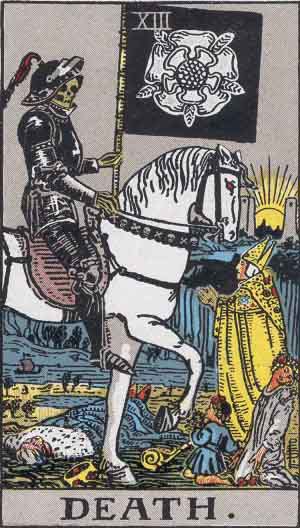
Detailed Interpretation
Transition. Ending. Transformation. And we could simply stop right here. Once again - Transition. Ending. Transformation. This is the answer. The main meaning of the card is that the natural end of the current situation is near. And there is nothing wrong with that. Death is the healing beginning of life.
The divinatory interpretations of this Arcana have always been more positive than negative: favorable changes and eternal movement, transfiguration and deliverance from the unnecessary. However, there is a reason for the old Chinese curse: "May you live in interesting times!" Life is currently entering such a "time of changes," and it is still entirely unclear when existence will once again take on complete and stable forms. A person who draws Death is facing a change in their former life, and almost nothing can stop it. Under Death, processes end, cycles conclude, projects enter their final phase, and what currently exists is destroyed. Death does not bring success, but it clears the path for new efforts and a new spiral.
In Death, the spirit of renunciation and refusal is strong. Since spreads are usually done when the querent harbors hopes for something, the appearance of this card with its pathos of a clear "no" brings little joy. Under Death, plans fall through, we abandon our goals, and we consign our projects to oblivion.
At the same time, Death throws open the gates to a new life. At a funeral, this isn't always obvious; however, it is true. Always. Inevitably. And what this new life might turn out to be will be suggested by the other cards. Comparatively rarely does Death indicate actual mourning, grief, or weeping over a loss. Sometimes, especially if the question or situation truly implies something similar, Death advises that one should come to terms with it and prepare for the inevitable.
It might be difficult to let go of what was once so valuable, but it must be acknowledged that it is time to say goodbye to it. Nothing makes the experience of Death easy, yet the dawn of a new era often carries a tinge of anxious joy. In a certain sense, the Thirteenth Arcana is a good card if the necessity for changes and deep, radical transformations is not frightening. Its meaning can also be linked to a person's victory over themselves.
Just as The Tower marks that which will inevitably transform due to accumulated tension, Death marks those places where the tension has completely vanished, like current drained from a circuit. Perhaps the querent feels nothing but relief that something which has exhausted itself has finally "fallen away on its own," or perhaps they are tormented by the bitterness of loss, but in any case, the time has come to forgive, say goodbye, and let go. By its appearance, Death mostly "marks" things that are somehow damaged or unviable, which are useless to cling to. Moreover, it is characterized by the quality of inevitability.
Death is natural and, at the same time, severe. It advises one to amicably (that is, consciously) abandon the familiar but obsolete, to say "This is finally over!" and to allow something new to emerge after a while. The changes it brings are very profound and irreversible. Death is never wrong. If it declares that it is time to say goodbye to something, it means that at this moment, it is necessary for further progress.
The main meaning of the card is that the end of the current situation is near. A break with the past, an end to the current state of affairs, the conclusion of the querent's life as it is now. The card indicates that something in life is approaching its logical, overdue end. This is some kind of turning point, which might relate to lifestyle, work, or relationships. The most crucial thing during interpretation is to be able to sensibly connect the card to the question.
It's just the right time to write a treatise "On the transience of all that exists and the essence of all that is transient." Under Death, we are constantly accompanied by the feeling that some part of our lives has come to an end, and nothing can be done about it. A time to embrace, and a time to refrain from embracing, a time to cast away stones, and a time to gather stones together. This feeling can be associated with an emptied home from which dear people have departed, with a wallet emptied due to losses, with the necessity to change the place of work, or with health forcing one to draw a line under a former way of life. Death often falls to people who have reached a certain age milestone when a transformation of personality occurs, a transition into a new quality.
Appearing in a personal spread, Death says: yet another stage of your life is nearing completion, a completely new personality is maturing within you, your way of thinking, beliefs, feelings, and reactions are changing. You will be able to become a different person, but at the same time remain yourself, only in a completely transfigured state. You will develop new hobbies, a new system of values, new friends and acquaintances. The only part of you that will not undergo change is what is called the soul.
In its essence, only it is the creative force that can truly forge something new and cast away the old, as only it has enough strength to carry out the transformation and force us to develop spiritually. This is the one and immortal thing within us that transitions from one incarnation to another.
Sometimes Death falls to a person suffering from a fear of life. They might seek solace in illusions or withdraw into their own shell ("How terrifying it is to live!"). Death can describe a person ready to leave – from a job, from a relationship, and sometimes from life. It brings severity and bitterness, depression and the seal of loss, the spirit of separation and detachment.
Under Death we feel that the end of some stage is just around the corner, we often ponder the thread of events, the past and the future (and we see the former far better than the latter; it is precisely because of this circumstance that attempts are sometimes made to breathe new life into places where life can no longer be).
Death often describes a person who is, as they say, difficult, capable of bringing noticeable and frequently rather joyless changes to the lives of others. At the same time, they can be well-mannered, exquisitely dressed, and not inclined to make noise around themselves (this is not The Tower). Yet, this is a personality quite radical in their decisions.
All these "If I can't have you, no one will!", "I perish but do not surrender," and the firm intention to take enemies with them to the grave (or, for example, to meticulously destroy their files on the work computer in case of dismissal) – these are extreme manifestations, but a similar spirit can be felt even in the little things, which doesn't make living together any more pleasant. A distinctive trait of a Death-person is joylessness. This does not mean eternal despondency and a tendency to dolefully complain to those around them, no.
They can behave quite adequately, giving the impression of a person of strong character and profound insight, sometimes even of extraordinary beauty... but something is missing. This something is the ability to enjoy life. The person described by the Thirteenth Arcana is a master of leaving, refusing, destroying, and saying "no". Their profession may be directly related to life and death and be, as they say, dangerous – for themselves and for others. A Death-person is usually alienated and very much "on their own." They are not merged with anything, nor obligated to anything.
In any environment, they are like a foreign body. However, just like death, they are rarely an "accidental guest," and if they have been brought somewhere, it is highly likely that they are in their rightful place, even if none of the people around them think so. The person described by the Thirteenth Arcana is often insightful; they possess a special gift of clairvoyance regarding themselves and others, the ability to see the underlying motives or the inevitable finale of events.
We enter Life through the gates of Death. This is a beautiful card. Death brings rebirth to a genuine life. Those who have been on the brink of death know this perfectly well from personal experience. It dissolves everything fake. It is the Great Transformer, liberating energy from exhausted forms for new paths. Death does not kill, but resurrects.
It is not without reason that the symbolism of the Arcana includes the Mystic Rose of Life on the rider's banner, and the Sun of Immortality shining on the horizon. The one who has died to empty temptations and fears is Born Free in their spirit. Pierre in the novel "War and Peace" goes through this death, being in captivity and realizing that he CANNOT be taken captive.
The absurdity and conventionality of all this is so obvious to him that he laughs uncontrollably. And this is an absolutely authentic sign that he has become an Initiate, because the first thing a person does whose level of consciousness has truly shifted to a fundamentally higher level is they begin to laugh out loud at how they saw things before.
Nothing is closer to life than death. Nothing makes you feel and appreciate life as keenly as the proximity of death. These are two codes fused into each other, yin and yang, a double helix. Death is the fruit that ripens within us all our lives. Realizing this, we do not perceive life and death as something opposite. Everything new appears only thanks to the fleetingness of the old.
The theme of Death is part of the ritual initiations of all mystical cults. To be reborn in a higher hypostasis, one has to go through the experience of purification by finality and part with something irrevocably. The ability to "die" - that is the secret of the initiates. The traditional Sufi saying "Die before you die" urges us to understand that we cannot live a full life as long as the fear of "letting go" speaks within us. Any clinging prevents us from being in the natural flow of Life.
The awareness of the finiteness of existence is the most important condition of life and the main way to stay truly alive. Death and immortality have always been objects of desire almost on equal terms. Mortals revered assimilation to immortal gods as the highest destiny, while immortal gods became mortals to understand what it means to live. The experience of Death perfectly helps you understand that you are just a human being, capable of feeling grief and weakness, pain and fear.
However, Death is only the middle of the path in the sequence of the Major Arcana of the Tarot. What doesn't kill us makes us stronger. Death brings a transition from one way of existence to another naturally – one thing has completely exhausted itself, "died," become unviable, and is replaced by a different form of existence. One has to say goodbye to the past. This change may seem abrupt, but it is actually natural and, unlike the Ten of Swords, does not depend on the querent. However, this is not something to be frightened of – in fact, a person walking a spiritual path worked precisely for this!
This is a stage in spiritual development when the time has come for a complete break with the past, a Transition from decline and "sitting in the shadow of death" to rebirth and reincarnation into a different person. Death says: forget what you were before, the old life has come to an end. A complete metamorphosis, a restructuring, a different way of existence, a different lifestyle awaits you. Upright, the card means that one's worldview is expanding, we are abandoning restrictions. Death speaks of the end of the existing situation, which implies profound changes in the psyche and in views of the world.
Its impulse is to destroy our sense of self, which is most often what happens when we come face to face with grief, depression, and loss. Misfortune seems like madness, something abnormal, and we feel as if we are wandering through the underworld over quicksand that only yesterday seemed to be the solid foundation of life.
However, later we will most likely remember this difficult period as one of the most valuable and significant for our growth. We do what we thought was unfeasible, we survive what seemed impossible to survive. Thanks to this, we feel like a phoenix rising from our own ashes. Having gone through the experience of destruction and powerlessness, we comprehend the full vitality of the human spirit. Death is a parting, a farewell, an end. Thus, it turns out to be a herald of the new, of what is to come, although from the card itself at first glance you wouldn't say so.
Nevertheless, the card is rather a good one, because this end is natural, we have waited a long time for it, because it is a liberation, albeit accompanied by pain. As opposed to the Ten of Swords, which means a violent end, that is, a premature one, this card symbolizes a natural end, indicating that the time has come to part with someone or something.
So it is completely in vain that it is associated with grief alone. Or, conversely, considered only as the beginning of something new, without understanding the meaning of Death's symbolism as the beginning and the end at the same time, as the bitterness of parting and the joy of expectation. "We have separated life from death, and filled the interval between them with fear," wrote Krishnamurti, "yet life without death does not exist."
The medieval allegorical image of Death warned against pride – do not think highly of yourself, you are dust and to dust you shall return. Memento mori! This is the medieval "Dance of Death", a favorite allegory adorning many churches: a round dance led by Death, from which neither the rich nor the poor could escape participating. The skeleton and the scythe are important attributes of Saturn, the planet that represents the fundamental structure of our existence. The scythe (or sickle) is also associated with the waning Moon, and through it with Hecate, the dark deity of death, whom time itself (Saturn) deprived of the blessing of having children.
In Tarot, Death personifies the renunciation of one's former self, which a person can decide to do when they have gone through the experience of The Hanged Man, realized the futility of clinging to control, the inscrutability of paths, the insignificance of ego claims, and the power of the flow of existence. Having reached the Thirteenth Arcana, The Fool can allow their mask to finally fall off and die.
On many cards, Death clears an area around itself. Its energy serves as a destructive force, loosening any shackles. The completed past is removed from the present and future by the inescapable swing of its scythe. The number 13, perhaps, came to be considered dangerous and "unlucky" largely due to the position of the Arcana of Death in the sequence of cards. The fear of change often overshadows the perspective and obscures the opportunities granted to a person capable of changing the course of their life.
But the moment has come, the shackles have loosened, it is time to change this very course of life. In the territory cleared by Death's scythe, rebirth and regeneration begin almost immediately. "Red, red blood in an hour is merely earth, in two hours it's flowers and grass, in three it's alive once again..." The number 13 symbolizes transformation and rebirth (the link between what is and what will be). The card symbolizes positive transformation in spiritual perfection, but most likely through suffering after all. The idea of radical plutonic transformation, clearing the path for new efforts.
Although, for example, Guggenheim attributes a very inspiring meaning to Death - "this is the card of rebirth and creation, renewal and rest, changes for the better." Banzhaf notes that the Death-rider on the Arcana is making his way to the right, towards the sunrise, while the people's faces are turned to the left, towards the sunset. Death is an end that brings a new beginning, but people tend to see only the end. Thirteen is a number that falls out of the natural sequence of twelve (months, hours, signs of the Zodiac...). It simultaneously means "the end of time" and stepping beyond the limits of this conditioning.
The most positive meaning of the card is Lughnasadh, harvest time. The seed was sown, it sprouted, the time has come to gather the fruits. This is an aspect of God playing the role of a caring father who is killed to feed the people. A time of abundance, but also a time of death and sacrifice. At this time, a person reaps what they have learned, separates the wheat from the chaff, and moves to another level of existence. Banzhaf and Akron write: "To live means to constantly part. Somewhere in the very depths of our souls, we know that nothing is wasted.
Therefore, we must not cling to anything, especially to what has already lost its meaning. From this point of view, the very idea of rebirth is meaningless, as it points more to the ego desperately clinging to life rather than to a wise understanding of the eternal cycle of transformation."
The thirteenth card of the Major Arcana depicts a skeleton in armor – a symbol of the mortal shell of man. Sometimes it literally mows down heads, arms, and legs rising from the earth, like previously sown seeds. In the course of these labors, it evidently also cuts off one of its own legs. Not all decks feature this detail, but it definitely points to the truth that imbalance and destruction are synonymous. The skeleton is the emblem of the first and supreme Deity, for It is the foundation of the body in exactly the same way as the Absolute is the foundation of Creation.
The skeleton exoterically means decomposition, and esoterically - the irresistible impulse of Nature that every creature acquires towards the final transition to the divine state in which it abided before the creation of the illusory Universe. The skeleton symbolizes the material shell of a person and is simultaneously associated with the "rider on a pale horse" from the Apocalypse. The flower woven on the banner of the mysterious rider is the Mystic Rose, a symbol of eternal life in the esoteric iconography of the Rosicrucians. The sun rising between the towers is also a symbol of immortality and rebirth. The bend of the river that we see on the classic Arcana is an image of the coming metamorphosis. The river separates our world from the world of shadows.
The Pharaoh's boat moves east along the river, striving towards the beginning of a new day – to the very same place where Death is headed. The blade of Death's scythe is represented as a crescent Moon, with its brilliant power. In some decks, Death is depicted clad in armor on a snow-white horse, trampling both young and old with its hooves. A bishop, a child, and a young maiden have fallen prostrate in humility before it, and only the child perceives it directly, without fear or pleading. Nearby lies the body of a defeated king, whose scepter and crown – symbols of earthly power – are scattered on the ground.
All are subject to death, and earthly power is nothing to it. Ancient man did not realize that he was mortal: for him, death was only the death of the lineage, and the soul was thought to be passed from grandfather to grandson. At the same time, it was obvious to him that with the onset of death nothing ends – examples of this were both the change of the moon phases, and the change of seasons, and the birth of new members of the tribe. The concept of one's own death arises when a person becomes aware of their "I", their individuality, although ancient myths insist that they were conceived as an immortal creation.
Life, drawing its energy from death, conquers death, and existence presents itself as an eternal cycle of death and rebirth. Death does not actually exist: it is fragmented into flickering frames of a script replayed many times, while life, being the core of Being, abides eternally. Therefore, the Egyptian god of the underworld, Anubis, was always depicted walking, and the Virgin (Life) with a spikelet in her hand, standing, symbolizing that death is transient, and life is eternal.
"Nothing is destroyed, everything is replaced and moved, and when beings change, obeying the eternal order, then among people this is called to die." If, in order to continue moving forward, it is necessary to be reborn and appear in a completely new incarnation, then there is no sense in resisting these changes, especially since they will happen anyway. There are thresholds we are never ready to cross, and yet we step over them all the same.
Death opens the doors of true light and, serving as a transformation of the old in the name of the birth of the new, is astrologically associated with the sign of Scorpio. The motto of the Thirteenth Arcana is - "Die and be reborn, arise and pass on".
Light and shadow (advice and warning)
Advice: let go. Allow something to end. Throw the trash out of yourself and out of your life. Preferably – all of it, even if as a result rather little remains ("skin and bones", "bare walls"). Abandon old ideals and former actions.
Trap: to insist on unviable options at any cost ("even if you die").
By and large, death is good when the question concerns the end of some not particularly pleasant and sluggish situations, or a way out of a crisis. If the querent was interested in the prospects of some business venture, then the project risks ending before it has even begun. There are stillborn ideas and unviable plans – Death "marks" them quite clearly, as far as can be judged from practical observations.
Even if efforts are made to advance the project, the resources expended are disproportionate to the result – this is more reminiscent of existing in a mode of "artificial respiration" and ceaseless financial injections, while natural development never comes; all this merely keeps the business "somehow afloat" for some incomprehensible reason.
Death marks steps that have no future and roads that lead nowhere.
It loves the conclusion of projects and consigning them to oblivion. How timely, painlessly, or conversely, agonizingly this happens can be suggested by other cards. The action of Death is generally distinguished by its naturalness. Often a person is capable of foreseeing the logical end of the situation regarding which Death falls, even without a spread. The Arcana merely dots the i's. A break in working relationships, leaving a certain position, parting with business partners, dismissal, changing workplaces, and sometimes saying goodbye to a profession.
Under Death, one must prepare to save at least something or, at the very least, survive hard times. On the other hand, it is quite possible that what will replace the old will be much better!
What else does Death mark? The impossibility to unfold oneself in the current environment. A project that has exhausted itself morally. Global changes in the workplace (for example, bankruptcy, change of owners). The card often appears before layoffs, departures from a place of work. The collapse of plans, failure. Comparatively rarely do any aggressive events, threats, or major destructive conflicts pass under it.
Death can give advice to close a company if it is relatively small, and open a new one somewhere else; if the company is large, then to rename it (re-register). Under Death go restorers and gravediggers, surgeons and contract killers. It marks people whose profession somehow stands on the border between life and death, and sometimes takes a step to the other side (a police officer, for example, might fall into this category).
Loss of a job, of income sources (very typical). A global change in financial status. This can be both the end of a difficult period and a decrease in income; the other cards in the spread can provide a clue. Old investments, ways of earning and using money are most likely already unpromising, and it is necessary to look for new ones.
Destruction, disintegration, the end – all these meanings of the thirteenth Arcana usually manifest quite vividly if the question is about love. Often the card indicates that the time has come to part, to find a replacement for relationships that have exhausted themselves.
Death usually marks their natural conclusion. Under this Arcana, there is a chance to part as friends, especially if other cards do not contradict this. It is also a typical card of divorce in those cases when a relationship has gradually lost its viability. Death grants freedom – perhaps an unwanted one, but you don't look a gift horse in the mouth (and especially not this horse...).
In any case, this is the end of a certain life period. If the period corresponded in spirit to The Hanged Man (powerlessness, crisis, despair), then Death brings wonderful news – all this will finally be left behind. If the querent was tormented, not knowing how to get a divorce, then the drawn Death clearly indicates that now an opportunity will appear to leave a failed marriage behind, to start anew and build a new life.
Death can reflect both dead feelings and the fear of losing a relationship that is still important (it makes sense to pay close attention to the Cups cards, if they are present in the spread). Death marks "form without content" - for example, a marriage that is still considered to exist, but in essence has lost its emotional filling. The partner described by the card of Death has made a clear decision to part and let go. "Between me and you remains the wind" (by the way, the music video for the song containing these words is sustained strictly in the style and energy of the Thirteenth Arcana).
Occasionally in love it can point to Shakespearean scenarios, the indissoluble bond between love and death (with corresponding other Arcana). One shouldn't forget that Scorpio, which corresponds to the Thirteenth Arcana, is connected to sex and the reproductive organs. The unbreakable bond "Love - Death" is also widely represented in medieval allegories. For love, one could always catch a dagger in the back, or die in childbirth.
This card is unfavorable in terms of health. The spirit of Death is decay and destruction. Tooth extractions and operations for tumors, various amputations and "...ectomies" designed to rid the viable of the unviable pass under this card.
Under Death, quite serious health disorders can pass, such as operations, heart attacks, and the like, as well as chronic and incurable diseases. In extremely rare cases – a coma, clinical death. Contrary to its name, Death extremely rarely means the actual physical death of the querent or someone close to them.
Death often describes a state of depression. Meditation on this card helps to survive a loss or joyless changes if they are associated with stress. Sometimes damage and evil eyes pass under it.
Atrophy, menopause, shutdown and cessation of certain functions and rhythms correspond to Death.
Reversed Death can mean that the end of a matter is near, but hasn't arrived yet, or that a person is not allowing it to arrive. Reversed Death resists the changes that this Arcana brings when it is in an upright position. It is like a person with a toothache postponing a visit to the dentist.
Under reversed Death, we do not let those matters and processes end that should be ended; we find ourselves unable to let go of something. Under reversed Death, it is extremely difficult to solve a problem (at any rate, definitively).
It brings torment, but not relief. Changes turn out to be partial or too slow. Various hangups, stagnation, immobility, temporary inaction. In a reversed position, the card symbolizes the fear of change, stagnation in business, dragging changes in life and the associated inconveniences and unpleasantness. If there are good cards nearby, it means a slow advancement towards good changes.
Reversed Death brings weakness, passivity, unhealthiness. A state of inertia, evil eye, damage, "sleeping on your feet," as well as playing with otherworldly forces, in whatever form they may be expressed.
There is an opinion that reversed Death can indicate a miraculously avoided situation of danger.
Moreover, it can also serve as a warning that a person is trying to "cut off" the wrong thing.
With The Fool – a risky undertaking
Death and The High Priestess – a bad sign
The Emperor and Death – can point to a financial crisis, a business collapse, the breakup of a firm
With Strength – a forced necessity to let go of something, to abandon something under pressure
With The Hanged Man – vain attempts to grasp onto something, to save what is departing.
The Tower – intensifies the power and speed of the impact of transforming forces. The combination can portend accidents and injuries.
With The Moon – depression, apathy, decline of strength. With a reversed Moon – drowning (from an ancient interpretation book; however, ancient interpretations generally focus on the literal meaning of Death, which is why its combination with The Hanged Man, for example, paints a picture that allows no two opinions)
With The Sun – success after a crisis
After a reversed Ace of Wands – a threat to health due to overexertion (stroke, heart attack)
Eight of Wands – accelerates the end and transformation
Five of Cups, Eight of Cups – intensify the meaning of loss, the proximity of a finale
With Four of Swords – hospitalization
With Five of Swords – renewal (according to Guggenheim)
With Seven of Pentacles – an unexpected treasure (from an ancient interpretation book)
Hades
Thanatos
All heroes and heroines of myths and legends going through the experience of death and rebirth – Inanna, Persephone, Osiris, Orpheus, Adonis, Tammuz...
The Mysteries of Dionysus, Attis, Orpheus...
"I have a theory why women like racing drivers. It's our proximity to death. The closer you are to death, the more alive you feel. The more alive you are." (James Hunt in the movie "Rush")
"We must allow ourselves to fall. When we let go of everything that has supported us, even the ground under our feet, so that we listen only to the guidance of our heart, - then everything is won." (Hermann Hesse)
"Death is very likely the single best invention of Life. It is Life's change agent. It clears out the old to make way for the new. Remembering that I'll be dead soon is the most important tool I've ever encountered to help me make the big choices in life. Because almost everything — all external expectations, all pride, all fear of embarrassment or failure — these things just fall away in the face of death, leaving only what is truly important. Remembering that you are going to die is the best way I know to avoid the trap of thinking you have something to lose. You are already naked. There is no reason not to follow your heart." (Steve Jobs' Stanford commencement address)