The Hanged Man
Major Arcana
Detailed Interpretation
The Hanged Man has gained a reputation as one of the most unfavorable cards that can appear in a spread. It is hard to argue with this, perhaps – the experience described will certainly not be simple or easy. However, it can be very valuable, for one. As one of the great minds said, life experience is not what happens to us, but what we do with what happens to us.
Where one will fall into a destructive state of an eternal victim, drowning in self-pity, another will feel a unity with the whole world and a mystical merging with the Flow of fate, akin to an act of love (it is not without reason that the ancients called it "amor fati"). Besides, in the case of The Hanged Man, a great deal depends on the subject of the question! If it concerns the querent's intention to achieve some important goal for which they are ready to sacrifice something, then The Hanged Man clearly states that the event in question will happen. The question may relate to long-term study at a higher educational institution, purchasing real estate or other valuable property on credit, and so on. Obviously, the querent is about to get involved in something (The Hanged Man is bound), to "hang" on certain goals and a lifestyle for a long time (The Hanged Man hangs), and to some extent, turn into "real estate" themselves (to lose the ability to freely manage their money, time, or other resources, as they are dedicated to the chosen goal). Will this happen? If The Hanged Man is drawn, the Tarot says – yes. Thus, it will be a positive answer. Wherever devotion to duty is implied, The Hanged Man is in its rightful place.
However, if the querent has nothing of the sort in mind, and their head is by no means burdened with Napoleonic plans designed for long-playing heroism, and the question is about how a pleasure trip will go, whether the boss will lend money, or if a person of interest will call, then The Hanged Man's answer will be negative. The trip will be postponed or fraught with all kinds of obstacles, the boss will not only refuse to give money but will also cut the salary for someone else's sins, and one could wait for a call until the end of the millennium. As a base or final card of the spread, it likes to report that there will be no forward movement, so it is better to abandon the intended course for now and leave the topic alone. All this will take much more time than desired. Once The Hanged Man has fallen, something is testing our patience or offering us to learn a lesson in humility.
In other positions, the card describes the necessity (or, less often, the desire) for some sacrifices and a new approach. There are goals for the sake of which one can endure something unpleasant. If you hold out, the sacrifice will fully pay off. But sacrifice is understood here not as a fruitless loss of something dear, but as giving up in the name of acquiring something even more necessary. The main lesson of the card is to understand that the sacrifice is voluntary because THE GOAL IS WORTH IT. Both the sacrifice and the goal can be anything – physical, intellectual, spiritual. But throughout this difficult and possibly prolonged ("expiatory") time, one must remember - the sacrifice is voluntary and the goal is worth it.
This stage also signifies a period of respite between significant events, a state of uncertainty, a state of limbo. Fate freezes in weightlessness. A time of apathy, lack of forward movement, and capitulation to external factors exerting a strong influence. Being in a state of volitional stupor, paralysis, loss of control over what is happening, inability to influence events.
Under The Hanged Man, a person often feels punished and frequently cries out "What for?!" Mary Greer notes: this is merely a description of what happens to a person mired in material concerns and refusing to see what the Spirit requires of them, the next stage in the development of consciousness. When the so-called real world hangs in limbo, a person has the opportunity to understand this. The experience of The Hanged Man was fully lived and perfectly reflected by Oscar Wilde in his manuscript DE PROFUNDIS: "Prison life helps one to see people and what drives them in their true light... People who live in the outside world are held captive by the illusion that life is continuous movement. They revolve in a whirlpool of events and therefore live in an unreal world. Only to us, living in the stillness of captivity, is it given to see and know."
As a rule, this Arcana brings an inability for external activity, a confinement in the monastery of the spirit. The will is bound hand and foot, all efforts go into spiritual work, shifting the assemblage point. Under the pressure of external obligations, one's own passivity is perceived painfully. In any case, a person feels unfree in their decisions: they can do neither what they want nor what is necessary. One must gather patience and humility, remain calm, wait, and perceive the situation from its bright side. It can appear when there is a fairly clear idea of what needs to be done, but something prevents taking this action.
This is a card of accepting fate, a lesson in duty and patience. A person can be limited by circumstances to the point of understanding its deepest meaning, and then humility is dictated by this understanding. The Hanged Man breaks the habit of clinging – to control, power, comforts, attachments. He does not preach like The Hierophant, does not summon to court like Justice, does not crush like The Tower. He simply... suspends. By stripping away power and control, he grants a genuine humble readiness to accept change, life flexibility, and elasticity of thought.
The Hanged Man often appears when what is happening seems strange, difficult to comprehend. Incomprehensible things are happening - things that, in reality, cannot be. But this should not be too frightening; it is better to try to be open to everything new, to look at the world with different eyes. The Twelfth Arcana says: if the familiar world has turned upside down, remember that you can do the same. Patiently await the development of events. Learn to observe, but try to maintain clarity of thought and peace of soul while doing so. Learn, endure, maintain clarity of spirit – and wait. It is even more important to maintain a balance between what is inside you and what is happening outside - do not try to withdraw into yourself and limit yourself to the world of your own experiences. With this card comes an overturning of the entire value system (not a destruction via The Tower, but precisely a paradoxical rearrangement "upside down"). A paradox, a look from a different point of view, a complete change in consciousness (which can be painful in itself if it is hard for a person to sacrifice a habitual opinion).
In practice, this card means the need to learn new things. Thus, it is one of the cards that gives a positive answer to questions like: "will the child get into the institute?". Yes, they will get in and fall into a situation of bonds and academic obligations until they "extricate" themselves by successfully defending their diploma; thus, many sacrifices will have to be made for the sake of a higher goal. However, it also advises adults not to hold onto old notions, but to try and find a new point of view. The spirit of this card is devotion, dedication, self-renunciation for a higher goal (similar to taking monastic vows). Giving up something for the sake of something better, known only to you, something sacred.
The main positive meaning of this card: growth of wisdom, intuition. It is also a strong card for clairvoyance.
"Sacrificial lamb". The state of well-being can vary – from lost helplessness, powerlessness, and a complete lack of understanding of what is going on, to an unshakable firmness, self-dedication, and belief in the meaning of what is happening, much like the faith with which the Christian martyrs departed for the Kingdom of Heaven from the arena of the Colosseum.
This is the creation of one's Self in the image and likeness of a chosen ideal. Dedication, self-renunciation, growth in knowledge. The higher the goal, the greater the sacrifice, and this card personifies a person ready to pay dearly for what they want. Throughout this difficult time, one must remember that the sacrifice is voluntary – either pay the price, or sacrifice the goal.
The Hanged Man is a card of self-determination, crisis, the sacrifice of the old ego, its dissolution in the waves of an overriding power, the Flow. The Hanged Man, to look at it simply, means that we are "stuck", have reached a dead end, and feel that we cannot change circumstances right now, not even imagining how to do it.
Upon closer inspection, it turns out that behind this external immobility lies a necessity and a good opportunity to rethink many things in life, and as a consequence - to make profound changes, both in life itself and in one's outlook on it. The passivity to which we are condemned during this period is most reminiscent of the image of a bedridden patient - this is also one of the card's meanings. C. G. Jung spoke well of The Hanged Man as a feeling: "To hang means (...) a thoroughly positive hanging on, which, on the one hand, means some difficulty, although surmountable, yet precisely for this reason represents that rare situation which demands the greatest tension from a person, giving them the opportunity to reveal themselves entirely."
The Hanged Man often testifies to an undoubted depth of nature, to a readiness to make sacrifices for oneself and one's loved ones, to pay – and generously – for what is desired.
He knows what he wants, even if for others this goal is incomprehensible and unattainable. The Hanged Man symbolizes a person who rejects the status quo and consciously marches out of step with everyone else. One can assume that a very vivid modern embodiment of The Hanged Man archetype is the now legendary Steve Jobs (not without a mix of other Arcana, of course). Initially a "victim" (a child abandoned by his parents), a "victim" subsequently, deprived of all rights and thrown overboard by the company he founded, and a "victim" in the end (a difficult departure from life), he, nevertheless, truly transformed the modern world. His fate echoes the myth of Prometheus, corresponding to the spirit of The Hanged Man, who gave people a fateful know-how and parted with his health, so to speak, and his speeches about those marching out of step became a model of rhetoric on the subject. Analyzing the symbolic correspondences of the Arcana, the halo around The Hanged Man's head also proves curious – starting from the hint of suspended intellectualism, and ending with the aura that enveloped Jobs's personality by the time of his passing. The notorious Think different (a cardinal upheaval of thinking) and Apple's "evangelism" also come to mind. In the upright position, the card is a symbol of "standing on one's head", the notorious overturning of the entire system. Through this example, we see that The Hanged Man is about real losses and sacrifices, but by no means personal helplessness and weakness. Also, The Hanged Man is fond of obsessive thoughts that are not easily gotten rid of. Any slave to inspiration, any scientist or, for example, a composer who, without eating, drinking, or sleeping, pores over catching incoming ideas, passes under the Twelfth Arcana.
In a negative sense, this card can describe a person who sees no meaning in life, dangles in a suspended state between heaven and earth, experiencing restlessness and defenselessness, humiliation and insult.
Sometimes the card describes the state of a person who has some bad habit or shameful weakness that they could not get rid of because, in reality, they didn't want to at all, but at the same time realized that it would be better to live without it. One must give it up for their own benefit, for example, for the sake of health.
It often symbolizes the impossibility to perform any action other than meditation, a lack of power over oneself, an inability for external activity, a time when a person stops, hangs in limbo, and delves into themselves in order to find new, more fulfilling, and correct life guidelines and feel the taste for life again.
A stage in spiritual development when it is necessary to master the ability to voluntarily sacrifice something to achieve a goal, to peacefully let go of what was, if needed. In life, it is very important to be able to sacrifice something, to give something up. At this stage, one has to realize that we cannot have everything at once, at least not the way we planned it. The pathos of The Hanged Man is self-sacrifice for the purpose of spiritual growth, achieving insight and wisdom.
Having lost something, one can realize what one did not understand before. The need to sacrifice childish egoistic illusions for the sake of making a true mature dream come true, giving up pleasure to achieve a goal - this is an unpleasant experience, a martyrdom, but it is one's own voluntary choice, for the goal is worth it. If you withstand the trial, the goal will be achieved, a triumph awaits you.
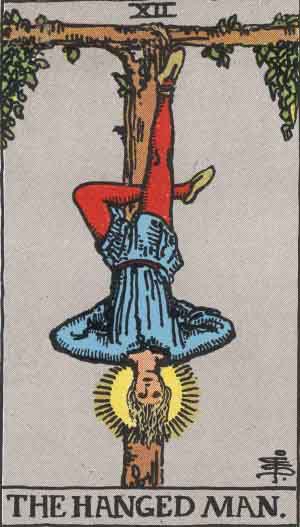
Traditionally, the Arcana bears the name "The Hanged Man", however, other variants are possible ("Victim", "Messiah", "The Hanged God"). Before we turn to the meaning of this card, let us look more closely at the image. Before us is a deserted landscape. The sun is setting, coloring the whole picture. And against the background of these colors, tied by the foot to a crossbar, a living tree (the Tree of Life), or a blossoming hedge, hangs a man. Being suspended by the left leg signifies that the person came to this situation unconsciously. The crossbar is supported by two logs, each with six chopped-off branches – an allusion to the Zodiac. The Hanged Man's right leg is usually bent and crossed behind his left, and he has joined his hands behind his head in such a way that they form a cross. The figure forms, as it were, a reversed symbol of sulfur. The legs at the top signify the spiritualization of the lower nature. The red stockings are a symbol of earthly passions, which are now to be subdued. The "cross" of the legs symbolizes earthly, material reality, and the "triangle" of the arms – the divine plane.
In some decks, the man holds a bag in each hand, from which coins are spilling out (according to one interpretation, this card depicts Judas Iscariot with the money received for his betrayal). The card symbolizes the temporary victory of polarity over the spiritual principle of balance. Thus, to comprehend the heights of philosophy, a person must overturn their habitual way of thinking ("In doing so, he rejects the rules of gold in favor of the golden rule"). The core idea of this Arcana is sacrifice, a kind of crucifixion.
Once Odin, who was a deity not only of the military retinue but also a teacher of wisdom acquired in an ecstatic state, nailed himself with a spear to the World Tree - the ash Yggdrasil. Having hung in this state for nine days, he quenched his thirst with sacred mead from the hands of his maternal grandfather - the giant Bölthorn, and received from him the runes - carriers of wisdom. The same sacrifice is made by the Apostle Peter, who himself asks the Romans not just to crucify him (as they did with Jesus), but to crucify him upside down. There is much evidence that the holy martyrs were in an enlightened and even ecstatic state on their path, and nothing could shake their confidence in the divine reward prepared for them and the crown prepared after death (The Arcana of Death is followed by the Angel). The Hanged Man allows his ego to dissolve entirely in the flow of Life, and this is the only thing that prepares him to encounter the next Arcana – Death.
The Hanged Man (like The Hermit) is described in many religions and myths – he is the one who made a sacrifice to achieve wisdom or a divine state, in the name of higher considerations. He is both Prometheus and Christ. This is the descent of the spirit into matter, accompanied by suffering. In fact, The Hanged Man is not sacrificed by someone – it is his choice and he knows what he is doing. This knowledge is the most important component of the Arcana.
In the highest sense, a person absolutely voluntarily, by their own choice, limits themselves, subjects themselves to "torment", asceticism, meditation, confinement, for the sake of something higher, meaningful to them. In those around them, this provokes a lack of understanding, sometimes a tendency to attack and ridicule him. It is not for nothing that The Hanged Man has a peaceful, thoughtful, sometimes even ecstatic facial expression (no pain, no despair, no protest, no suffering – he trusts his path and feels that this is necessary). The goal is known to him.
From the point of view of mysticism, in the periods between incarnations, our soul fully sees its paths and its karma. Possessing this knowledge, it chooses the circumstances of the future incarnation, with all its inconveniences (and there are no incarnations without trials, everyone has their cross to bear). Thus, like The Hanged Man, it knows what it is going into and for what. Upon the soul's "impact" against matter and the realities of the next incarnation, this knowledge is lost, but it can be found again in the course of life's trials – this is exactly what the halo of The Hanged Man symbolizes.
Carrying within itself a sense of primordial unity and closeness to the heavenly homeland, karma immerses a person in the contemplation of life's waves and cosmic vibrations, - symbolized by the planet Neptune, into that primary principle where human consciousness was born, with which he seeks to merge. Turning off consciousness brings bliss, and in this it is like sleep - but that unconscious involvement in the one, which in sleep is perceived as unspeakable bliss, in reality can turn out to be inexpressible suffering. Whether the mind accepts or rejects the joys and flaws of the world, it is merely their passive reflector: the active role is played by the soul, making its choice, and in the reactions of which the principle of analogy triggers: it reacts to what is close to it, what touches and affects it. But if the soul has joined the world flow to which it owes its life, the mind has nothing to oppose it, since it itself is of the same origin. And consciousness sacrifices itself in the name of the incomprehensible primary principle. One of the meanings of The Hanged Man is the descent of the Spirit into matter. Therefore, the person is depicted head down to the earth. On the card, this situation is depicted by a person hanging upside down on the key of life: he sees the world turned upside down. Since only in an upside-down (suspended) state - the state of searching for one's lost reflection - can a person comprehend the truth and reveal the Neptunian secrets of their soul. In their reflection lies the essential meaning for the inner world of a person. The gift of enlightenment and providence in most cultures is associated with trance and ecstatic states, sacrificing one's ego (again, Neptune).
The Twelfth Arcana perfectly characterizes what is usually considered the Slavic soul - a combination of restlessness and enlightenment. And the planets correlated with this card are also characteristic of this psychotype: Neptune and Uranus. On the earthly astrological level, this card corresponds to the conjunction of Mars with Mercury and means enterprise and even adventurism, while in the spiritual sense - it is the search for new solutions and discoveries.
The Hanged Man is considered a wonderful card for mystical realizations and spiritual growth, esoteric practices, and the cognition of mysteries. Fasts and prayers, meditations and retreats, yoga and trances, penances and confessions, extrasensory perception and prophetic dreams – all this falls under the Twelfth Arcana. And even staying on a deserted seashore or in a distant country, detached from familiar reference points as well. All situations where we turn inward, stepping beyond the boundaries of the ego, and experience humility and merging with the flow – this is the mystery of The Hanged Man. We return changed and enlightened, communed with the mysteries of life, which is exactly what the halo around the character's head on the card symbolizes.
It is unlikely that a person who drew The Hanged Man is happy in their professional field. Sometimes it indeed becomes like the Colosseum arena. This card confidently indicates situations where the querent becomes a "scapegoat", a "fall guy", someone who is "set up" and wrongfully accused, upon whom all blame is pinned. Reprimands, public condemnation, talks behind their back... all this is part of the palette. The Hanged Man often describes the state of being "at the pillory".
Sometimes this card clearly points to making sacrifices for one's professional service – this can be both undermined health and lost money, as well as the burdensome necessity to go to a corporate banquet where one does not want to be, or to give a speech from a podium when they would most like to hide in the back rows.
Under this card, a person experiences their work as hard, bringing neither success now nor prospects for the future.
For a businessman, an upright Hanged Man is most often an advice to start mastering new areas of business, practicing new tactics, non-standard solutions. The other cards in the spread will show what comes of it. This is a complete and unconditional acceptance of a different point of view.
Projects under The Hanged Man often encounter forced halts, usually due to a lack of funding or the sluggishness of management. The card often marks, similarly to the Two of Swords, situations of a dilemma, some delay, and an inability to make a decision. Being late in resolving one's affairs (the suspension of a position).
This is a card of wanderers, vagabonds, travel bloggers, mystics, and shamans. The Hanged Man is also the archetype of the Wounded Healer, who can help only when he himself feels bad.
Sometimes the card marks representatives of "sacrificial" professions, like ballet dancers or secret service agents, as well as programmers, cryptographers, codebreakers.
Financial sacrifices – the need for unprofitable investments, expenses, and "payoffs" associated with health restoration, payment of compensation and fines, and the like. Loss of funds. Loss of housing (of course, there must be other indications in the spread about the risk of such a development of events). The need to economize, cut back on spending, "tighten the belt". Material losses. Loss of income sources. Being forced to sell some valuables, to part with something. Burdensome obligations, for example, those tied to real estate, communicating for a long time a sort of "financial immobility" to the querent themselves - the loss of the freedom to manage funds at their own discretion, since payments must be met.
The risk of being the victim of some financial machinations or signing an oppressive contract from which even Houdini would not be able to extricate himself.
Inability to control what is happening in the relationship, one's behavior, and the partner's behavior. Feeling like a powerless victim and a good case study for a psychotherapist. Being forced to compromise one's desires, passions, and freedom for the sake of the relationship.
Intuitively, it is clear that The Hanged Man, falling in a spread on relationships, symbolizes some kind of crisis. Moreover, not the beginning of a crisis like The Tower, nor the end of it like the Ten of Swords, but a permanent, sluggish crisis that has no end in sight. However, the finale is sometimes seen – in ephemeral, unsettled relationships that "hang by a thread", the appearance of the Twelfth Arcana brings a great risk of losing everything.
Often in established relationships, this card corresponds to the feeling that everything has frozen or even died. Apathy, dullness, boredom, decline. A helpless standstill, powerlessness, a crisis; this state lasts longer than one could imagine and goes further than one would like. The feeling of an "evil eye", the relationship is unfruitful, there is no sex whatsoever, and what comes next is unclear.
In combinations with cards hinting at a love triangle (for example, The Lovers, Three of Swords, Three of Cups, Six of Pentacles), The Hanged Man shows a person "crucified" between two poles and clearly states that everyone is suffering. In this situation, there are no winners, and attempts to make everyone happy end in indescribable suffering.
The Hanged Man does nothing because he cannot do anything and has no idea what could be a way out in this situation.
It is perceived as a vicious circle. In theory, it can be transformed, but to do so, one must start acting differently. This dilemma can only be resolved by making a sacrifice, giving up something that was natural (usually, this means – choosing the fire by which you will warm yourself in the future after all). But it's not that simple. In relationships, such a meaning of The Hanged Man as narrowness and limited conceptions often manifests itself. The result of being bogged down in contradictions and being caught between two fires is emotional exhaustion and depletion, and even more importantly - both fires go out.
For single people, The Hanged Man marks periods of a vain search for a relationship, indicating that creating a couple is not to be expected in the near future, since the soul definitely faces other tasks. Fruitless attempts to meet someone and start a romance will not add joy to the querent. The card may indicate that creating a relationship has become something of an obsessive "idée fixe", while personally the person is not ready for it (in particular, not really ready for the sacrifices and altruism that spending time together day in and day out, night after night, will require). In general, The Hanged Man often unflatteringly reports – selfishness and a fixation on oneself and one's needs, that is all you have right now. And until this changes, fate will not offer you a wedding limousine, in particular. After all, marriage crowns one with "martyr's" crowns, and the unreadiness to accept trials and limitations is a poor foundation for it.
This card in itself is one of the indicators of a sick person. Chronic illnesses, psychological disorders, all sorts of addictions, especially those related to being in an altered state of consciousness and "getting stuck" on something – the spectrum of its manifestations is very wide.
A stage of withdrawal, masochism, asceticism. Exhaustion, undermined health, debility, depletion.
Loss of mobility (for example, a broken leg)
In a certain context, it can point to severe conditions: polytrauma, coma, consequences of chemotherapy or radiation therapy, a stay in intensive care.
Black magic influences and attempts to interfere in a person's subtle structures also pass under this card.
Reversed, it means that a person is not ready to perceive the new, therefore, studying and reviewing old views are unlikely. Sometimes the card means an excessive absorption (egocentrism) in one's own affairs (the opposite of a selfless sacrifice in the name of others), as well as a useless chase after an unattainable dream. The reversed Hanged Man categorically refuses to make sacrifices in essence. A very frequent meaning of the card is petty or hypocritical sacrifices. A person pretends to care or invest a lot, but in reality, these are performative actions, and by and large, they don't even bear any hardships, although asserting the opposite.
Another option for interpretation is the uselessness of the sacrifices, their wrong direction or fictitiousness. There is no use in such sacrifices. As an option – attempts to "look fresh" with the help of a cream at a fabulous price instead of a healthy lifestyle in general, observing which, of course, requires much greater sacrifices (sleep, sports, diet...) or buying with money what should have been acquired through one's own labor.
In the reversed Hanged Man, there is a lot of egoism, posturing, and immaturity, despite the fact that in reality the ego is in no way restrained and the person does not even imagine how to do it. False gurus and false prophets also pass under this card – they are great masters at lecturing on how to live and demanding spiritual feats from those around them, while they themselves often lead a very low lifestyle. This is a card of broken commandments and promises, "relapses" in the middle of an educational, healing, or upbringing process. Sometimes, under this card, a person engages in God-fighting and zealously resists fate, even though they feel that the sands are shifting and efforts only exacerbate the situation. The reversed Hanged Man resembles The World; he claims to own everything and be free in everything, but in reality his hands and feet are tied, and he is far from the free cosmic dance of the Twenty-First Arcana. The 12th and 21st Arcana are indeed connected.
This is a very deep topic. Here there is a denial of bonds that actually exist, a showy freedom that is not and cannot be in the given circumstances. The difference between The World and the reversed Hanged Man is as great as between a high school graduate and a truant. Perhaps they are both having fun and entertaining themselves. But if the graduate is already truly free from classes and can not think about anything, the reality of the truant is completely different. Deep down, he is well aware that it will remind him of itself in an unpleasant way, and there is no getting away from it.
T-h-e-r-e i-s n-o e-s-c-a-p-e.
The upright Hanged Man renounces himself, and the reversed one - obligations. This is a desire to insist on one's own – and at the same time a clear indication that in the long term, the attempt is doomed to failure.
It is interesting that in old sources, this is an indicator of the common people.
The Hanged Man corresponds with the Two of Swords and the Seven of Pentacles, and emotionally - with the Eight of Cups.
The action of The Hanged Man is weakened by The Chariot and The Magician.
With The Fool – complete submission to doom and fate at the present time. Possibly a strong religious faith.
With The High Priestess – waiting, laying low, a lack of active moves.
With Strength – playing for time
With the Ten of Swords – sacrifice, martyrdom
From the pier fished the Apostle Andrew, While the Savior walked on the waves. And Andrew pulled out gudgeons from the water, While the Savior pulled out lost souls.
And Andrew cried out: "I will leave the pier, If you reveal the secret to me." And the Savior replied: "Calm down, Andrew, there is no secret to see. Do you see the cross rising there, on the hill, With a dozen soldiers below? Go hang on it for a while. And when you get tired, come back down, To walk on the water, to walk on the water, To walk on the water with me." ("Nautilus Pompilius")
Mister X (the reversed Hanged Man corresponds to his performance in the role of an imposter-aristocrat, which essentially corresponds to his true, but lost status, and in this sense the reversed Hanged Man is similar to The World, shackled and not entirely free in its dance)
"Remember! Selflessness is a divine law from which no one is exempt. But expect nothing but ingratitude from people for your good deeds." (Papus)