Eight of Cups
Cups — Minor Arcana
Detailed Interpretation
The Eight of Cups is one of the three "breakthrough" cards, signifying a sad farewell (along with The Chariot, meaning the hero's joyful "departure" to the battlefield, and the Six of Swords, symbolizing a journey into the unknown, to new shores). It says that a person is somehow involved in the process of saying goodbye to the past, a transition period when their life goals and priorities are changing.
The most traditional meaning of the Eight of Cups is the "abandonment of previous plans." What recently excited and inspired (the "visions" of the Seven of Cups, which precedes the Eight) loses its appeal; the person's interest in it wanes, they stop living it for some reason, realizing that this is "not a life." Usually, the "fairy tales" of the Seven (these can be love affairs, career matters, or anything else) become quite exhausting, turn out to be quite emotionally draining; the person feels they are giving more than they are receiving. And so, the moment comes when they turn away from them. This card can also describe saying goodbye to old sorrow, old ideas, connections, and habits.
It is the determination to step onto a thorny path in the name of higher considerations, leaving the old life behind. But what these considerations are and what kind of path it is, the card does not say; the surrounding Arcana can provide a clue.
This is a "change of power" in the head - the person realizes the impossibility of the old path for themselves, by their own free will leaves something well-known for the sake of the unknown, will exchange one set of worries for another. It is believed that this is a harbinger of changes in life that will affect the querent just as positively as they may be perceived negatively at the present moment. A series of successes lies ahead, but right now, perhaps, something dear to the heart has to be sacrificed.
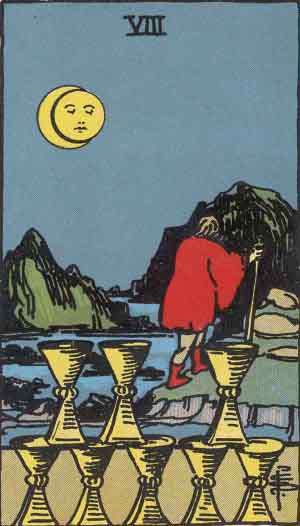
A specific feature of the Eight of Cups is that this decision is voluntary, but it is made with a heavy heart in a situation that feels hopeless. In the most traditional sense, it depicts withdrawing to a monastery. The card shows a person oppressed by something, leaning on a staff, resolutely and humbly walking away along a rocky shore, while behind their back stand eight cups, symbolizing their past successes and triumphs.
Unlike the Five of Cups, nothing is overturned or spilled here; it's simply time to move on. Perhaps the person had found something extraordinary, and yet for some reason, it has to be abandoned. The red cloak on the departing figure symbolizes the freely made decision. Former interests, attachments, worries, and desires are left to their own devices; he leaves on an uncharted path on his journey alone, because he simply cannot stay. At the same time, submission to fate is expressed as letting go of control and giving up trying to predict the results - come what may!
The most important point described by the Eight of Cups is that one thing is devalued for the sake of another. Perhaps the person has realized the flaw in their previous life. And its second feature - this card seems to say: the hour has struck! It is not without reason that it depicts an eclipse, emphasizing the importance of the time factor. In a negative environment, it can indeed indicate a kind of eclipse, a "dark hour" of life, when the situation is hopeless, strength has dried up, the battle is lost, and nothing is needed anymore (the collapse of the ego). In a more positive sense, the person unties themselves from the past, abandons the familiar swamp, and goes into voluntary exile - to evolve. And the surrounding cards will suggest what the meaning is and what the result will be.
Under this card, we say goodbye to what leads us astray from the proper path, whether it be people, activities, or habits, in order to concentrate on what fills life with true meaning.
It shows that we must leave our familiar surroundings, part with people or things to which we have "attached our hearts" (and not always in a good way), and set off on a long journey, into an unknown future, changing our lifestyle. In any case, it indicates that we have not been banished; it is we ourselves, of our own free will, who have decided to leave (another matter is that we might not have had any other choice). The "heaviness of parting" lies in two things: we must leave what is dear to us, and we do not know what awaits us. Emotionally, this is a rather difficult card. An unknown and unpredictable future can be perceived as harboring a threat (especially if there are cards nearby indicating self-defense, like the Nine of Wands or the Two of Swords).
Crowley places emphasis on an environment that is dangerous for the person, which somehow poisons and destroys them, and they generally understand that they need to leave. But it can also just be an inert and stagnant environment that provides no opportunities for development and does not allow one's creative potential to unfold.
By the way, the meaning of the card also includes the possibility that the person is making a mountain out of a molehill - things are not so scary, not so important, and not so grandiose at all; they will realize this as soon as they take the first steps and see everything from a closer distance.
Joyless, but resolute. Two different modes can dominate here - either lethargy, emptiness, fatigue, the inability to mobilize, or a very decisive, albeit sad, departure on one's own path, a rejection of the past. In both cases, there is a crisis of genre. Both states accentuate Saturn, only in different ways, but the common element is gloom and joylessness.
Characterizes situations of quiet depression, when everything is done against one's will, contrary to desires. There is something here of the state of an alcoholic sobering up after a binge. Often the meaning of the card according to Crowley comes into play (and here, too, there is a depressive flavor) - lethargy, laziness, idleness. Utter boredom and stagnation.
According to Crowley, the "exhausted" Eight of Cups follows the orgiastic dissolution and rapture of the Seven of Cups. It is a kind of hangover card, indicating that a period has passed in the querent's life when there was too much pleasure, self-indulgence, and pandering to one's passions and desires. A departure from what has exhausted itself, in search of a new path. This is depression, possibly the grief of loss, but also a search for renewal in the depths of one's own soul.
The card may indicate a person of a contemplative mindset, keeping a distance from everyone around them, but this is usually not without reason. They have a past that has tuned them to this wavelength. It may look like shyness, gentleness, timidity, modesty, but still, this is not the indecisiveness of a novice, but rather the old wounds of someone who has been through thick and thin.
The waters of the Eight of Cups are simultaneously an IV drip and a detergent for the suffering soul. By the way, there is plenty of decisiveness here – the person leaving under the Eight of Cups is guided by a special force, and no matter how bad they feel, the call of the path and internal excitement do not give them peace, providing the necessary energy (symbolized by the red cloak). This is the card of vagabonds and travelers.
This is the mystery of wandering, of moving away from abundance, wealth, and past achievements. It is the courage to "walk past" what at another time one would have gladly feasted on, and it is a freely made decision in this situation. The necessity of self-limitation, of denying oneself something. The manifestation of inner strength in one's non-involvement in the situation, withdrawal into one's own world.
Patience, the ability to say "goodbye" and let go of something in old interpretive texts hide behind words about bashfulness, modesty, restraint, shyness, and chastity. Behind this, one can guess the images of all those women or men who for centuries, for various reasons, withdrew from the world, giving up their piece of the pie at the feast of life. One of the ancient interpretations is fleeing from temptation. A person prefers to lose what they could have gained; they would rather refuse and turn away than grab the opportunity presented to them.
For example, they will turn away from the poured cup of love and take the lonely path of The Hermit. Therefore, one of the traditional meanings of the card is missed opportunities (in the Four of Cups, the person doesn't notice them in their mood, unconsciously; in the Eight, they see everything but walk away). Traditional interpretations insist that the person will get what they hoped for, including love, if their own caution and shyness do not paralyze them completely. The presence of the Eight of Cups in a spread says that currently the querent is involved in some situation (an enterprise, relationship, project...), and in theory, everything is developing well, but they are terribly insecure, too shy to take the necessary steps, and as a result risk losing what they deeply want to get! Here it is very important to finally go out to meet your happiness.
In the Upright position, the card can indicate qualities such as practicality, knowledge of social rituals, and the ability to be in harmony with people while maintaining a distance. In old interpretive texts - a tendency to live for today, not thinking about the past.
Under this card pass people who prefer to go with the flow, wander aimlessly, search for "I don't know what," and less often professional travelers.
Eight is the number of transformation. There is an opinion that the Eight of Cups describes a felt inner necessity to leave a stagnant situation in search of new stimuli. There are types of "harmony" whose stability is unbearable for consciousness. The card describes a successful ascent to a new stage of development. And this, as a rule, does not come for free and on an ordinary level requires some sacrifices. In Masonic symbolism, this card personifies the candidate for initiation into the mysteries, surrounded by the eight masters of the Lodge. He says "goodbye" to worldly goods and earthly comforts.
In essence, it is the card of Taking Vows. A person consciously and by their own free will leaves the temptations of everyday life for the sake of a high and narrow path, a plunge into the inner world. Much connects this card with The Hermit, just by looking at it. This includes the image of a wanderer in a cloak, going their own way, and the higher goal of this Arcana - spiritualization in the depths of solitude. The difference is that The Hermit is calmer and more whole. There isn't that self-denying determination and longing in him that permeates the Eight of Cups.
The eight cups placed there look as if the set is incomplete, something is missing. And somewhere in the distance lies something most important, invisible (here the card echoes the Four of Cups, taking it to a different octave). What they have in common is a journey inward and the search for spiritual truth. Allegorically, the Arcana depicts a quest - a knightly wandering for one's soul (symbolized by the Grail, the ninth cup). The mountains speak of the search for spiritual heights, the wanderer's staff is a symbol of will and wisdom.
This card is emphatically related to astrology.
Firstly, an eclipse is depicted in the sky on it. This is both the meeting of the lunar feminine and solar masculine principles, and a certain fatal moment. If its appearance in a spread occurs exactly during this period (or the period between eclipses), its meaning is exacerbated, especially in the sphere of personal life.
Secondly, we can assume that the card is related to an aspect configuration like the "Axe" (two sesquiquadrates forming the "blades") with a square at the base. This configuration inclines a person to cut off the "past" over and over again, to run away from it wherever their eyes may look, to start all over again.
The first decan of Pisces symbolizes an inner need for the highest and an outlet to mystical spiritual sensations, to the inspiration that is born when a person surrenders their will to the unknown. This is a calm immersion in the waves of life and a fatal resignation to what is happening, based on the understanding that the life process as a whole is wiser than the claims of an individual. This decan is ruled by the planet of predestination, Saturn (according to the modern system - Neptune, which predisposes to contemplation). Saturn emphasizes the departure from traditional emotional canons to one's own sensual criteria, which secures the final emotional break with the past perception of the world. People of this decan are more characterized by a subjective perception of events, and they are prone to a fascination with the surreal and romantic anxiety about things that do not exist in objective reality - but which, in all likelihood, lie at the bottom of our collective unconscious.
This decan symbolizes a strictly individual mystical path of a person, and therefore its representatives are sometimes distinguished by equanimity, reticence, a tendency to solitude and a feeling of rejection, as well as some gloom. But it is also the ability to transform oneself without conforming, but by remaining oneself and not losing one's inner core. The card depicts a man who has left behind all his past experiences and internal achievements - eight full cups - and with a traveler's staff walks towards the dark mountains of the unknown.
Above him is the Sun in conjunction with the Moon: a new moon astrologically symbolizes peace of mind and the beginning of the new, while a solar eclipse, on the contrary, represents the dangers of life's depths, not illuminated by the bright light of reason. The card can also be interpreted as the discovery of new possibilities in our psyche and ways of rationally understanding them. Saturn gives a test of isolation and independence; it destroys all that is false. If a person (or the bond between people) passes this test, they become extremely stable and strong. Saturn always requires the implementation of a certain program, and therefore limits the emotional life.
Light and shadow (advice and warning)
Advice: respect your past, but leave it behind and find your own path. Leave the beaten track - it does not promote growth. Some lessons can only be learned far away from familiar and comfortable conditions. New places, people, and events will help you look at things from a different angle. It makes sense to give up habits, people, ideas that have filled your life for years, and set off to meet the new. Change your lifestyle, go on vacation, rest. Another piece of advice from the card: earn the honor, stop being modest, and grab opportunities instead of shyly hiding from them.
Warning: do not run away from the situation. It may seem like a logically and morally justified step almost out of the realm of heroism, but in reality, it is only the path of least resistance. "Those who love do not renounce." It is not the time to give up what is familiar (or your intentions) and wander wherever your eyes lead and where the grass is supposedly greener. Let well enough alone, and the best is the enemy of the good.
Heavy atmosphere at work, lack of motivation, despondency, brewing difficulties. Stagnation in business, the feeling of a "swamp."
Everything is done against one's will and contrary to desires.
The need to leave a hopeless situation, to leave a job that the person has already outgrown (or which they never liked).
Sometimes – obstruction, mobbing, bullying of an employee, forcing them to leave (there should be other indications for this, the most eloquent of which is, of course, the Five of Swords). Change of power in the organization.
The need to part with unjustified expectations and set new goals. A hopeless enterprise - it promised a lot, but in reality turned out to be total nonsense. Sometimes the point is that the issue under discussion is not as important as it seems. The actions taken will expose its true, slight value, after which it will be possible to switch from this "huge problem" to something else.
Some authors are inclined to interpret the Eight of Cups optimistically, as a sign that the querent will achieve the implementation of what was conceived without much difficulty, moreover with the help of colleagues and acquaintances.
Change of profession, line of work.
Taking a sabbatical or academic leave is also covered by the Eight of Cups.
Under this card, people leave their homes, say goodbye to what is familiar. Getting rid of unprofitable enterprises, burdensomely expensive housing, projects that may be dear to the heart, but do not bring a profit.
Crisis, the end of prosperity and abundance, decline, stagnation, recession. Sometimes these are attempts to hold on to something already destroyed, to preserve the remnants of former luxury.
Oh, the situations and subtleties this card reflects! To figure out which of them is more important in a particular spread is the task.
In the Eight of Cups, the hero says "Goodbye!" to their hopes and goes into voluntary exile, with a heavy heart. They don't just want to leave, they believe they must do it. Every step hurts, but it is necessary and justified.
This is a difficult card in the area of personal relationships, and various scenarios are possible here, but almost all of these scenarios are united by one meaning - the collapse of an already doomed union. The only difference is how dear this union was to the person, how dramatic the parting is. This card regularly appears when the topic of ending a relationship comes up, and it is advised to consider it as a sign that there is no point in holding on to what is no longer there. The best thing to try to do is to end the relationship on a pleasant note.
Because the time has come for something else. "The time has come" - the symbol of the eclipse depicted on this card. This is not thrilling; rather, one must, with a heavy heart, turn one's back on something wonderful because it is again NOT THE TIME.
A fairly typical case is parting due to distance or moving. Also, the "third one must leave" situation often manifests itself. It is very possible that under this card, in a person's life there are secret meetings with someone they cannot meet openly (for example, because they themselves and/or the other are family people). But it seems that a line will be drawn under this connection, no matter how much both regret it. Observations show that in such a situation, the legalized union or the one that existed before the appearance of the "third" is usually preserved, even if this particular connection was emotionally richer. Here again, the meaning kicks in that something beautiful was found, but it must be abandoned.
Less often, it is simply alienation and dissatisfaction with the relationship.
Thirdly, this can be a decisive step onto a new path, without much enthusiasm, but the inferiority of the previous life is clear to the person. This can be a rake retreating to a monastery, or entering into marriage with a heavy heart for someone who has avoided it for a long time. A person says "goodbye" to their former comforts and hopes, knowing that it must be done. The Eight of Cups covers the case when a person breaks with their former life, quite cheerful and satisfying, in order to enter a path from which they do not expect a special blessing, rather out of a sense of duty, but this duty is understood secretly and deeply. They do it seriously and with a sense of doom – they have decided, it must be done. Marriage here can very well be perceived as a monastery ("a dashing rake takes monastic vows"). From now on, no casual affairs (one of the old meanings of the card is modesty, correctness, and decency).
Total devotion to one's better half becomes the result of some colossal impact on a person, either internal (a serious transformation) or external. This is an indicator of a person making a clean break with their old ties. They take on new obligations and gradually get used to a new lifestyle.
The Eight of Cups is a card of heavy, inert feelings. To some extent, it's even good if it concerns an already ended relationship and expresses sadness and longing for the lost, separated, and gone. But if the relationship (marriage) is present, then it is a significator of their fair hopelessness.
It reflects a person's powerlessness in the current situation, unjustified hopes, disappointment, despondency, emotional exhaustion... and stagnation. Brewing difficulties force them to realize that changes are necessary, but to carry them out means to leave, and that is exactly what there is not enough powder for. It seems like there's no reason! The swamp looks quite decent. The content of this card generally gravitates toward "numbness" - and a heart that has survived a parting can become numb, just like a heart that does not dare to survive it. Here, one way or another, the element of emotional blocking of feelings is strong.
Gerd Ziegler gives a wonderful description of the Eight of Cups: "The water of emotions is standing still, not renewed by a single spring. It begins to stagnate, and the fogs of staleness rise to the heavens, obscuring the light of clarity. The two remaining lotus flowers continue to pour out their energies. But in the given situation, these are futile attempts. The stale, stagnant water immediately swallows up their small amount of freshness and vitality. It drowns in a slow, viscous swamp. You have already spent enough of your energy on people who give nothing in return. You have filled them with your energy, but they were like bottomless barrels. You feel empty and drained, this picture speaks of an interpersonal situation and this may be an old behavior pattern - to always direct your love to such people, from whom nothing comes back. The more you try to revive a relationship that is stuck in a rut, the more powerless and empty you feel. Time to reflect on yourself, set some limits and say 'No'."
In marriage, this is a card of incomplete success and regret, of a certain disappointment in family life. Both he and she feel as if they are missing something, and something irreplaceably important. As if somewhere in the distance - or, perhaps, very close by - there lies another, most important cup, which is exactly what is missing for complete happiness. Yes, the person themselves guesses this, some force, internal excitement does not give them peace. Reversed means that the mistake has already been made, and, perhaps, it is worth considering how to change your attitude towards life, learning to appreciate what you have.
The most optimistic meaning of this card at the level of love relationships is difficulties that are overcome through patience and tact, that is, two strong individualities rubbing against each other. Some authors believe that at the level of the Eight of Cups, a fully conscious emotion, having taken fairly concrete forms, undergoes coordination with logic, with reason, that is, there is a harmonious combination of desires and passions with the mind. This is a situation when love does not harm business, and business relationships do not harm love.
The Eight of Cups, appearing in a reading about a relationship with a partner (or simply a person of interest), predicts a period of cooling: this card is a sign that all personal matters are better put off "for later," until a more favorable time.
The relevance of self-recovery under this card is obvious.
It indicates exhaustion, lack of energy, lack of vitality, and a clear need for rest. You need to change your environment - the current one has already drained you to the bottom. Resting at a water or mountain resort can play a positive role. It is believed that the water on the card reminds us of the healing power of the sea.
The worst that the Eight of Cups describes are suicidal-depressive tendencies, when life is not sweet, but one is too lazy to settle scores with it. It may indicate an intention to leave life (of course, the context must be taken into account when interpreting).
Sadness, depression, emptiness. Various forms of escapism, fleeing from reality (among which narcotic methods are in the lead). Attempts to fill the "bottomless abysses" of the devastated soul - with excessive food, shopping, or collecting random partners. Mary Greer points to insomnia and somnambulism (sleepwalking).
Sometimes – a viral infection, in general, an unhealthy environment in which a person finds themselves.
The old interpretation is extremely positive: enormous happiness, great joy, stormy success, celebration, pleasure, fun, satisfaction. Most often, all this applies to an event about which the querent knew, or already expected. It's something like the biblical joy of a shepherd who found a sheep that had strayed from the flock on a mountain slope. Holidays, amusements, entertainment.
This card can indicate sudden gifts, and quite serious ones at that (Scorpio is at work, a sign that does not waste time on trifles). The desire to give someone a gift is also not excluded. In general, the interpretations emphasize the desire for material success for high goals (for example, to earn money to help someone or make someone happy).
The emergence of a new sphere of activity.
A new love affair (it is possible that it is out of inertia, a ricochet from the old one - the emotional charge after the breakup remained, and it is directed at a new object). Love for those who left.
Modern tarot readers still believe that the energy of the Reversed Eight of Cups hinders the further path, emotions and unfulfilled desires do not allow one to leave and leave the past behind (for example, it is impossible to untie the knot of an outlived relationship). Perhaps the time for this has not yet come. Perhaps the person has already made a mistake by leaving what should not have been left and not appreciating what was given to them.
The card may mean canceling a vacation or a trip. It also refers to "journeys to nowhere," paths that lead nowhere. For example, a person cannot stand the system, restrictions, floats with the flow, but feels only hopelessness, aimlessness, and decline. One of the meanings of the card is redemption, paying debts.
With The High Priestess – breaking of relations.
With The Hermit – strengthening of influence, search for deep meaning, a state comparable to taking vows, withdrawing to a monastery (at least temporarily). Breaking of relationships, going one's own way.
With Strength – inner fortitude, strength of a made decision, confrontation with some habit, attempt to overcome an addiction
With Death – departure, parting
With The Devil – a person is moving towards decay due to bad habits, or is drawn into some dangerous ideas (like joining a cult)
With The Sun – this card weakens the influence of the Eight of Cups
With Three of Wands – a trip, entering new territory, opening up new horizons
With Eight of Wands – the end of a life stage, the cards strengthen each other
With Nine of Wands – persistence, confidence (close to a combination with Strength)
With Six of Swords – mutually reinforcing meaning.
With Ten of Swords – burning bridges, irretrievable departure, suicide.
Reversed with Three of Cups – a debtor will pay their debt.
The destruction of Sodom and Gomorrah (according to Banzhaf and Akron)
Jane Eyre, secretly leaving Thornfield and setting off to wander.
Swamp, logjam