Seven of Cups
Cups — Minor Arcana
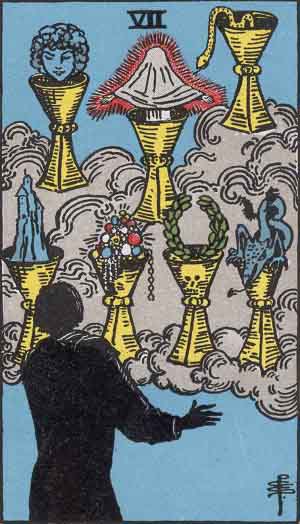
Detailed Interpretation
This card indicates the presence of various possibilities; their abundance is confusing, making it unclear which decision would be best to make. When this card appears, it is not easy for a person to define their own desires and understand what they truly want. It can also hint that we have once again engaged in wishful thinking. On the card, we see mysterious cups filled with various illusory images and visions, while the dark figure in the foreground is a symbol of bewilderment. Its presence in a spread can suggest that for now, there is nothing clear, permanent, definite, or substantial.
Sometimes (especially in a professional context), the card hints that the whole matter is nothing more than an illusion, or speaks to the instability of achievements. The Seven of Cups is a card of fog, mirages, and phantoms. It shows that we succumb to deceptive hopes and false ideas, that we deceive ourselves and allow ourselves to be deceived. As a rule, it acts as a harbinger of sobering up, meaning disappointment. The Seven of Cups can indicate that the querent is overcome by certain temptations. Perhaps enticing offers are being made to them from all sides, or perhaps they are indulging in certain fantasies themselves. The presence in the spread of cards like The Magician or The Devil might hint that someone is manipulating them through their desires and using them for their own purposes.
Ancient interpreters are unambiguous in this regard: the cups symbolize the dreams and doubts of a person pondering what to choose, yet in reality, it is all a false choice. All these gifts are merely a temptation, an illusion: no matter what the person chooses, it will not bring them happiness. The chase after mirages ends in emptiness. This card appears when it seems to the querent that they know all the possible options and merely have to choose one of them. But in reality, in this case, they must find yet another option, completely different and as yet unknown, or at least postpone the decision, for right now it simply cannot be the right one. The appearance of the card has always been considered an indication of "unfulfilled hopes", "unrealizable desires", "false promises", and "far-fetched decisions".
The meaning of the card—Imaginary Success—can be interpreted in two ways. On the one hand, it is an apparent, illusory success. If with the Seven of Swords we deceive, then with the Seven of Cups we are usually deceived—the nominally united Cups and Swords are always connected on a deeper level. On the other hand, it is something like visualization—a person paints before their inner eye various scenarios of events, what could be. Visualizing success is sometimes important. One of the old psychological theses comes to mind—if you cannot even imagine how you achieve it, then your brain is categorically unready to help you on this path... it literally "cannot imagine" how it could happen at all. So visualizing the fulfillment of a desire is not a bad thing. However, as they say in Odesa, seeing the pie, having the pie, and eating the pie are three entirely different things. And it is better not to forget this when the Seven of Cups appears in a spread. This card is exactly about "seeing the pie".
Whether one will manage to taste it and how beneficial it will be for their health will be prompted by the other cards in the spread.
Sometimes the Seven of Cups describes bad company, associating with people who behave poorly, escaping from reality, engaging in fraud, or seeing no harm in addictions.
At best, the presence of this card in a spread points to an emotion that inspires a person to certain deeds, and also indicates that they have a choice. The Seven of Cups has another interesting feature—it promises us help and support from those from whom we did not expect it, provided we manage to swim out of the "I don't know what I want" fog and develop some intelligible intention that makes sense to those around us. In this case, others come to the rescue, although their help may take an unexpected form.
"Spoiled for choice." "I don't know what I want myself." Confusion due to the presence of several different possibilities, all equally uncertain. Many desires, many options. It is difficult to set priorities, understand one's goal, and move on to concrete actions in the chosen direction. Combined with Swords, the internal conflict is felt quite acutely. An abundance of fresh but vague ideas in the head, but nothing concrete, permanent, or substantial yet. Building castles in the air, fairytale prospects. A lack of realism, but also an artistic and creative uplift, great creative energy.
Regulation, control, and certainty are not characteristic of the Seven of Cups. It is a flow, an activation of fantasy. It is a state where a person daydreams, and often dreams not of something clear, permanent, and substantial, but simply allows the stream of imagination to carry them into the unknown. This is contemplation, unfocused meditation. Since the card has appeared, this is a necessary process at this time—the mind is exploring new possibilities, even distant ones, shedding the routine of rationality. This can lead to a better understanding of the soul's true needs, to the creation of new, happier goals. The card calls for long sleep, peace, relaxation, meditation, recovery of strength, immersion into the world of the unconscious, waking dreams, a kind of SPA for the soul.
Escapism, flight from everyday life, loss of connection with the real world, a tendency to disconnect from external impressions, an altered state of consciousness.
This Arcana can truly be defined as the "sleep of the soul," in which it gathers strength by indulging in dreams, contemplates the images of the inner world, and heeds the signs and prophetic thoughts that bring rebirth. This dream, containing vivid pictures of the subconscious, can be either beneficial or unhealthy, and the dreams can be either completely phantasmagorical or relevant to reality. Sometimes—tears, a hysterical state, because not everyone is capable of accepting both the attainment and the non-attainment of their ideals. It happens that the card points to an escape from reality as a result of depression and empty illusions accompanied by complete passivity.
This card characterizes a person as a creative individual, full of fantasies and often withdrawing into a fictional world from the real one. Living in dreams—but ultimately, it's not the worst place to be. Humanity would have been left without art if no one lived there! Sometimes the Seven of Cups points to creative, as well as clairvoyant and mediumistic abilities. A person whose emotional life is under the patronage of the Seven of Cups is so absorbed in their dreams that they sometimes forget about the problems and worries surrounding them (it is exactly in this category of people that there are many absent-minded individuals prone to neglecting their duties as insignificant).
There is an opinion that a person of the Seven of Cups, possessing attractiveness, plays with other people's lives, constantly changing partners without thinking about a sense of proportion.
In practice, we more often encounter, perhaps, strings of fantasies coupled with an inability to practically make the right choice. This "enchanted wanderer" often considers themselves very talented and builds castles in the air, taking advantage of the fact that their consciousness expands with intoxicating ease. They may indeed possess giftedness, especially when it comes to the arts, but between giftedness and talent lies a terra incognita that frightens them immensely, called "work." Laziness, indulging, and scheming are much dearer to their heart than real effort. It is difficult for them to make decisions; they often overestimate themselves and gladly listen to those who paint brilliant prospects for them. On this matter, Philadoro writes: "The violent wind of imagination turns consciousness like a weather vane, directing it towards dreams, temptations, and frivolous plans. It is necessary to restore relations with reality, starting with its simplest foundations."
At its worst, the card speaks of susceptibility to temptations, a reckless indulgence in one's desires. Its dark side—alcoholism, drug addiction, substance abuse, internet addiction, in short, anything that substitutes one reality for another, making the person feel that "it's easier this way." It can simply be laziness, a lack of initiative, and a tendency to drift "without rudder or sails" (with a deep conviction that, generally, everything is within their reach and under their control, they just don't feel like making the effort). In a psychoanalytic sense, the Seven of Cups corresponds to regression, an unconscious infantile striving to become a child again and plunge into the boundless satisfaction of the Id, returning to childhood behavior models. The search for a transcendent experience becomes merely an escape from reality, with its boundaries, responsibilities, duties, and all the rest.
A literary character corresponding to the Seven of Cups could be considered Dorian Gray—as Crowley writes, "external gloss with internal decay."
This is the card of the power of imagination, giving life the taste of waking dreams, castles in the air where the soul in flight can find refuge.
It is a vitally necessary enchantment with dreams and strong feelings, a fascination with dreams, the astral light of spiritual life. Blissful escapism that colors the gray everyday life (It’s a kind of magic!). The secret of this Arcana is that it is ALWAYS present in our perception, to a greater or lesser degree. Turn off the energy of the Seven of Cups entirely, and life will seem terrible, ugly, flat, and empty. It's like looking at a person and constantly "seeing them as they are," that they have a skeleton, arteries, and intestines with all their contents. Well, the Seven of Cups helps us to see the "expression of the eyes" and not the "gleam of the mica body." And sometimes even to attribute an expression to those eyes that they don't have at all, or to create those "eyes opposite" entirely in our imagination.
The merging of the imaginary and the real falls under the purview of the Seven of Cups. It is the card of passionate desires, limitless imagination, wild fantasy, magic, and witchcraft. In fact, the Seven of Cups, with all its illusions, meditations, photoshops, and waking dreams, poses a staggering question: what is HAPPINESS for you? Just like that. What is happiness for you, what delights you, why and about what, exactly, do you dream and yearn, what attracts and excites your soul?
It raises both the question of the level of this very "happiness" and the question of the illusory nature of our ideas about it (an indescribable number of people over the centuries have realized that obtaining what they desired, what they raved about and passionately sought—whether it be a royal crown, lots of money, victories over rivals, brilliant fame, physical beauty, or a "happy" family meeting all the canons—somehow did not make them happy, and in some cases even "made things worse than before").
Perhaps the person is in search of spiritual knowledge; meditation, contemplation, prayer, and attuning to one's inner self serve this purpose. Mystical (or, at any rate, quite subtle and unusual) experiences, an interest in esotericism or art, and the search for the meaning of life all pass under this card. Altered states of consciousness, after all, arise not only as a result of using psychoactive substances. Music, a film, a photograph sometimes also evoke an unusual state of consciousness—deep emotional experiences, inspiration, revelation. They might even be perceived as signs of destiny.
At the same time, the Seven of Cups can more often be viewed as a warning—all these daydreams and fantasies, while offering fleeting comfort, contribute nothing to the real development of the spirit and personal fulfillment. It's just... a trip to the SPA for the soul. Mary Greer writes that seven is a number of testing and trials, and the Seven of Cups can point to psychomachia or a battle for one's own soul with a crowd of phantoms besieging it. Heroes undergo such a trial in many fairytales, arriving in an enchanted place where everything seems so good that they forget why they came in the first place—a sort of Fata Morgana castle. Why look for something or save someone when it's so great here? But as long as the hero wanders through enchanted gardens and drowns in pleasures, their journey stands still; they lose time, gaining nothing. Arthur Edward Waite called the Seven of Cups "fairy favors."
If the first decan of Scorpio reflects the power of passion, and the second the elevation of love to a universal one, then the third decan of Scorpio symbolizes the development of feelings in depth. This is the penetrativeness and dramatization of feelings, allowing a person to access the mysteries of life and death. Reaching an extreme peak and sublimating into a single impulse, emotions bring a person face to face with their main problem—and the potential with which the feelings rushed to solve the problem allows the person to break free from it. This decan is ruled by Venus—proclaiming the triumph of life over death, and therefore, in this decan, the extremity of feelings does not destroy a person but is one of the natural manifestations of life. However, the freedom and emancipation of feelings achieved here lead to temptations, as feelings take precedence over reason. Accepting the world as it is and discarding past illusions, the person is inclined to indulge themselves: internal power gives them a sense of permissiveness.
The card depicts symbols of the vices that arise when feelings overflow: this is self-delusion, egoism, pride, jealousy, envy, laziness, and greed. There are different opinions on how the images in the cups and the temptations relate. For example, the golden wreath can symbolize the temptation of glory and the sin of vanity (Vanagloria), and the castle high on the rock—selfishness and pride (Superbia). The female head relates to sex and lust (Luxuria), the pile of jewels to wealth and greed (Avaritia). The veiled figure in a cup may symbolize the possibility of forgetting oneself and an unnatural state of spirit (Acedia), the snake—gluttony and drunkenness (Gula), the winged dragon—jealousy and anger (Ira). In Pamela Smith's interpretation, the cups contain symbols of: love (woman), wisdom (snake), holiness (veiled figure), power (castle), wealth (jewels), glory (laurel wreath), and evil (dragon).
Sometimes it is believed that the snake embodies jealousy and suspicion, and the figure covered by a veil represents the unconscious spiritual aspirations of the neophyte, frozen in confusion before a huge choice. Just imagine—you really can get every single element. Will you give up glory for love? Wealth for spiritual insights? And so on. It seems all signs and all planets are involved at the level of this card. Neptune predominates over them as the planet associated with ideals.
The person has stopped in front of them in confusion. Feeling affirms the given and seeks to tie the person to what already exists—and therefore, in order to move further in the process of cognition, it is important to be careful in attachments and not leave room for weaknesses of character. The feelings are right, but the temptations are illusory: in the picture, they are depicted shrouded in puffs of smoke—the fog of illusion. Overcoming the inertia of feelings, human consciousness disperses the clouds and finds itself on the threshold of new discoveries.
Sometimes this card is associated with baptism, initiation. In its worst sense, it passes for submission to the influences of false "gurus," dogmatism, hypocrisy, and religious fanaticism as the meaning of life.
Light and shadow (advice and warning)
Advice: use your imagination; it will help you find a good solution. Allow yourself to desire, contemplate, and meditate, to be an "enchanted wanderer." Relax and follow your imagination, without creating obstacles for it and enjoying its gifts. The card advises the disciplined hard worker to remember unrealized dreams and fantasies, to give the soul a "vacation at a resort." You can allow yourself to be lazy and indulge your weaknesses at this time. Do not demand organization and focus from yourself.
Warning: you should not trust "good" offers. Do not engage in wishful thinking; do not succumb to fruitless hopes. Confusion and the danger of losing contact with the real world, drowning in dreams. Imagination is currently prone to excess. The trap of the card is to follow it without analyzing anything. Its warning: open your eyes! If you do not start acting more realistically, you risk ending up with nothing.
The situation of a high school graduate who has no idea where it is best to continue their education and has laid out promotional brochures from a dozen higher education institutions in front of themselves. At the same time, their understanding of their desires and abilities is vague and far from the truth.
This is a case where you can invent all sorts of schemes to make a profit, but they turn out to be unrealistic. Plans turn out to be mythical; all sorts of discussions about "what and how" are empty words. Illusory situations. Fruitless negotiations. Unsuccessful business ventures. In Banzhaf and Theler, we also find such a definition as "dirty business through relationships". Imaginary success, wishful thinking.
One should be wary that current plans and projects are nothing more than ideas that, unfortunately, have nothing to do with real life. It is possible that no one is to blame for this: the situation simply "has not matured" to the point where it is time to get down to business.
In a favorable surrounding of cards, the traditional meaning can also manifest—consultation, reflections.
As a career indicator, it points to creative work or an occupation that helps people relax. The spectrum of activities here can be very wide, ranging from the film industry and SPAs to the sale of alcoholic beverages or intimate services. These are also "voyeuristic" professions related to admiring objects—photography, cinema, fashion magazines, striptease, the entertainment industry, visual art, design. All sorts of production of fairy tales for children and adults. Magicians, illusionists, hypnotists—whatever involves hypnosis. This could also be a fashion magazine editor, a TV presenter, or the creator of a pyramid scheme. People in bohemian professions (or those who think they are). The surrounding cards can indicate the level of real achievement.
The card can indicate that in money matters we have become victims of idealism and fantasy. Paths to generating income are illusory. Fraud and shady deals also fall under the purview of this card.
Hovering in amorous daydreams about what is not there, or a cloud of sweet fog (but strictly a fog) of infatuation with what is. Sometimes—major misconceptions about an existing relationship: a person sees what is not there and does not see what is. Rose-colored glasses, occasionally glinting with purple—that's the style of the Seven of Cups. And although it prefers to be deceived rather than to deceive, one must still take into account that one of the partners (or even both) is not entirely honest. Sometimes this card represents a partner who assigns certain qualities to the object of their love ("drowning in projections") and allows their imagination to carry them too far, only to be disappointed later. One engages in self-deception, while the other is in no hurry to fulfill promises.
At the same time, we also encounter such a concept as "made-up relationships"—the person imagines them to have gone much further than they have in reality, interpreting any ordinary courtesy in their favor. This card should not be underestimated—Cupid's arrow here not only hits the target, but its tip is also laced with hallucinogens. Dreams of a "great, but pure love" and passionate visions of an explicit nature, intoxication and obsession, high hopes and gullibility... "enchanted, bewitched". The other cards in the spread can tell what will come of all this.
This is a card of amorous and erotic fantasies, which is not without reason correlated with Venus in Scorpio. Sensuality is very strong within it; it loves games and temptations, it is not alien to spicy predilections, especially of a voyeuristic, contemplative kind, like looking at erotic photographs (in the mildest version).
The Seven of Cups is always excessive, always overflowing; it is not for nothing that one of its words is "orgy". It speaks of the excess of pleasures, the sharpness and depth of sexual experiences, complete dissolution in them, pleasure leading to addiction (which is why the Eight of Cups follows next). The space of the Seven of Cups is in its own way happy, but excessive and toxic. Under the Seven of Cups, we sometimes swallow poison as if it were a delicious nectar, and then indulge in regrets and sometimes even swear it off entirely (again, the Eight of Cups).
Sometimes this card describes the presence of several candidates at once, accompanied by a desire to get everything at once; sometimes—a complete lack of clarity in motives (the person themselves does not know what they want).
In a favorable surrounding of cards, this can mean emotionally intoxicating relationships that inspire creativity and bring a feeling of being "drunk with happiness" (but also generating a strong emotional dependence).
The partner described by the Seven of Cups is a master not so much of seducing, but of being seduced—they are, as they say, "easily led". They see erotic bait even where there is none. In the eyes of the Seven of Cups, we usually see two things—dilated pupils, and ourselves in these pupils as a source of temptation. This trait in itself can be very seductive—after all, it is hard to resist waving the "veil of Maya" in front of such eyes!—but this person is still more of a contemplator, and one should not expect virtuoso flirting moves from them. The Seven of Swords is a much greater specialist in seduction, "turning heads", "pulling the wool over someone's eyes", etc. The Seven of Cups already has their own head turned and wool over their eyes, one can only wonder when they even had the time... Their desires are usually strong and sharp, and easily turn into stubborn addictions. They are jealous and deeply attached, prone to falling into a kind of narcotic dependence on their partner. If The Moon or The Devil are nearby, it is simply a "heroin" scenario.
There is a claim that the Seven of Cups always points to a complex regarding love and sex, but this must be understood correctly. The Seven of Cups would rather enthusiastically watch a striptease performed by their partner than put one on themselves, not because of complexes, but because of their contemplative-consumer position. The person of the Seven of Cups has many sexual whims. As for complexes in the sense of internal prohibitions and boundaries of what is permitted, the Seven of Cups rather shows a complete absence of them. Fantasies and desires that come into this head casually on a weekday would not come into any other head even on a full moon night during an hour of hormonal hurricane. The concept of perversion in the space of the Seven of Cups is absolutely relative (or, as it was phrased in a delicate guidebook of past years, "love in a multitude of manifestations, sometimes the most unexpected"). As a result, a highly palpable magnetism of attraction usually emanates from the person, which may be completely unrelated to their physical appearance, age, social status, and other things. They intoxicate and "blur" just by their presence, as they exude indecent vibes. Perhaps that is why in old guidebooks the Seven of Cups symbolizes success in love, attractiveness, and personal charm.
As an indicator of an illness, it can point to poisoning (especially alcohol), as well as a mental health disorder. The Seven of Cups covers hallucinations, delirium, less frequently sleep disorders, nightmares.
One of the meanings is a poisoned atmosphere (smoking, fumes, etc.)
This card specifically points to alcohol, psychotropic drugs, and potent medications. Under its purview are unhealthy addictions and various forms of dependence.
The Seven of Cups governs hypochondria—vague symptoms of made-up diseases that defy diagnosis.
A sense of an achieved goal, strong will, a rational choice. The reversed card points to more realistic plans, projects, determination, intention.
Some tarot readers believe that in reversed form, the Seven of Cups means that the false choice has already been made, and now the only thing left is to think about how to fix the mistake.
With the Three of Cups – successful enterprises.
With The Hermit – desires will not come true due to betrayal (from an old guidebook).
The mystery of the reversing Seven of Cups is perfectly reflected in the film "Breakfast at Tiffany's," where both main characters, Paul and Holly, start off as upright Seven of Cups, balancing between bohemia, prostitution, drinking, and the banknotes of rich men more or less satisfied with them, and end up as reversed Seven of Cups, acquiring reality, exposure, honesty, and each other under a pouring rain that washes away all glamour from them. Yes, the hopes of the past are shattered in the process, but the impression of insight, enlightenment, and the scales falling from their eyes overtakes them with complete irrefutability. Deep down, the realism of the final scene near the New York garbage dump does not appeal to everyone, and the film is far more famous for the shots belonging to the realm of the upright Seven of Cups. This proves once again how much we love this Arcana.
The reversed Seven of Cups speaks of a person's ability to rid themselves of dangerous illusions, to withstand temptation, to banish blinding desires from their head, and to find the right solution. Under its purview are realistic plans and properly set priorities (after a period of desperate delusions and roads to nowhere).
The Magician – weakens the effect of the Seven of Cups, bringing focus and conviction.
The Emperor – also weakens the effect of the Seven of Cups, bringing discipline and order.
The Lovers – strengthen the emphasis on choice, the need to make a decision regarding various possibilities in life.
With The Hermit – although this combination is associated with an anchorite who is suddenly overcome by worldly temptations, for an ordinary person it can indicate a period of conscious solitude, openness to the spiritual, important dreams, and a positive contact with one's subconscious.
Temperance - weakens the effect of the Seven of Cups, brings balance and restraint.
With The Devil – dependencies, abuses, self-indulgence. A destructive bait.
With The Moon – drowning in fantasies, total lack of realism in ideas.
With Nine of Cups – sensual excesses.
With Three of Swords - presumption.
With Ten of Swords – sad thoughts (presumably, with the Nine as well—imaginary fears).
With Eight of Pentacles – readiness to work on the implementation of one's plans.
Circe, Lorelei, sirens, and similar seductive and dangerous beings.
Fata Morgana, Klingsor, will-o'-the-wisps.