Six of Cups
Cups — Minor Arcana
Detailed Interpretation
This card is considered one of the most favorable in most decks. It describes a harmless situation, effortless success in a harmonious environment, the manifestation of generosity, magnanimity and love, the joy of life and inner harmony, well-being and an uplift (at least emotionally). As the outcome card of a spread, it usually indicates that an almost forgotten dream will unexpectedly come true.
But beyond this (and primarily), this Arcana is a vector aimed at the Past. A card of nostalgia, memories of the past, and romantic feelings, it signifies past infatuations whose influence we have entirely or partially shed, as well as vanished people and things. Everything that seemed lost at the stage of the Fives returns in the Sixes. The presence of this card in a spread speaks of the awakening of long-forgotten desires, past aspirations, intentions, and plans. Something will vividly remind you of the past—people, places, meetings, events... This card flips through the pages of one's own book of life. Its domain includes both ordinary memory, which does not go beyond a single lifetime, and so-called karmic memory. Ancient interpreters assign this card the meaning of "that which has disappeared," but the trick is that it hasn't disappeared. It cannot disappear. "Manuscripts don't burn."
With the Six of Cups, the best of times do not arrive; the best of times return. "Before the war, absolutely everything was better," the grass was greener, the birds sang louder, prices were lower, feelings were deeper... well, you get the idea.
The appearance of this card indicates that something or someone will once again make you see the good in life. The Six of Cups should be perceived as a logical continuation of the Five of Cups. Sadness, bitterness, disappointment, and dissatisfaction with what is lead to nostalgic thoughts about past love and lost happiness, about how good things used to be.
And the best thing the Six of Cups can provide (especially to someone "crushed" by the Five) is the inner knowledge that happiness exists, that it happens in principle, and if you were ever happy before, you can achieve it again, you can learn it anew. This card shows that the querent can know happiness once more, that happiness can return, especially in a favorable spread. The feelings we begin to experience anew through this card are such that they usually fill us with light and joy and inspire us to take new steps. Impulses arriving from the past grant the strength to bring something important to life here and now, and experience allows us to change much in life for the better.
Like the Ten of Cups, the Six of Cups can be an indicator of the querent's home, and even in a much broader sense such as their homeland, origins, roots. Sometimes the presence of the card in a spread indicates that the root of the problem lies in the querent's childhood; it may point to certain episodes or impressions of their early years, and if the Six of Swords is nearby, then it is unequivocally some ancestral undercurrent. Under the Six of Cups fall family celebrations, special dates, memorable days, and simply meeting people we haven't seen in ages.
In itself, the appearance of the Six of Cups in a spread often indicates that the current state of affairs has deep roots in the past, and it makes sense to reflect on its influence on the present. A negative surrounding of cards might suggest that this is a traumatic, destructive influence.
Most authors agree that the Six of Cups portends the most favorable development of events, successful progress toward a goal, and even the attainment of happiness and love.
Sometimes this is literally a "journey into the past"—to the places where we left a piece of our heart.
The first traditional meaning describes such human qualities as childishness, naivety, innocence, sincerity, and simple-mindedness, a kind of inner child devoid of doubts, duplicity, and other hangups of adulthood. This is the state we typically lose along life's path, and here is a glimpse of it—the Six of Cups in a spread. Traditionally, it is associated with acknowledging one's inner child. It is a return to oneself.
Another meaning relates to profoundly non-childish experiences—if anything, they are more inherent in mature individuals. This is nostalgia for the past, sentimental memories, immersion in bygone days, a feeling of an unbreakable bond with the past. Sometimes the card speaks of a person for whom the present does not exist without the past because they belong entirely to that past with all their heart. It's an indication that a very important, invaluable experience is hidden there for them.
Sometimes this "bygone" actually refers to childhood experiences—the card can gravitate towards Freudian psychoanalysis, concepts rooted in childhood. Both idealization and dramatization can be present here. But more often it is romantic nostalgia, up to the tendency to live in the past. This card shows the great significance of memories—the past is still so alive within a person that they return to it in romantic daydreams or in achingly nostalgic experiences.
Emotional rebirth and well-being, helpful feelings. A positive attitude toward life. A sense of balance and fulfillment; with favorable neighboring cards—happiness and harmony. Altruism, readiness to share, help, and love. In some ways, this card is the opposite of the previous one: unlike the Five of Cups, the Six of Cups characterizes a person as a self-confident and internally liberated individual, who is at the same time capable of controlling their own emotions.
Poise, contentment, good mood.
Through the Six of Cups, memories of karmic knots tied in past lives become accessible. The card describes a state of mind nourished by images of harmony. The ability to return to one's original, authentic state, and this will aid upcoming renewal. For Crowley, this specific card corresponds to finding one's center, returning to the creative source. Within the idyllic space of the Six of Cups, emotional desires become a creative force. This card symbolizes a protected sacred space.
Banzhaf and Akron write that this card represents an encounter with the feminine principle and the source of motherhood. Light penetrating the eternal waters of the unknowable (Sun in Scorpio) as an ancient symbol of fertilization. Regarding astrological associations: "The second decan of Scorpio expresses the idea of deep awareness of the hidden processes of the collective unconscious, granting power over them.
Observing the mechanisms of life and mastering them through the understanding of their essence provides the ability to control a situation and elevates a person above others. This decan is ruled by the Sun, which governs both the heart and the self-awareness of man, merging feeling and reason into one. However, sometimes Uranus or Neptune is considered the patron of this decan, as it does not abuse power but tends to treat feelings reasonably, which can, as a consequence, lead to a somewhat detached view of the world. But its purpose is not to retreat into the otherworldly realm, but to be able to live in the present; this requires not only depth of thought but also childish spontaneity.
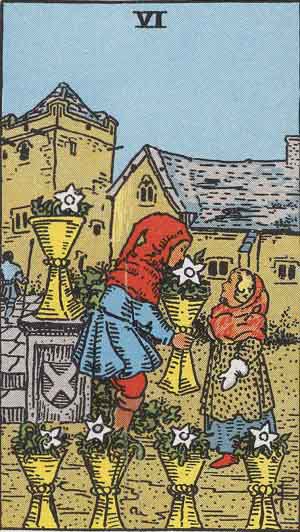
On the card, a merchant dressed as a jester (an interesting interpretation!) selling flowers hands a flower to a little girl with a smile. On the counter's tablecloth is the St. Andrew's cross of compassion. The merchant is trading goods—this reveals the nature of Scorpio, a passionate hoarder of wealth and human emotions. But the white flowers in the cups serve as a symbol that emotions have been purified down to their most primal and direct manifestations: only those feelings that lead a person to the wellsprings of life are retained. Now he can offer them as a gift to someone in need: a passion dangerous to those around him has been transformed into universal love and compassion. Participating in the passions of the world is perceived by the merchant as a game—hence his jester's attire. But this does not prevent him from showing love: his power in the world is expressed as compassion for people."
At this stage, emotion is spiritualized and transitions into love for everything that exists. The manifestation of this card in a spread can point to a situation requiring tolerance, rising above vanity, and true spirituality. This card seems to embody Virgo in all her highest manifestations: mercy, help, kindness, what the ancient Greeks called "therapeia".
According to another tradition, the exchange of cups is similar to the one depicted in the Two, but whereas there were the Father and Mother, here are their children, the Son and Daughter. From an alchemical point of view, the card contains an allusion to the Great Work: six (Macrocosm) lilies in cups, each with five (Microcosm) petals.
Light and shadow (advice and warning)
Advice: confidently embark on the planned endeavor, everything will be fine. Indulge in nostalgia and memories that nourish the soul; try to bring long-standing dreams to life. Evaluate past experiences, summarize outcomes, and compare original goals with concrete achievements. Trust life and enjoy it with all your heart. If possible, return to a childlike state when there was no room for the delusions and hangups of an adult. Let your loved ones know they are dear and needed, protect them from negative emotions, but share everything good. Remember that sincere feelings are more precious than any treasures.
Warning: do not look back and get stuck in the past; you must live "here and now" without running away from reality. You shouldn't regret missed opportunities, wallow in oppressive thoughts about what is lost, or passionately desire what cannot be brought back. Let the heart explore the present. Excessive attachment to traditions prevents introducing necessary changes into life. One should not be overly idealistic—this is a case where the road to hell is paved with good intentions.
This is a card of cooperation and "clean" affairs. Great creative potential, deriving pleasure from work. The meaning of this work can be therapy, providing aid to the "old and young."
A return to postponed projects, to plans that were once already discussed. This is a card of "remakes"—in both the literal and figurative sense.
Professionally, this is quite a "Cancerian" card, successfully describing work with children and the elderly, as well as studying history.
Resumption of payments. A reminder of past obligations. Restoration of well-being after a period of instability. Cooperation wherein both costs and revenues are fairly shared.
"Small happiness," a minor profit, but completely risk-free. Good for novice businessmen. People of an adventurous mindset will certainly not be satisfied with this.
A highly favorable card for housing matters, it symbolizes the security and serene peace of one's home. A dwelling in a retro style. An ancestral nest. An increase in the quality of life, arranging the house and garden.
The card can have two fundamentally different meanings. One of them, in the old-fashioned way, describes innocent flirtation, playfulness, immature relationships, and the lightness of being.
The second—relationships that are not just mature, but specifically fully ripened, having a fundamental base in the past. If Judgement or Wheel of Fortune is nearby, it is almost a certificate from the karmic registry office. The traditional meaning of "nostalgia" in this case turns into an "old foundation"—people already have an emotional pattern of relationships established in the past (other cards will tell more about its quality).
Often the Six of Cups signifies nostalgic feelings, the return of a past object of love, an "accidental" meeting with a person you never hoped to see again, or the resumption of relationships after a "dead" period. This is the case when a promise for the future arrives from the past in the form of very strong and important impulses—a renewal of feelings nourished by past emotional experience, awaiting happiness and love. Romantic nostalgia sometimes truly nourishes and sustains a person on their path, sitting deep in their heart as a precious legacy of the memory of feelings.
The card describes karmic reunions, connections full of emotional power (and, as a rule, immense intimate attraction). In interaction—a rich exchange of sexual and heart energy, the blossoming of feelings, and deep happiness.
Good intentions, pure-heartedness, sincerity, trust based on what has been passed through and experienced together. The desire for unity combined with a harmoniously balanced flow of feelings creates a happy state where people have a great time and enjoy everything that happens. Reconciliation, generosity, kind attitudes toward one another, support, and trust. Mutual attraction, emotional closeness, tenderness, and soft sensuality, playfulness and affection, a wealth of sensations, erotic satisfaction, sexual pleasure. Joy, gratitude, and safety.
By and large, the Sixes (coupled with the Twos and Tens) describe creative energy in the realm of relationships, the blossoming of feelings. But the Fours, Sevens, and Nines are more destructive; these are largely cards of loneliness (or, at any rate, states that do not contribute to the development of relationships). The Six of Cups describes what largely constitutes the beauty of relationships—tremulous tenderness, trustingness, affection. It is harmless and utterly devoid of cynicism and vulgarity. It contains nothing of the danger of wounding or the desire to hurt. It creates an idyllic space of warmth and acceptance, where there is no jealousy and violence, malice and woes, dependency and anguish (it is not for nothing that one of the card's meanings is "oasis").
Under the Six of Cups, intimacy is experienced not only naturally but also prayerfully. It is generous with love and the most romantic feelings, which is why many authors define its meaning as "deep happiness" and the fulfillment of cherished desires long living in the heart. Former obstacles fade into oblivion, allowing one to fully enjoy the good times. Symbolically, it depicts an "enchanting garden of family joys" (and one of the traditional meanings of the card is marriage).
This card promises sensual pleasures, coziness, and peace, and is very good for people of a "domestic" disposition or those tired of adventures. Where we are at home, where we feel safe, we can give vent to our simplest and most natural feelings—kindness, tenderness, love—and there is no need to hide or "ration" them. This is the readiness and opportunity to share the joys of love on all levels.
Under the Six of Cups, courting takes place, "flowers and chocolates" are gifted, partners are generous in expressing tender feelings, and generally, the very best intentions are present. Sometimes the card can speak of indecisiveness, a lack of passion. Old friendship that poses no difficulties in interaction.
In general, this card is highly favorable when trying to forecast a relationship with a loved one. The Six of Cups says that the querent will manage to achieve what they want, not only without spoiling the relationship but making it far more solid than before. If the spread is not clouded by negative cards, then the Six of Cups can point to good relations with relatives, to mutual support in a multi-generational family, and to a sincere regard for family values and traditions.
Sometimes under this card, a reunion of lineage representatives takes place, a renewal of contact with some family member who hasn't been seen in a long time. A new family member might turn out to be truly new, and not just a "well-forgotten old" one—under this card fall family expansion, the birth of a child, christenings. However, mystics would say that one does not exclude the other—some representative of the lineage who already had the happiness of belonging to it in the past could easily incarnate in the family; a great-grandfather could very well turn out to be his own great-grandson. Sometimes the Six of Cups indicates guardianship and adoption.
In a negative surrounding, the Six of Cups can take on meanings such as trouble with children, difficult relationships with the older generation, rebellion against parental authority, dependency on the family, or getting stuck in old models of perception.
Childhood or Old age, fading. Limitation of strength in any case.
In the reversed position, the card is, on the contrary, entirely directed toward the future. It signifies new opportunities opening up ahead, upcoming events; it indicates that something important, significant will happen soon.
Expanding one's worldview, foresight of what is to come. Renewal, rebirth. New knowledge, a new environment. A change in mood, in relationships. A person lets go of the past, outgrows it, gets rid of old emotional attachments and behavior models, and sometimes along the way—of all sorts of family junk.
The card may signal that in the near future plans may require adjustments, without which they could collapse (in ancient interpretations).
The reversed Six of Cups also indicates that the situation is not as innocent as it seems. In negative surroundings, it can speak of violence experienced in childhood, or generally unsightly things that took place in the parental home.
Ancient interpreters mention such a meaning as receiving an inheritance, although perhaps not as large as expected. Modern tarot readers emphasize the unwillingness to fulfill parental duties, leaving the family, running away from home.
Aspiration toward the future as a denial of a difficult childhood, an escape from the original environment, a pointer to the dysfunction of childhood experience (overly dominant parents, destructive influences, physical abuse, etc.). A person strives for the future because they turn away from the past and want nothing to do with it (while still being unable to live in the present). The need to rise above one's roots, to ensure that nothing reminds one of the past. A break with old friends.
With The Devil — the temptation to step into the same river twice (to make the same mistake twice). Sometimes it also indicates a meaning such as corruption, covering up for the guilty. With The Star — a wonderful combination, goodwill, love, involvement. With The Moon — the card is especially strong in terms of love With the Nine of Wands — negativism, readiness for the worst, loss of idealism. With the Five of Swords — cynicism and hostility, the combination can indicate ill-treatment of children or during childhood, up to sexual abuse. With the Seven of Swords — manipulation of feelings With the Nine of Cups — satisfaction With the Ten of Cups — happiness, the person feels blessed With the Five of Pentacles — childishness, infantilism
"The Eternal Feminine draws us upward!" (Goethe) The Golden Age as the archetype of Paradise.