Five of Cups
Cups — Minor Arcana
Detailed Interpretation
The most traditional meanings are difficult relationships or unexpected troubles and obstacles in affairs, but most importantly – grief over what is lost. The Five of Cups is a card of sorrow, pain, and melancholy.
It can show that we have lost something that has been important to us for a long time, or that something important never happened.
This card is associated with strong emotions (and this is its difference from the apathetic Four of Cups); it can be righteous anger or lovesickness, but most often – mental anguish that cannot be overcome before its time, an emotional crisis, or depression. Something that once brought joy and delighted the soul is left behind, and this pain must be comprehended and lived through.
This is not a cosmetic correction of ideas; it is a radical disappointment in which the person themselves sees nothing positive. Emptiness can clear a space for new fulfillment, but while in the space of the Five of Cups, a person cannot yet see what will reward them for this. This card implicitly contains the potential for new opportunities or a new perspective on things, to which the person is not yet able to turn.
This card indicates a somewhat false point of view, and often does not reflect real events, but rather represents a projection of fears and doubts regarding the issue for which the spread was done. However, if it has appeared – these fears, doubts, and pains are quite strong, and they will have to be reckoned with. The trap of this Arcana is getting stuck in sadness. One who looks only backward will not notice love, even if it is very close. This is such a deep immersion in thoughts about one's loss that a person stops paying attention to other goals and opportunities – after all, we live in a dual world where every negative event has a positive counterpart, and almost every loss can be viewed as an acquisition. If we have missed some opportunities and lost what was dear to us, we still have to turn the page and keep moving forward. No, life is not over, says this card; even though the grief is great and the losses are significant, there will still be joys and acquisitions ahead.
Under the Five of Cups, we lose something, experiencing sorrow and regret. This could be a very real item, like a mobile phone – in this case, the two cups behind the back indicate that you will inevitably acquire a new one, perhaps better than the old one, because emptiness essentially frees up space for something new. But still, its most typical appearance is associated with a situation where we lose something intangible – a dream, an illusion, a feeling... Some expectations were not met, hopes collapsed, and the person under this card is genuinely disappointed. What they counted on was truly supposed to belong only to them (or so it seems), but... it didn't work out. There is a very expressive Russian slang word for this – a "bummer."
The Five of Cups is an internal bummer. Although the main feature of this letdown is that not all is lost (new opportunities are symbolized by the two cups behind the character's back). Many authors point out that this card rarely appears unless a person is in a state of deep grief, but in practice, things are not always so serious. Quite often, the Five of Cups indicates a desire to "turn away" in one's dissatisfaction from the imperfection of the situation. But in fairness, it must be noted that the loss of a loved one also passes under this card.
The Five of Cups often highlights the desire to redo the past and regret over missed opportunities, inner discord, emotional resistance to change, and, finally, humble acceptance of what is happening and the inevitable shift in priorities. By the way, the best thing about this card is that it always says the person is not alone; there are people around who love them, capable of at least brightening their life and providing support at this difficult stage of the journey. These are kind and reliable friends, whose warm involvement will help overcome the crisis period and gain confidence in the future.
As a card of the future, it speaks of admitting mistakes, a time of sorrow, and returning to the flow of life over time. The card can speak of minor setbacks and passing sadness. Under the Five of Cups, you can get a scolding, after which you will have to "wipe your nose," in the manner of the character depicted on the card.
The traditional meaning of the card is an inheritance, a gift from ancestors (in the past, funeral mourning was often softened by the receipt of profits, and these were symbolized by the two cups behind the back, "happiness in misfortune"). Another traditional meaning is an upcoming union, perhaps a marriage or partnership, but in it, one will still have to "learn happiness," because this is not what the querent wanted and expected.
Sorrow and a loss of spirit. "I want to cry" (sometimes without quotes). This can be a prolonged bad mood, regret over missed opportunities, resistance to change, or simply inner discord. Mental suffering associated with a passionate desire for the impossible and an ecstatic self-pity passes under this card. A bitterly disappointed state in which a person does not see the good, but only sees the bad. And usually, they can easily identify the cause of their pain, say what they are worried about, and why they feel bad, unlike the Four of Cups (when everything seems fine, but they are "fooling around" and "don't know what they want themselves"). Here, they have experienced bitter disappointment, they have been abandoned, hopes have collapsed, something important has failed.
Emptiness, weakness, and depression; everything literally falls out of their hands, complete immersion in negative emotions, and it seems there is no one to confide in (but this last point is exactly what's wrong). The feeling that the purpose of existence is lost. But in reality, under the Five of Cups, we mourn the past, standing with our backs to those life sources that nourish our present. Under this card, painful memories often weigh a person down.
The danger is that under the Five of Cups, very deep and very negative subconscious desires can develop in a person's psyche (even leading to suicidal thoughts), the realization of which causes suffering and a confusion of feelings. Self-rejection passes under this card, even hatred directed at oneself, an unwillingness to work on oneself, an inability to learn from one's own mistakes, an inability to navigate one's own feelings, and emotional dependence on other people. In rare cases – complete despair, actions in a state of passion.
This is a card of sadness, but here we are no longer talking about sluggish despondency, but about excruciating pain. This card doesn't actually appear often unless a person has suffered some kind of harm and is in a state of grief. It is regret, disappointment, mourning, a moment of pain that cannot be overcome before its time.
As a card of personal growth, it symbolizes the need for freedom and change. As a rule, the person has outgrown the current situation, and therefore must move forward, even if it means parting with loved ones or everything to which they have an emotional attachment. The querent most likely knows very well what they have lost and why.
The card also has a Saturnian-Uranian flavor – a kind of purification of emotion takes place, a test of its truthfulness. These emotional efforts are not in vain and lead, first of all, to a renewal of life. Like any Five, the Five of Cups symbolizes an attempt to go beyond the rigid quaternary form. The instability that arises in the Five knocks consciousness out of the stability of the four. A person in such a state feels excommunicated from the source of life. What once bloomed and smelled sweet has turned into dust and ashes. They no longer feel in contact with the feminine, receptive side of existence. Deep inner feelings have dried up, we suffer from loneliness, and passionately long for what, it seems to us, is lost forever.
This state can captivate us to such an extent that we find ourselves unable to discern the new opportunities that still fill our lives. Within the suit of Cups, the way out occurs through connecting to the great current, the great tradition. Venus (the main planet of Cups) prevents direct confrontation. Therefore, the card can indicate the strengthening of ties with tradition, with the past, which is realized through one or another form of spiritual inheritance, the finding of forgotten knowledge.
On a mundane level, this can indicate a gift or inheritance in the most literal and direct sense. Higher up – at the level of the card, Leo already sounds.
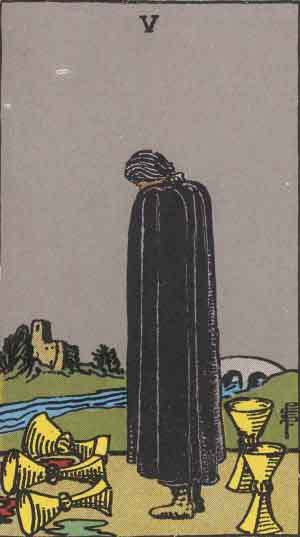
Abandoned and insulted, a person in a black mourning cloak stands and stares intently and sadly at three spilled cups, symbolizing their dashed hopes – it seems they have lost hope or joy. In general, it is widely accepted that overturned cups indicate lost love. The black cloak symbolizes longing, bitterness, and sorrow (in such a cloak, a person might even go into a monastery, disappointed in the world). They do not know that behind them stand two filled cups, symbolizing new opportunities or a new way of looking at things (or both). They regret the feelings they used to live by and in which they became disappointed, having learned the truth they sought to know. Something has leaked out, drained away, and the sky has darkened. What once overwhelmed them has now dried up.
The lesson of this card is to come to your senses, notice the two cups behind you, and carry them across the bridge to your home, into the fortress visible in the distance, to start all over again. The river on the card symbolizes the flow of time and our life. The bridge symbolizes the two banks – two periods of life (this can be associated with the sacred duty of The Hierophant – to be a high priest, a bridge-builder between the material and spiritual worlds).
The sign of Scorpio symbolizes the development of feelings in depth. The first decan of Scorpio expresses the idea of a passionate and demanding analysis of life and a search for its essence. This decan is ruled by the planet of hidden potential, passion, and suffering, Pluto (in the old system, Mars). Emotional dissatisfaction, inner uncompromisingness, and a desire to remake the world are inherent to this decan. This is self-sacrifice, reflection on death, and the need to renew life once again. Destruction does its job, but it is impossible without it – it sweeps away imperfect structures so that something better can emerge in their place.
From a magical point of view, this is a card of mediumship, communicating with the dead. This is an archetypal journey to the underworld, where the traveler is stripped of all worldly veils and attachments in order to gain genuine values.
This is a card of "bummers" – failed projects, false promises, unfeasible ventures, unprofitable enterprises, broken contracts. This is a situation where all sorts of past shortcomings frustratingly surface (for example, failing exams).
Partly, this is a card of indecision, an inability to force oneself to think about some important issues – the person defends themselves and runs away from the situation instead of working. Sometimes it foreshadows a change of environment, plans, and personal circumstances, due to a desire to avoid these issues.
An unfulfilling job is possible, where talents either do not find their proper application or do not receive their deserved appreciation.
A temporary state in which a person sees only the downsides and does not yet notice the upsides (both are reality). Perhaps someone did not keep their promises (for example, the working conditions turned out to be not what was agreed upon). The card describes a peculiar state of mind – the person does not notice achievements, sees nothing good in the current situation, and therefore wants to escape from the shortsightedly perceived situation instead of working.
This is the presence of a real and simultaneously false problem: the loss of harmony due to a misunderstanding of something important. The person is their own worst enemy; they are ready (uncompromisingly!) to exchange the true for the false. There is a risk of losing a real bird in the hand while chasing two in the bush.
This card (especially in a constructive environment) can describe psychotherapists, people whose specialty involves the ability to understand another's pain, an understanding of the motives of their own behavior, receptivity, and a desire to know themselves and others.
Temporary losses.
Unforeseen expenses.
Unmet expectations regarding income or profit.
Traditionally, the card symbolizes a will, gift, inheritance (which does not exclude frustration and emotional damage), inherited property.
Personal relationships
The card often indicates that at the moment a person is up to their ears in heavy feelings that do not entirely correspond to the real state of affairs. Nothing particularly tragic has happened, except for a terrible entanglement in their own desires and fears. Pulling oneself together seems impossible, but in fact, the querent is capable of managing their own life; it just has to take time before they realize it. Sometimes this card appears right after a serious argument or divorce, when feelings are still raw, and an attempt to start something over seems unthinkable.
The Five of Cups describes the frequently encountered situation when expectations were too high, and some unexpected event, for example, a callous reaction, sharply destroyed them. Probably all of this had already been accumulating and was under the surface, but the person was so unwilling to admit it that they didn't notice. And now such a sobering has come, which is comparable to a slap in the face and which you wouldn't wish on your enemy. In an emotional sense, this card indicates the initial stage of trauma and realization, when feelings are raw, and the attempt to start something new seems inconceivable.
Unlike the Four of Cups, this is a card of strong emotions, of uncompromising attitudes. The Five of Cups is youthfully maximalist, sometimes overly so. Sometimes this card means disappointment precisely as a deliverance from delusions. Emotionally, it gravitates towards the "Gothic," that is, cutting off everything superfluous, towards feelings on the level of "all or nothing." The very great influence of Saturn takes its toll here, bringing something of Capricorn's irreconcilability and uncompromising nature into the card's action. In essence, this is another "broken heart" card, alongside the Three of Swords.
The Five of Cups is a highly informative card for the topic of relationships. It manifests through Saturn, bringing with it quarrels, losses, partings, disappointment, sorrows, a feeling of imperfection, despair, and grief over what is lost. It is here that all the flaws in building relationships, all the omissions, contradictions, misunderstandings, misinterpretations, and unrealistic expectations can "surface." Moreover, the disappointment of the Five of Cups is usually not an external event at all, but a strictly internal, intimate, so to speak, affair. The point is not that the partner did something that disappointed and wounded the person (although this is possible, especially if the Three of Swords or the Five of Swords is nearby), but that the person "is the fool themselves," and here they have finally felt it. Sometimes they even manage to hide this from their partner, but as a rule, the distress is still discovered.
This sad "is the fool themselves" is expressed either in the fact that the goals pursued were incompatible with true needs (the partner is unsuitable or cohabitation is not indicated at all), or in the fact that the person is in a relationship that somehow contradicts their moral principles (for example, they resigned themselves to cohabitation outside of marriage, although deep down it makes them feel murky, or they entered into marriage under some conditions that they initially did not approve of, but stifled this feeling within themselves). One way or another, failures, sorrows, and losses occur because the person somehow casually violated themselves, stepped on their own throat, and is now surprised that their throat is tightening.
Yes, this is disappointment. "The game wasn't worth the candle." "Sold too cheap." And now it is excruciatingly painful and the melancholy seems deadly. There is no sense in reveling in self-digging and self-pity – this is exactly the case when everything is clear even without a psychotherapist, and these sessions will bring no fundamentally new additional knowledge. Rather, a temporary separation can play a therapeutic role here, helping one to see the situation more clearly and do something to fix it.
Sometimes this "fixing" looks like breaking off an unsuccessful connection and starting new relationships, but it happens that this is some purely internal affair, during which a person learns to appreciate what they have and see its upsides (the Two of Cups behind the sad character's back says that these upsides are genuine and truly exist, and we engage in self-deception more so when we surrender to despondency). Sometimes a temporary separation helps to see the situation more clearly. But often under this card, a continuation of relations in a partnership union is observed, despite their destructive impact; there is a sacrifice of oneself for loved ones. The card serves as a powerful indicator of a vulnerable union or partnership.
This can be a fragile friendship, an "unlucky" marriage without true love, a union whose meaning the person does not understand or accept, a dangerous liaison, widowhood, or, in the highest sense, an unusual or mystical marriage. The Five of Cups can also indicate a time of mourning, when a person is just getting used to a heavy loss, and the state immediately after a breakup or divorce, when it is crucial to acknowledge their pain.
Situations and states under the Five of Cups can vary from an unpleasant phone conversation that leaves a passing residue in the soul, to mourning one's entire destiny, and this is no joke, genuine, deep sorrow, where thoughts of suicide creep into the head. In comparatively milder cases, a person simply spills out their fear for a fragile union, uncertainty about the future, and often the partner still helps restore confidence in tomorrow – it's not for nothing that two cups stand behind them. Warmth and emotional support are fully present.
The mind is currently focused on the problematic aspects, flaws, and imperfections of this union, but this is temporary. And sometimes everything is experienced much worse, the person feels defenselessness, shame, and grief, they have been harmed, although as a rule, it is specifically about love. Often this is a socially unusual and therefore vulnerable union, but it can simply be a not very successful one, in accordance with the canonical meaning of the card.
Sometimes under the Five of Cups, a person painfully realizes that they behaved contrary to their convictions, upbringing, everything they considered right; for them, this is a very painful life experience, sadness, and disappointment – primarily in themselves. If a month ago someone had said that something like this would happen and things would go so far, they wouldn't have believed it. What happened is an unexpected loss for them (again – of themselves) and it endlessly grieves them. Pain and anguish consume them openly; it is clear that the wound in their soul will not heal immediately. To some extent, they mourn their entire past life, realizing that everything is left far behind and will never return. Grief over the lost, pain, despair, and encountering a difficult emotional test – this is what this card means.
This is a feeling of abandonment, resentment, internal torment (even if the "offender" embraces and whispers words of love – in other, less favorable cases, abandonment and deceit can also be added to this). This is a genuine emotional crisis, an agony of feelings, the deepest mental pain, pain because something has gone irrevocably... but that's just it, there are two cups standing behind. They say that they are not alone, that there is a loving person nearby, that one must try to get rid of sadness as soon as possible – yes, this pain must be experienced and comprehended in order to lead to further spiritual growth.
For some people, this card literally describes the MYSTERY OF LIFE, once again confirming that there are no Minor Arcana. As a rule, this is a string of unsuccessful marriages. A person cannot recover from the first breakup for a very long time and refuses to turn to face someone who, in the meantime, would give everything for their love. When this union finally takes place, the state of the Five of Cups forms again; the partner still seems somehow wrong, and the union – a sad mistake. The Great Mystery of this Arcana is that the TWO CUPS ARE MORE IMPORTANT THAN THOSE THREE from the point of view of Fate.
It stubbornly overturns the three to turn the person towards those two, to turn them from an not entirely genuine union to the truly destined one. Like the Four of Cups, this card largely serves as a warning that the person is currently tuned incorrectly; they are choosing the worst and discarding everything positive; essentially, they are harming themselves trying to spite another. Happiness and the fulfillment of desires have been waiting for them for a long time. Still waiting. Essentially, they are trying to escape instead of working on the situation.
In principle, this card teaches that it depends on us whether we see the glass half empty or half full (while in any case it is a half, a partiality). If a person manages to see the good side of what they have, they can be happy in their own way. Sometimes the Five of Cups foreshadows a change of environment as a result of a desire to avoid these issues.
Sometimes the card speaks of a marriage not with the one you wanted, but which is much better than the one you wanted, and of the task to see what gold you have received, rather than mourning what did not come true. Yes, it is not what you expected. You mourn what you didn't get, and there is a reason to. But you GOT IT! What you do not yet know how to appreciate.
Sometimes the Five of Cups reacts simply to a storm in the ocean of the subconscious, when one of the partners wants to cry, they feel vulnerable themselves and the relationship, but in reality everything is fine, everything is in order, it only seems to them, and the other is ready to calm them.
One of the innermost meanings of the card is a will, gift, inheritance. It may relate to the karma of love, gifts from a partner who is not around, a mystical marriage with them, which does not correspond to the usual idea of happiness, but may well embody harmony.
Especially in young people, the card can describe mourning over a relationship that is not working out at the moment, which is being watched by a certain society (symbolized by the Three of Cups) – school, friends, a clique following the development of a "soap opera." But they WILL WORK OUT, that's the point, just in a different format, detached from the clique, and these will be the true Two Cups, a simple, right, and harmonious love, without an audience and prying eyes. Sometimes this is a relationship that cannot work out precisely because of the close attention of others (if the Five of Pentacles is also nearby, there are reasons for this, for example, people are not free or are of the same sex), but if it weren't for this fact, everything would be quite harmonious. It can indicate a desire to close off from the outside world, a fear of emotional exposure.
Perhaps the best thing that can be done in the situation of the Five of Cups is to honestly see the essence of the torment, learn to forgive, and with complete self-confidence, decide on something new if you can't bring back the old. Smile through your tears and trust, having overcome the fear of a new life.
Genealogies and family histories with the heroes of the clan and the "black sheep" pass under the Five of Cups.
Brokenness. Hangover.
Depression, melancholy, general suppression, weakness. Nervous diseases.
Conditions requiring the use of painkillers sometimes pass under this card.
Sometimes the card serves as an indicator of problems with conception (but still not infertility).
Abortion, miscarriage.
Hereditary diseases, including mental disorders.
Mary Greer points to accidents, even disability, as well as incontinence issues.
Advice: be satisfied with a partial solution, not an ideal state of affairs. Accept grief, gradually overcome the pain, and turn to the positive side of the situation. "Turn your face toward me and your back to the forest." The card says that most likely we have lost what we did not try to hold onto too strongly, or that in any case, the lost item will soon be replaced by another, less strictly meeting expectations, but in reality – no less beautiful and more suited to our real needs. The Five of Cups says that it is in our power to see the good. The reason for disappointment lies largely within ourselves. It is enough to turn to face the present, leaving the past behind, and your former tirelessness, resilience, and mobilization will return. Everything will work out in time. As is well known, experience is what you get when you don't get what you wanted. But for now, you need to gather your strength and not break. This is not the most fun time, but it must be used for personal development. Over time, new plans and goals will come. Perhaps this whole situation arose EXACTLY so that we would pay attention to what is IMPORTANT! To what the two cups behind the back represent.
Warning: do not try to do something you will later regret. Do not plunge too deeply into dark thoughts – you might miss something important this way. The inability to show feelings, closed-offness, and a hardened, depressive mood will hinder the further development of affairs and relationships. This is a friendly warning: stop the self-flagellation. You are doing the best you can with what you have right now. Leave the past behind and love the future. Don't give up and cling to your suffering. Don't drown in self-pity; it is like the sea – the further you go in, the deeper you sink.
In the reversed position, the card means: a new outlook on life, encouraging news, pleasant experiences, new alliances, returning to old friends, reunion with someone. This is a card of those who are recovering from illness or loss, leaving the past behind, and ready to move on. Renewal, return to normal life. Traditional meanings are news, return of old friends, alliance, reconciliation with someone dear, renewal of broken contacts.
If an inheritance often passes under the upright card, then under the reversed one – a gift from someone currently living.
In rare cases – denial of problems, an appearance of false well-being. Another rare meaning is chores due to the arrival of relatives who were not expected and domestic quarrels.
With The Lovers – establishing a relationship
With Death – loss, parting
With Judgement – self-justification, deliverance from grief
With the Six of Wands – triumph, victory; the card is considered to weaken the influence of the Five of Cups
With the Three of Swords – parting, loss of love
With the Five of Swords – revenge for what was taken away and lost
With the Six of Swords – depression; in general, this combination can also describe an upcoming trip to a funeral, mourning the loss of a loved one
With the Nine of Cups – pleasure; the card is considered to weaken the influence of the Five of Cups
With the Five of Pentacles – lack of support, rejection
With the reversed Four of Wands – a relative will provide financial assistance, with the reversed Eight of Wands – will not provide (from an ancient dream book).
Pluto, who stole Persephone, and Demeter, threatening to make the earth barren
Wasteland – the devastated lands from the Grail myth
"Every cloud has a silver lining"
"Let the past bury its dead"
DE PROFUNDIS by Oscar Wilde
Shakespeare's 90th Sonnet
Then hate me when thou wilt; if ever, now;
Now, while the world is bent my deeds to cross,
Join with the spite of fortune, make me bow,
And do not drop in for an after-loss:
Ah! do not, when my heart hath 'scaped this sorrow,
Come in the rearward of a conquered woe;
Give not a windy night a rainy morrow,
To linger out a purposed overthrow.
If thou wilt leave me, do not leave me last,
When other petty griefs have done their spite,
But in the onset come; so shall I taste
At first the very worst of fortune's might;
And other strains of woe, which now seem woe,
Compared with loss of thee will not seem so.
The ring of King Solomon, on which, according to legend, there was an inscription "Everything passes," which comforted him in difficult times. When a greater misfortune than usual happened to him, he looked at the inscription and it angered him. He tore the ring from his finger, it rolled, and suddenly it was discovered that on the inside of the ring there was also an inscription. It read "This too shall pass".