Four of Cups
Cups — Minor Arcana
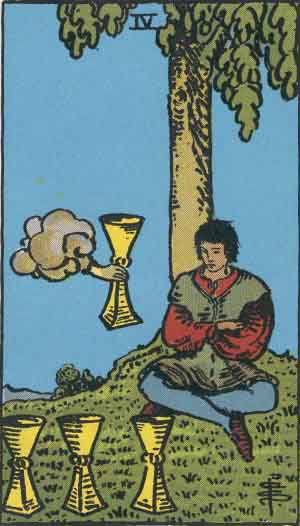
Detailed Interpretation
Melancholy, despondency, being immersed in the past and failing to notice the present. A person overlooks something very important in their life or situation; they are bored, but this is entirely due to their own blindness.
This card is essentially a friendly warning that a negative outlook on the world is holding the person back from achieving everything they need and accepting everything they hope for. All of this is available, but their own dissatisfaction keeps them from recognizing, accepting, and taking advantage of the benefits. This card speaks of various situations where it seems like everything is there, but there is a lack of the inner disposition to properly rejoice in it. It foreshadows the beginning of a stagnant period in life, one that is internally even more empty than under the Four of Swords. The person rejects new opportunities, is unwilling to develop creative abilities, start new projects, or make new acquaintances (it seems to them that all of this is meaningless). The information carried by the Four of Cups forces one to think seriously about brewing emotional problems in life. Essentially, this card always speaks of the need for honest self-reflection to restore inner balance, and that an effort must be made to see one's life as anything other than boring and dull. This is a very small effort, but no one can make it for the querent.
Typical meanings: upset, annoying incidents, problems, something causing irritation. Older interpretations of this card include yearning and boredom, displeasure, unfounded suspicions, imaginary annoyance, and disgust. How did Pushkin put it? "You stand there looking like some Childe Harold." This was said to Lensky, although it would have suited the satiated and therefore melancholic Onegin much better! The Four of Cups follows the Three - essentially, this is a card of internal "burnout" after excessive socialization. One of its names is "the morning after a fun night," with all its apathy, lethargy, and "withdrawal from affairs" when continuing the banquet is no longer appealing. The old meaning becomes understandable - the negative influence of the past on the present. Someone clearly overdid something.
Strictly speaking, all the unpleasant states of the Four of Cups might not be entirely imaginary. Perhaps the situation the querent finds themselves in is genuinely causing them annoyance, or an offer made makes them doubtful, or they harbor well-founded suspicions and dissatisfaction with their significant other, or they have run into unexpected obstacles or opposition.
A rarer interpretation of this card is a gift from heaven. Yes, a gift of fate, its grace and giving, a certain proposal that causes anxiety and confusion; a person cannot make sense of their feelings. In essence, it is about a realistically achievable chance that the person does not take seriously.
Crowley's interpretation of this Arcana differs from the traditional one in a positive way. The card describes not so much boredom and apathy as a luxury akin to "a cat that got the cream." A pleasant pastime in a good, familiar environment and a feeling of security and stability, enjoying life, and the ability to relax.
The old interpretation of the card is dubious pleasures.
A typical modern one - something has become so tiresome that a person desperately hopes to get rid of it. What this is, and how far they will go in this endeavor, can be suggested by other cards in the spread.
Sour and apathetic. "Always lacking something—if not money, then meaning, if not meaning, then a tram." Similar to the English spleen - in short, Russian melancholy. This is either a tendency to lazily ignore and miss out on opportunities offered by life, or a "be careful what you wish for" situation. You seem to have gotten what you wanted (relationships, money, work, a house, stability, or something else), but you feel mostly boredom, apathy, and dissatisfaction. The toy brings no more joy. The card reminds us of the fickleness of our desires: we desire something with all our heart and soul, yet upon achieving it (and even more than we wished for), we suddenly realize we don't need it.
This can express itself as despondency, indifference, or conversely, irritation and resentment toward the whole world. Sometimes the disappointment and fatigue of this card manifest aggressively - the person makes life miserable for everyone. But more often, it corresponds to a quiet gloom and a bad mood. As modern psychology would put it - emotions of the asthenic spectrum, up to a passive-depressive state. Playing the role of a background martyr, nursing their dull sufferings, lack of self-belief, loss of the meaning of life. A dip in spirit after a period of prosperity and initial achievements. "Sick and tired of it all." Causeless lethargy, motivation deficit, rejection of the present reality ("everything is fine, but I don't want anything"), feeling dissatisfied, unhappy. Some authors associate this card with the state of a capricious prima donna - a person thinks highly of themselves and is displeased with everyone around for no reason.
This is a card of emotional crisis. This is not the case where creeping depression can be bought off with a dose of pleasure - precisely because pleasures will not bring any enjoyment. The search for inner harmony will require what seems like a tiny, but nevertheless significant change in one's view of the world. This effort cannot be replaced by anything, and no one will undertake it for you - this is one of the lessons of the Four of Cups.
The card describes a specific distressed state of mind when everything available has been exhausted, drunk to the dregs and known, and has caused disappointment and dissatisfaction because it turned out to be incapable of satisfying the demands of the soul. All this is rejected, as it seems empty (it seemed like there was a lot, it seemed like you got EVERYTHING, but this everything turned out to be meager and insufficient). The person has an as-yet unconscious goal, a star they do not yet see, a wisdom not yet grasped, the cup of which they have yet to drink, a kind of fervent desire to serve their ideal. All that is needed is a small shift in consciousness (which, however, is hardly realistic in their current state), a fundamental broadening of vision. This is the state where "only the blade of a sword separates you from the Grail," but this sword is your current mind, and here the person is their own enemy.
Considerable egoism, emotional callousness, alienation. Self-absorption, detachment from the world. To the typical groan of "Nobody loves me!" the card reasonably objects, "But you don't notice anyone!" Apathy and passivity, not the slightest initiative, stagnation in the soul. In this case, unlike the Four of Pentacles, the person does not erect defensive walls between themselves and the outside world. They don't need them... because the world is essentially indifferent to them. They simply have nothing to wall themselves off from.
In general, the Four of Cups always indicates some difficulties with emotional opening. In some ways, this card echoes the sign of Cancer. They crawled out of their shell, got hurt once again, and crawled back in. The Moon and Saturn resonate in this theme, and this card will play out especially vividly in people who have these planets strongly expressed in their horoscope. In this sense, the Four of Cups is a card of loneliness. Sometimes it indicates that the person is rendered inert by excessive daydreaming.
Sometimes this card represents a state of childish "resentment against everyone" - well, I'm not going to do anything!... what, do I need it more than anyone else?... I don't need anything from you at all!... and so on. In this petty state, a person can commit a major folly, miss a favorable chance or offer.
Crowley's interpretation accentuates the power of developed femininity and maternal emotionality, the importance of the hearth, affection, and security, which also corresponds to the modality of Cancer. And yet, the natural state of water is flowing and moving. The Four, with its structure and formality, limits and "stagnates" it.
This is a card of the first existential disappointment in earthly life and its joys. After its first experiences and successes, the first joys and achievements, a person is overtaken by the feeling that "you can't love all the women or drink all the wine anyway," and that generally, this isn't it... A sort of Onegin-esque spleen begins.
Essentially, the card says that one must also think about the soul, turn to values of a finer and higher order. It is precisely these that are symbolized by the fourth cup, extended from a cloud to the one who does not yet notice it. Guggenheim writes that the man sitting under the tree symbolizes the Buddha meditating at the Bodhi Tree.
Ideally, this is a card of a nearby, impending prophetic revelation, a lightning sign. Apathy (lack of drive) and fatigue, being stubborn in the sorrowful limitations of one's vision, prevent one from noticing the closeness of an apocalypse standing right beside them. Apparently, it was this Fourth Cup that St. Bernard addressed in his famous 12th-century sermon: you have everything, knight, all the gifts and blessings, but you lack the meaning of life. You can find it.
The third decan of Cancer is ruled by the Moon and symbolizes the spontaneity and simplicity of emotions manifested outwardly. This decan possesses a rich imagination and is prone to contemplation and dreams. While the second decan is occupied with developing a mechanism for switching from internal perception to external, the third decan has a well-established system of communication channels between the internal and external and is maximally involved in the process of transmitting its impressions and emotions to others. The basis for the richness of internal sensations here is the external world. Emotions correspond to objectivity and are positively perceived by others.
Life is conveyed as an inexhaustible source of feelings, and their endless flow allows a person to feel the continuity and eternity of life. This decan carries the idea of unknown possibilities hidden in the depths of life itself, which must be seen and understood. The card depicts a young man sitting under a tree, with three cups standing before him. A hand from a cloud offers him a fourth, but the young man does not notice it. This gift from above may be lost to him. Daydreaming makes him too inert, and his ideas too vague. At the stage of the Four of Cups, desire takes on concrete forms, although these forms do not yet fully correspond to our imperfect world - they are somewhat idealized and imprecise, but at the same time quite material.
Light and shadow (advice and warning)
Advice: Open your eyes and see that fate is presenting a gift. Look more broadly at the surrounding world and yourself. See the fullness of meaning in the fabric of everyday life. Accept someone's generous gift or lucrative offer. This Arcana, like no other, contains both a problem and the answer to it. "Despite all the fatigue, depression, antipathy, disgust, disappointment, and lack of happiness - bear in mind, all this is imaginary, it is the fruit of your mood and imagination." So, Waite's advice is to look for signs, dreams, enlightenment, and flashes of insight from above. Accept gifts, do not reject favorable chances. According to Crowley - do not force events, rest, do not take events to heart, and do not try to solve problems that can wait until tomorrow.
Trap: Rejecting an offer from heaven if it initially provoked mixed feelings. Blindness to the opportunities that have opened up. Stop sulking, this card says, listen to what you are told, or you will regret it later. In the warning position, it hints that it makes sense to step away from daydreams and return to reality with its cares. Another trap is a pernicious desire for total peace and comfort. This choice, having been made, will lead to a state of boredom, satiety, and dissatisfaction. And finally - the sacramental question this card asks: "Are you tired of living?"
Everything is quiet, familiar, known, predictable, and already boring. There is neither a sense of challenge nor satisfaction in the work. It does not arouse enthusiasm, and there is no desire to perform feats of labor. There may be a slight feeling of being "sucked into a swamp," leaving no room for growth and self-expression. Disappointment in the profession. The initial stage of professional burnout.
Lack of motivation
The organizational environment under the Four of Cups is also characterized by yearning, melancholy, indifference, nostalgia for the better times of the past, and an atmosphere of depression and sadness. What this is connected to—financial difficulties, a change in management, etc.—will be suggested by the surrounding cards.
Modest solidity, partial satisfaction. Financial stability, but no growth. Attachment to money; it can be used to satisfy emotional hunger (shopaholism in a mild form), but also the emerging realization that money can't buy happiness and that the soul cannot be satisfied with a variety of junk. Inability to handle money.
Traditionally, this is a card of "bachelors and spinsters," that is, people who delay marriage for a long time due to their own psychological attitude and refuse the gifts of fate.
Everything stems from one's own unwillingness to accept the good being offered or to take advantage of the benefits. A person unconsciously revels in their role and is so stubborn in their apathy, lack of initiative, and dissatisfaction that they refuse the fulfillment of their desires. Essentially, this is the warning - "You do not see the gift right before your eyes." Or you do not understand your own happiness. The cause of the depression is that you are sitting in it, not that life is bad and boring. Everything in life is exactly as interesting as you are yourself.
This card can also describe being absorbed in some dead-end relationships, because of which the person fails to notice much more interesting new opportunities.
This is something like a young fan's "romance" with a movie star, whose portraits hang on all her walls, while no faces from real life are perceived at all. By the way, in view of such a situation, another "strange" old interpretation becomes understandable - fervent service to one's ideal, idol, religious fanaticism. Here, the "idol" for the querent becomes a person who does not reciprocate their feelings, or a relationship with whom never really started, or has clearly already come to an end, yet the querent still does not want to notice anything around them and is still entirely consumed by "that which cannot be," nothing else interests them. In this case, the hand extending the fourth cup to the sufferer, which they do not see, symbolizes fate, ready to give them something completely different.
Sometimes this card really does represent resentment, malice, the rebellion of innocence offended in its best feelings, jealousy, disappointment, grief. But more often, acute states go to the Five of Cups. That one truly grieves and worries. The Four is more just bored and melancholic. It finds everything uninteresting and unpleasant. It suffers not so much from pain as from a lack of motivation.
The card can symbolize a stable but unhappy period in life, full of boredom and rejection, yearning and stagnation, conditioned by one's own vision and essentially being a matter of personal choice. Only one's own disposition prevents the use of what is actually available, and the satisfaction of desires to which there are no obstacles. This is a kind of fanaticism, really. But – stability, a kind of internal harmony, and to a certain extent even growth (thanks to introspection). A person sacrifices the pleasures of life for the sake of health or out of moral and religious considerations, while their inner core is quite strong. Sometimes the card points in the same sense to the economic aspect of life - modest solidity, partial satisfaction, but stability.
If it comes to existing relationships, the Four of Cups can indicate boredom, a lack of impressions, changes, or qualitative development. This is exactly that first crisis when the initial wonderful stages (the Two and Three of Cups) have been passed in one way or another, and the relationship needs to "somehow develop." In their voyage, the couple has reached stagnant waters, contrasting sharply with the intoxicating Three of Cups. What to do next and why to stay together in the middle of this swamp is completely unclear.
It is believed that this card indicates disappointment in the object of love and the breaking of a relationship. This is more true for the stage of romantic dates between mere acquaintances and for very young spouses, and less true for an established marriage. But one thing can be agreed upon - for relationships, this is a truly heavy card. Mainly because of the absorption in one's own melancholy, accompanied by detachment from the world and indifference to the feelings of other people.
It describes satiety, a situation where something well known (for example, previously intoxicating meetings) no longer brings joy. This is a rejection of the partner and a depressed state of mind. Frozen feelings, sexual lethargy, causeless bad moods, and an inability to rejoice in what deserves it. This could be a natural crisis in the development of a relationship, when the time comes to discover new depths in it and move to a qualitatively new level, symbolized by the fourth cup. But there may be another emotional reason for this.
At the sight of this card, one is reminded of a married person who, after a fleeting encounter, indulges in vain memories of past happiness. For a while, they are immersed in themselves and this sadness, and therefore do not notice the joys of life with their current spouse, depriving and emptying themselves. For a time, these joys have become emotionally inaccessible, unwanted, and unnecessary to them. This is the classic state of the Four of Cups. What previously constituted the highest value and joy of life (an element of the Three of Cups) has lost its appeal, a loved one seems alien and distant, sexual tone is at zero, and for some reason it has simply become impossible to live and rejoice. The relationship is in an obvious crisis, indifference, lethargy... a readiness to drink from grief and sob from melancholy. Happiness and joy are at arm's length, but melancholy clouds the eyes.
Sometimes the problem is simply routine, being absorbed in maintaining the familiar order, an excessive concentration on stability and predictability (all the Fours carry this element). The need for variety is as natural to a human being as the need for stability. Without periodic shake-ups and a change of impressions, a "hunger for incidents" arises, quietly felt as boredom and disappointment; it's just that everyone's dose is different.
The card also has another, almost opposite meaning (according to Crowley), and sometimes it works very accurately. This experience can be defined rather as emotional stabilization - acute feelings are gone, but there is the luxury of peace and happiness. A person enjoys life, feeling that they have the right to relax, be content, and not force events (indeed, there is no motivation for this, in this sense - yes, it is a card of lacking motivation). A familiar pleasant pastime, tenderness and care in close relationships, a feeling of stability and security.
Crowley's interpretation differs significantly from the traditional one. He believes that the Four of Cups describes things that are quite favorable for close relationships. This is the wealth and depth of feelings, stability, emotional richness, and affection. Here there are delights and pleasures, and no room for boredom. But still, Crowley also writes about the desire to possess in one's emotional superiority, about possessiveness and limiting another person's capabilities through excessive attachment. Something of excessive condensation, which can manifest itself as a routine filling of inner emptiness and a lack of vivid feelings, is also caught here. The difference is that Crowley does not emphasize the isolation from loved ones (or from one person), which, unfortunately, is often observed in practice. But he also indicates that while enjoying inner peace and happiness, it is important not to forget about the further development of the relationship.
Loss of vitality, exhaustion, decline in strength. A person feels sick and weakened (although this feeling may be illusory).
Hypotension, chronic fatigue. Lowering of the body's resistance, weakening of the immune system.
Depression, defeatist mood.
A very typical hangover card. Headache, stomach upset.
If in an Upright position the Four of Cups is a rather critical card and can be seen more as an unlucky one, then in a Reversed position it acts in the exact opposite capacity. A person shakes off boredom and opens up to something - this can be new opportunities, new connections, new acquaintances, new approaches to old problems, new knowledge. They reconsider the possibilities they rejected earlier and try to overcome their own passivity. This is a fairly typical card for someone ready to rush headlong into a relationship after a period of loneliness or to grab onto any job, just to get back "into circulation."
In general, the Four of Cups corresponds remarkably to the behavior of many female characters from Russian folk tales - first, a sour refusal of all princes and lords (Upright card - excessive fastidiousness), then a firm "I'll marry the first man I meet!" (Reversed card - fastidiousness is out of the question). What the "first man" will look like in this case can be suggested by other cards in the spread. In any case, quietly sitting and hopelessly meditating is no longer an option under this card; fresh impressions are needed. Searching for new incentives for life against the background of the exhaustion of past experience. A second wind.
If the Upright card correlates with recurring situations and chronic problems, then the Reversed card indicates another attempt to solve these problems, a renewal. An unforeseen event.
Old interpretation - new relationships or achieving mutual understanding with a loved one. Premonition, prediction, foresight of changes for the better, all sorts of signs and prophecies.
However, there is also a negative interpretation of the Reversed Four of Cups - if in the Upright card the person was offered some chance that they did not notice, now "the train has already left," the chance has been missed, and they are now gripped by acute depression.
With The Hermit – concentrating on oneself, breaking the habit of relationships
With The Moon – silence, unwillingness to share one's feelings and thoughts
With The Sun Reversed – presence at a fire (from an old interpretation manual)
With The World – involvement in something, participation (the card reduces the influence of the Four of Cups)
With Four of Wands – enthusiasm, the emergence of energy after a slump (and in old interpretations it means "an out-of-town outing will be upset")
With Ten of Wands – amplifies the meaning of working beyond one's strength, of Sisyphean toil.
With Two of Cups – unity, coming out of one's shell
With Four of Swords – amplifies the meaning of contemplation and self-analysis, meditation and solitude, healing mental wounds (well, and boredom from loneliness too).
With Five of Swords - dreaming in solitude (according to Guggenheim)
With Six of Swords - depression
With Eight of Pentacles – labor that helps overcome inertia and lethargy
Stagnant water
In the Crowley tradition – luxurious spring, green meadows, branches breaking under the abundance of foliage, flowers, and fruits.