Eight of Swords
Swords — Minor Arcana
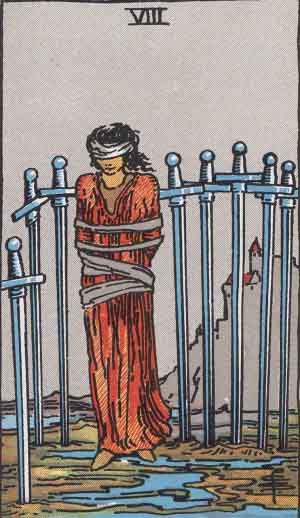
Detailed Interpretation
Traditionally a negative, unpleasant card, indicating getting into a very difficult position. Falling in the perspective position, the Eight of Swords warns that things will go the wrong way, and it will be difficult to get out of this situation. This is a very clear warning that things may go off track and encounter some obstacles. As a result, the querent risks falling into unpleasant circumstances, feeling cornered, and severely restricted in the freedom to make decisions. The card can serve as either a warning or a description of an unpleasant situation that has already occurred.
This is a card of limitations. It describes states of being bound, entangled, helpless—all those situations when a person does not feel free and cannot live the way they like. Sometimes the Eight of Swords appears at a moment when life is pressing from all sides, tangled circumstances do not allow doing anything the way one would like, and one constantly has to give up their own desires and things dear to their heart. Other cards can suggest what this is connected with and whether it is worth it.
Perhaps the most striking theme raised by the Eight of Swords, regardless of what the question is about, is that the person has allowed absolutely everyone else to dictate the terms. They have given up their power, given up their strength, become a hostage to what someone else does or doesn't do, and expects nothing from themselves, as if nothing in this world depended on them. Why? What makes them act this way? After all, it generally shouldn't be like this.
The card is a clear indicator of a deprivation of freedom, sometimes in a completely literal sense. This should be taken into account if the situation being read for involves such a risk (for example, if it involves some kind of scam—in this case, it's useful to remember that the Eight is a continuation of the Seven of Swords). This could mean getting into a sticky situation involving compromising material and blackmail. On a simpler note, the Eight of Swords perfectly describes getting stuck in a traffic jam. In combination with other negative cards, the Eight of Swords can warn of an illness or injury.
Sometimes the deprivation of freedom turns out to be more internal—we are forced to agree with something, pay for mistakes made, admit and atone for our guilt, stepping on the throat of our "own song". This card raises the question of who is actually in charge of this situation, who is managing it, and upon whom its outcome truly depends.
Disapproval, criticism, slander, malicious gossip, and condemnation fall under the Eight of Swords, where a person becomes a victim, "humiliated and insulted" at the pillory. They feel a similar way, akin to the Eight of Swords, within the "system"—a highly bureaucratic organization with strict regulations (for example, when facing legal proceedings or even the healthcare system).
The Eight of Swords emphasizes the temporary nature of the troubles. This situation can be avoided, prevented, or resolved on one's own. The best thing about this card is that it contains the potential for liberation.
Constrained and suppressed.
"One's own worst enemy." A state of powerlessness and indecision, captivity and fear, "psychological stupor." The personality does not develop because it fears mistakes and the consequences of its activity. Doubts and the fear of making the wrong choice "blind" them. The person prefers to remain motionless, withdraws from making decisions and taking concrete actions, and hopes that someone from the outside will solve everything for them.
The Eight of Swords is like an obsession that excludes all alternative options from the mind. Acting in such a state is usually simply impossible; it is a card of self-paralysis and enslavement. All attempts to act differently encounter tremendous resistance. The Eight of Swords shows that we ourselves are suppressing some part of our personality. Often, these are internal barriers or prohibitions that we usually set for ourselves, yet we prefer to find their cause in the surrounding environment. This is the typical "Yes, but..." position ("I would love to do this and that, but...", "I would really like to have this and that, but...", "I would be glad to become so-and-so, but...").
At the same time, the only obstacle to these things turns out to be an unwillingness to take a step for one's own good. This card shows us that the restrictions, difficulties, and prohibitions that we perceive as a hindrance do not belong to the outside world, but merely reflect our own fears (it is no coincidence that the next Arcana is the "panic attacks" of the Nine of Swords). Although sometimes it may only be a matter of temporarily giving something up or a voluntary restriction based on highly reliable information, the Eight of Swords usually points us to the blocks that need to be overcome and the prohibitions that need to be eradicated.
And here, to each their own. Surrounding cards can provide a hint, and often the subject of the question itself does. In general, the Eight of Swords always calls for working on oneself—what lies behind the fear of openly declaring one's desires, behind voluntary self-restraint?
Banzhaf and Akron emphasize anxiety, bad premonitions, exaggerating the importance of problems, and internal turmoil. Thought blocks can manifest as both chaotic and dogmatic thinking. Shyness, timidity, the fear of being the center of attention.
Sometimes the card describes a slandered, disgraced person, or simply someone in a humiliated position (compared to their usual one). Sometimes a feeling of abandonment and vulnerability comes to the fore, complete loneliness in the face of a cruel fate, less often—self-destructive behavior. In any case, the suffering and sense of powerlessness associated with this card should not be underestimated.
This card has something in common with The Hanged Man, and it also contains the motif of sacrifice, offering something on the altar, confession, and atonement. Under the Eight of Swords, we sacrifice ourselves in one form or another, act against our natural will, endure, submit, capitulate, and ascend the scaffold to undergo some kind of execution. A meaning of this card that often manifests itself is paying for mistakes, a sort of semi-ritualistic "flogging of the guilty."
Perhaps willpower and firmness collide with a far too destructive influence. But most often, this influence is represented by doubts and internal conflicts that do not allow a single step to be taken towards the goal. Restraint and control are good when they help achieve what is desired, but here the opposite effect is evident.
Archetypally, the Eight of Swords is a damsel in distress waiting for a knight in shining armor to save her, absolutely refusing to save herself. Perhaps she truly lacks any resources to do so. The eight swords stuck vertically into the ground symbolize limiting, restraining, and obstructing thoughts. They are like a boundary that cannot be crossed.
However, there is a clear passage, a path between them; they by no means hopelessly "lock in" their victim. But the person does not see this path because, in addition, their eyes are blindfolded. It is important that this figure has far more opportunities than it seems. The main thing about the card is not the absence of a way out, but that the person is not looking for one! Although the water underfoot (a symbol of the subconscious) hints that a way out can be found, using feelings and intuition rather than through rational means.
The state of "the spirit is willing, but the flesh is weak." The person is "torn from the wheel," alienated from their usual behavior, severely limited in their capabilities, and paying for mistakes. The traditional allegory of the card is captivity, imprisonment, and here its connection with the 12th House of karmic retributions is visible. Just as the structuring of consciousness occurs in a dream, so in the states described by the 12th House, the structuring of karmic memory takes place.
From the perspective of wakefulness, sleep can also be a tragedy, but overall there is nothing terrible about it. In a spiritual sense, the Eight of Swords speaks of a slowdown in development; nevertheless, our global goals and achievements remain the same and are not questioned. Shortened force can be both an obstructing and a saving factor. An analysis and evaluation of one's actions, a return of an old debt, takes place. This is a card of memory and deep reflection. One of the esoteric correspondences of the Eight of Swords is sacrifice. Allegorically, the Arcana depicts a sacrifice offered on the altar of fate, which echoes ancient mysteries and rituals in which a pure virgin was sacrificed to the gods.>1
Logically, the Eight of Swords follows the Seven, which has unclean hands. In this sense, the card says that the person succumbed to the temptation of certain opportunities, misunderstood some life situations, or misdirected their activity (the scarlet robe of the bound woman hints at this), and for the time being, they will not move any further. Metaphysical power collides with the passive resistance of inert matter (hence the feeling that the soul is entangled and captivated by the bonds of matter, an alien dense body).
In the occult sense, the Eight of Swords reflects the "web" of total interconnections and the link between time and space. If the Four of Swords is a cage, a closed room, then the Eight of Swords is an expanded in space, but equally closed, Labyrinth where the Minotaur waits. Ariadne's thread is needed to get out of there (knowledge of the karmic Law of the sequence of actions). Until true inner freedom is gained, a person will not see outer liberation.
Looking at the card, one might get the impression that the woman managed to escape from the fortress looming behind her, but cannot take advantage of her newfound freedom: it seems to her that she is still a prisoner, that dangers lie in wait at every turn. However, the sky on the card is clear; if you look closely, you can see that the bonds tying the woman are loose, and she can easily rid herself of them. And there are no swords in her path either—they all stand aside. It would seem like a piece of cake—throw off the bonds, feel free, and boldly step forward! But it wasn't to be.
Things are indeed not that simple here. The motif of the "pillory" is strong in the Eight of Swords. A person who misbehaved under the Seven of Swords can face censure and condemnation, their reputation may be ruined, they could face criminal prosecution, go to jail, and so on. But all this can also happen on a different, non-public, invisible level. As a result of incorrect actions, one's karmic status worsens, the person is condemned by the "court of destiny" (and it's no accident that these words have a common root) and receives retribution in the form of incomprehensible limitations that can affect the most diverse aspects of their life.
It is believed that the Upright position of the Eight of Swords reflects the influence of Virgo, and the influence is in its sharpest, most severe form—carping, biased judgments, meticulous controlling, censure, labeling, distortion, and profanation of words. Interestingly, the card rather depicts a victim of such behavior ("at the pillory").
The card is also related to the first decan of Gemini (which, like Virgo, is ruled by Mercury). The sign of Gemini symbolizes the shift in thoughts and the transformation of the human intellect as a whole, occurring at the moment of active interaction of consciousness with external material reality. All three decans of Gemini are ruled by fiery planets—Jupiter, Mars, and the Sun—and the intellect of this sign is always full of energy aimed at finding new paths. Representatives of the first decan primarily look for new possibilities of thought in the field of inner vision, through mental imagination. This decan symbolizes the elevation of the mind, the spontaneity of its movement, and unexpected metamorphoses. Besides Jupiter, which gives its search confidence and a desire to rely on spiritual traditions, the ruler of the first decan of Gemini is also Neptune, which, by blurring the boundaries of thought, can make it changeable and unstable.
The mystery, having come into contact with consciousness, creates intellectual inspiration. But this is precisely the situation when the mind, deprived of its former bearings, has to overcome the contradiction inherent in the thought itself: the duality between those images that consciousness finds in the external world and how it perceives them. In a broader sense, this decan symbolizes the barriers and limitations of the surrounding world that human consciousness is forced to overcome.
The Tarot card depicts a figure with tied hands and blindfolded eyes, standing between eight swords that form a barrier. The water on the path points to the power of the subconscious, and the castle in the background speaks of past achievements. The consciousness has left behind the clarity of its free vision (the built castle behind) and plunged into the contradictory matters binding it. Having dared to comprehend the external world and abandoned its previous attitudes and claims to knowledge, the mind has become a captive of the surrounding reality. It blindly goes towards the unknown, but a true internal understanding of things helps it overcome the barriers.
Jupiter in Gemini also describes mental turmoil and scatterbrainedness, distracting from the striving for true knowledge and higher goals.
Light and shadow (advice and warning)
Advice: tighten your belt and limit yourself in some way. The situation demands humility and submission. Even if we wanted to do something to fix it, the internal blindness and inability to understand ourselves and others are currently such that they will become an insurmountable obstacle to moving forward. It's better to leave things alone for now, let them develop on their own. The time to open up has not yet come. Suppressing feelings and desires is necessary for the time being. At the same time, an awareness of destructive tendencies that hinder the manifestation of willpower is needed. Sometimes, by changing our attitude toward something, we can noticeably change life as a whole.
Warning: most problems are far-fetched. The sleep of reason produces monsters. All obstacles are only in the mind, and our own worst enemy is ourselves. It is very difficult to break through the bonds of laziness, fear, and illusions to emerge from a defenseless state and passive expectation of rescue. No one can save a person from themselves. In any case, it makes sense to test all the locks for strength—the cell opens easier than it seems.
The card says that the person has to walk a thorny path. They face certain obstacles when carrying out their professional tasks. This could be their own fear and lack of competence, but it could also be something organizational—an unclear set of duties, or a system where you can't even sneeze without the boss's permission, or an activity regulated by such a number of rules, amendments, and comments to them that the devil himself would break his leg. Poor work organization, a lot of time is wasted.
The appearance of this card is a kind of bad news. Often it describes an element of opposition from colleagues, a conflict at work, but hidden, not manifested externally in squabbles and insults. The person is "squeezed" at work, not being allowed to fully display their abilities. Sometimes they themselves realize their ignorance, gaps in education, lack of competence. The inability to stand up for one's rights.
Professionally, the card is related to the system of courts and prisons, activities in specific conditions where a person is simply lost, feeling like a grain of sand. Another of its meanings is a waste of effort, vain endeavors, the prospect of being left in front of a closed door. Unemployment or a job that makes a person feel bound hand and foot.
Constrained. A situation when a person cannot afford much because there are no funds for it. This is a "starvation diet" card. Sometimes this is connected with the desire to save up for something.
The card speaks of possible financial losses, bad news regarding money matters, and a deficit of funds. Their cause may turn out to be procrastination, inconsistency, the contradictory nature of one's own actions, and the influence of those around. One of the old meanings is the loss of money, theft. Also—a lawsuit, litigation.
A dead end, a situation in which hands are tied. Draconian contracts, unfulfillable financial obligations, difficulties with repaying debts. The inability to "pull out" money invested at interest. Traditionally, the Eight of Swords indicates unjustified risk, naivety, and ignorance in financial matters as the root of the problems.
At the same time, one can find interpretations of the Eight of Swords such as the rational management of material resources, success due to one's own foresight or prudence.
The Eight of Swords serves as a clear indicator of a crisis in a relationship. They hang by a thread. In all likelihood, this is a hidden or currently unresolvable conflict (because at least one of the parties is unwilling to take a single step in an alternative direction, or rather, "cannot"). A lack of coordination of actions and needs, resulting in the feeling that one stands in the way of the other. There is no question of joy and sincerity of feelings here; misunderstanding, intractability, mutual attacks, false helplessness, and an unwillingness to consider possible solutions reign supreme. Attempts to fight family prohibitions, restrictions, and taboos that deprive one of a sense of freedom can be described by other cards.
Crowley emphasizes the demise of the relationship due to a third party (his card is titled "Interference"). But most authors still agree that fear and the dread of showing persistence, withdrawing into oneself, push happiness away. Sometimes the Eight of Swords describes an "unequal" relationship, in which one person is essentially held hostage in the hands of the other.
Not so rarely, the card describes a state of isolation and loneliness, which the person themselves feels as hopeless, "life behind glass."
In reality, however, they usually take no active steps to change anything. The "Sleeping Beauty," regardless of gender, waits (and even this is not a given!) for initiative from the other side, not wanting to take a single step themselves. Behind this, in addition to timidity and self-doubt, lies a complete lack of genuine interest in other people (this usually dawns on the person with difficulty, since in full accordance with the principle of projection, they tend to think that no one is interested in them). Solitude and isolation can actually be different, but in the semantic field of this specific Arcana, they are most closely connected with indecision, helplessness, and shyness. One of the most important points symbolized by the figure's blindfold is the unwillingness to open one's eyes even a little, to notice people in the surrounding world, to learn to perceive them, to realize how they feel.
Sexual complexes, an abundance of internal fears and prohibitions, being shackled by illusions, and an unconscious readiness to become a victim.
The feeling of abandonment is also associated with this card.
The Eight of Swords binds hand and foot, therefore it serves as an indicator of illnesses and injuries, being "imprisoned" at home (less often in a hospital), the need to slow down the usual rhythm of life, and cancel planned activities. An unpleasant weakness. But, unlike the Four of Swords, which usually puts you to bed seriously and for a long time, the problems described by the Eight of Swords are temporary. It is believed that with appropriate precautions, a person can avoid them altogether.
Injuries, fractures, anything requiring bandages.
Unwanted pregnancy is possible.
Energy blocks.
Sometimes—the "captivity" of mental illness (for example, obsessive-compulsive disorder). The card forces one to think about consulting a psychologist to identify fears and overcome certain barriers, especially in communication. Vision problems.
There is clearly a lack of certainty in the interpretations of this card. Traditionally, it is believed that the effect is rather positive—freedom of action opens up, fears are unfounded, the period of restrictions is drawing to a close, fate turns out to be not so inexorable, and it becomes possible to negotiate with destiny. Resourcefulness, enterprise. A "ray of light in the realm of darkness," some success in the midst of trouble. The person seems to take off the blindfold and take the first steps.
In the Reversed position, the Eight of Swords card can indicate betrayal that took place in the past, difficulties, hard work, depression, a depressed state of mind, anxiety, an accident, an unforeseen situation, opposition (usually unexpected or from an unexpected quarter).
All cases where one decides for another.
With The Fool - insanity of a family member. With the Knight of Wands - unexpected departure.
With The Magician – the effect of the Eight of Swords is weakened, a feeling of power and an understanding of the essence of what is happening arrives. The Hierophant – softens the effect of the card.
With The Chariot – the effect of the Eight of Swords is weakened, as The Chariot symbolizes dynamics, control, and great self-confidence.
The Hermit – strengthens the effect of the card.
With the Wheel of Fortune – nothing terrible or unpleasant.
With The Devil – a bad combination, extremely amplifying confusion and limitations, fetters.
The Tower – strengthens the effect of the card.
With The Moon – complete confusion, lack of clarity.
With the Two of Wands - the effect of the Eight of Swords is weakened, indecision and fear are replaced by confidence and strength. But the opposite opinion is also found!
With the Ten of Swords – "flawed mentality" (according to Guggenheim), a philosophy of powerlessness.
With the Three of Pentacles – competence, planning, the effect of the Eight of Swords is weakened.
With the Nine of Pentacles – professional failure (according to Guggenheim).
King of Cups – softens the effect of the card.
Ahasuerus
Odysseus
The Flying Dutchman
The Labyrinth of the Minotaur