Seven of Swords
Swords — Minor Arcana
Detailed Interpretation
The motto of the Seven of Swords is "smart heroes always take a detour." This card describes an attempt to find a way out of a difficult situation and avoid conflict through tricks and machinations (rather than open confrontation). It points to the necessity of being cunning, using your head, and resorting to strategic dodges. This might not be the best behavior, but sometimes it is necessary in life, and we all understand this in childhood. After all, you can't tell your parents the WHOLE truth, really! J Sometimes you have to put the Seven of Swords into play so that the wolves are fed, the sheep are safe, and the shepherd gets a medal of honor.
The Seven of Swords is light-fingered; it always raises the question of the rightness of actions and the decency of intentions. At the same time, this card can simply signify that we are facing a test of quick, effective thinking and ingenuity. One of its traditional meanings, which has not lost its relevance at all, is persistence, intelligence, and tenacity in a difficult situation.
An amazing property of all the Sevens in Tarot is their incredible fluidity and ability to "adapt" to a person's individual characteristics. Thus, there are people who cannot stand the Seven of Pentacles, and those who consider it a very good card indeed. The Seven of Cups means something completely different to one person than it does to another. The exact same thing happens with the Seven of Swords. For some, it might well be the most disliked card in the deck, pointing to outrageous treachery and foreshadowing the most unpleasant things.
But for others, it is like a stroke of luck, a valuable opportunity to escape a difficult situation, to throw a little dust in someone's eyes, blow a little smoke, and cover their tracks with a familiar motion. The Seven of Swords is the card of spies, "their patron and soul." For them, drawing this card is a professional holiday. It describes the ability to act with cunning and stealth, the capacity to avoid danger and not clash openly with an opponent. The only question is how big the deception is, what it concerns in the first place, and what its consequences might be (and this is usually shown by the other cards).
This is a card of insincerity and dexterity, of diplomacy and calculating tact. It is also a card of fleeing, of finding a way out of a situation rather than fighting (unlike the Five of Swords). This isn't always a bad thing. You just need to act subtly and without going overboard. In the worst case, actions taken under the Seven of Swords can end in ostracism and isolation if you have to answer for your actions.
Interestingly, the literature also does not offer unanimous interpretations. Some highly respected tarot readers shout that this is simply a giant red warning sign and everything is awful. Others, equally esteemed, position hope as its key meaning, claiming that overall the Seven of Swords is a good card of renewed confidence, that the worst is behind you, and that new attempts to overcome past failures will be successful this time because the person has wised up and gained experience—new plans, perseverance, patience, hope, faith... Still others hold somewhat different views. All that remains is to observe and draw your own conclusions.
Perhaps it can be argued that in a negative spread environment, there is a risk that overconfidence in the rightness of one's concepts will lead to ruin. It can also mean the need to be on guard, because someone does not intend to keep their promises or is trying to wrap you around their little finger. In a favorable environment, true miracles sometimes happen under the Seven of Swords. A person encounters pleasant surprises they didn't count on at all, which help solve a problem in a way that borders on fantasy (for example, for someone who forgot to take an important document on a business trip, a random fellow traveler who turns out to be a high-ranking official scribbles out of the kindness of their heart such a paper that one couldn't even dream of).
If the Seven of Cups is a card of dreams and fantasies, then the Seven of Swords is a card of designs. And sometimes—malicious designs... or conjectures... or fabrications. Making new plans in solitude, contemplating, searching for a solution, and the efforts brought on by uncertainty also fall under this card. Critical consideration of one's actions, calculating the decisive steps... a kind of "council of war in Fili." With The Devil, of course, it means unethical behavior, dishonorable tricks, things you would be ashamed of if they came to light.
The Seven of Swords can point to an issue the person is avoiding resolving, especially if there are other cards in the spread indicating stress. They don't like what is happening, it's hard to accept, and they are somewhat deceiving themselves and others. They are a bit more agile than a simple ostrich hiding its head in the sand (Two of Swords), but are just as inclined to take the path of least resistance. This is keeping secrets and evading responsibility.
Life is life—and it's impossible to travel endlessly on a smooth, paved road: at some point, we inevitably turn off. The Seven of Swords can indicate the fact that we have already "turned aside" and deviated from our previous landmarks. This can apply to personal relationships and commitments once made (hence one of the typical meanings—"betrayal"), as well as business, work relationships, and so on (hence—"tricks, cunning," and loss of trust).
In an everyday sense, the card can point to theft; surrounded by negative cards, it could mean the kidnapping of something or encountering blackmail. This is the significator of forgeries of all kinds—money, love, documents. All sorts of hidden drawers and pockets, stashed away savings, boxes with false bottoms, hidden cameras and voice recorders, and smartphones and laptops protected by three layers of passwords also fall under this card.
"Grand maneuvers." Under the Seven of Swords, we harbor rather dangerous thoughts and plans. Our theories and concepts depend on our mood, and the mood is often quite cowardly—we would gladly wriggle out of something or cheat. Appearing in a spread, this card says that right now we simply lack the strength to achieve a goal or fulfill a promise, and therefore the tricks, dodges, and attempts to find a way out begin.
The person of the Seven of Swords is not necessarily an inveterate liar. They value intellectual freedom and variety—and how much of that is there in everyday life, if you look at it? They simply make reality a little more interesting—both for themselves and for others. They like intellectual games, riddles, charades and subtle hints, cross-references and thrilling coincidences. How far they will go is another question. The Seven of Swords comes in different flavors. Imagine a game of poker: a skillful bluff is not meanness and treachery, but marked cards are.
The person designated in a spread by the Seven of Swords is always striving for something, making an attempt to pull something off, hoping for something. They possess persistence, intelligence, and a strategy for victory. What it is and where it will lead can be suggested by the surrounding cards. The person of the Seven of Swords possesses a developed and sharp intellect that quite successfully bypasses moral restrictions (this is called being unprincipled).
They are unreliable. Sometimes it is assumed that they are also a bit cowardly, but this is arguable. The Seven of Swords in its classic form is a spy, a double agent, a person who trades in other people's secrets. In order to, say, travel on forged documents, one needs their own specific kind of courage, just not the kind you rush into hand-to-hand combat with. This is the card of blackmailers, thieves, spies, kidnappers, swindlers, mystifiers, and paparazzi.
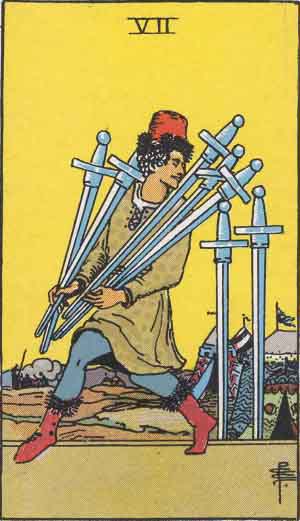
Sometimes it is a card of revenge, a desire to get even, to receive compensation. According to one version, the five swords that the character on the card is carrying away (two are left on the ground) are the weapons that were taken away in the Five of Swords Arcana, after which they were forced to retreat for a while (the Six of Swords), but now they have returned and taken back what is theirs. This is a tough cookie, a worldly-wise person who has been through hell and high water, a master of spinning yarns and navigating slippery slopes, mostly to dodge retribution.
The Seven of Swords is distinguished by a good understanding of the human psyche with all its weaknesses and is inclined to explain everything subtle and irrational with the help of logic (sometimes a bit nervously).
Withdrawing into daydreams (and often—negative expectations) and a melancholic detachment from a sober assessment of practical life. A flight of thought into the transcendent spheres of utopia. Reason gives itself over to the service of the soul and accepts its aspirations, hopes, and illusions: it detaches from reality and experiences surprise and confusion in the face of its own qualities, which it previously hadn't even suspected. Human fantasy can paint beautiful worlds—however, it is unable to manifest these worlds in life, which is why this card is called "Futility." What is created by thought is ephemeral, and reason doubts its own reality of its ideas.
Seven is the most perfect of numbers. At its stage, a striving for perfection manifests itself, so actions at the level of the Seven of Swords are distinguished by refinement and subtlety, although sometimes they are excessive. Air builds overly complex schemes on the path to victory, often contrived ones. When it comes to art, this is the development of skills and abilities. Here, metaphysical forces are realized as an act of creation on the level of subtle planes.
In the theme of the Seven of Swords, Venus, Neptune, and Uranus resonate distinctly. Neptune gives the Seven of Swords illusions. It encourages taking wishful thinking for reality, while in fact, the Path to the intended Goal turns out to be harder and longer. At the same time, this card combines the idealism of Aquarius and the half-heartedness of Libra. (Partial achievement of what was planned also implies the presence of a certain volume of what was not achieved.) But the Seven is not as maximalist as the Three or the Five, so it is capable of being satisfied with a partial result.
Some authors believe that the Seven of Swords shows the reverse side of The Magician, which is why they share the golden background on both cards. The power of knowledge, a clear, sharp mind turn here into dangerous thoughts and lack of principles, hidden plans and a fraudulent game, tricks and intrigues, meanness and deception, theft and swindling. In a milder form, it can be a practical joke, a wicked tongue, intellectual arrogance, or a "not my problem" attitude—an unwillingness to notice certain things, a habit of dodging, dodging, slacking off, etc. At the same time, it is unclear who is deceiving whom here, who is the crook and who is the victim. But most often it turns out that we are harming ourselves here.
Having decided on this, a person compromises their conscience - it is a path to nowhere. Resourcefulness in overcoming difficulties, getting out of a predicament through bluffing and lying... in general, the goals are very dubious, but in any case, the main thing is not to cross the line too far. Manipulations, slipping away from responsibilities with fox-like cunning. Dodges and excuses, tricks and ruses to achieve a goal. Skillful, cunning actions perfectly suited to the situation, with benefit to oneself. Often this benefit consists in finding a safe haven, a place of comfort and meditative pastime, and hiding out there, having fooled everyone. It's about dubious and invisible goals and intentions, an attempt to slip away, to evade unpleasant situations, contradictions, responsibilities...
And the basis for this are existential fears and negative expectations (depression). The only problem is that the conscious and subconscious minds have swapped places. Gloomy subconscious expectations seize the conscious mind and prevent obvious success. Heavy anxiety prevails, although in reality everything is going perfectly well. These destructive thoughts should not be taken seriously. Reality differs significantly from how it is perceived at the moment. Fears have nothing to do with it. This is a card of a critical approach to thinking itself—one must wake up and see what is really going on.
The card depicts a temporarily pitched tent camp. A person uncertainly carries five swords and looks back at two more, which he didn't take, apparently forgotten out of absent-mindedness. Or maybe he just can't carry away all the weapons he found in the enemy camp. There is an opinion that the card depicts a person habitually trying to find a way out of a difficult situation and avoid conflict through cunning. But now, alas, the tested method serves him poorly: two swords remain with the "enemies," and even those he managed to carry away cut his hands. The tents symbolize instability: in the realm of the unknown, consciousness feels like a thief sneaking up on the enemy—it is capable of rejecting and losing all its past achievements.
In this situation, it is important to define the guiding lines of thought, recalling one's previous goals: this will provide support and more confident movement in the long run. Turning to the past can become a "memory of the future," and the secrets of the depths of the soul—the future heights of thought: provided, of course, they don't remain secrets. At best, this card indicates inner cognition, epiphany, finding obvious solutions to complex issues, the ability to read signs of fate; the systematic development of inner perception. This is precisely why one encounters such super-positive interpretations of this card as a strong inner voice, great knowledge of the esoteric, understanding and acceptance of symbols, finding the spiritual meaning of life.
The third decan of Aquarius is ruled by the Moon and Neptune, the planets of Faith and mysticism, symbolizing the flight of thought into the transcendent spheres of utopia. In this decan, reason gives itself over to the service of the soul and accepts its aspirations, hopes, and illusions: it detaches from reality and experiences surprise and confusion in the face of its own qualities, which it previously hadn't even suspected. This decan is characterized by a withdrawal into daydreams and a melancholic detachment from a sober assessment of practical life.
Human fantasy can paint beautiful worlds—however, it is unable to manifest these worlds in life, which is why this decan is called "Futility." What is created by thought is ephemeral, and reason doubts its own reality of its ideas. The essence of this decan reflects the saying that laziness is the engine of progress, and the Aquarian image of Ivan the Fool, who miraculously became a king—but only because, doing nothing extraneous and without hesitating, he walked toward his intended goal. In the theme of the Seven of Swords, Venus, Neptune, and Uranus resonate distinctly. Therefore, this card also has the meaning of esotericism and verbal demiurgy (words directing the will, one of the card's meanings being "Oath").
Light and shadow (advice and warning)
Advice: if I can't take it by force, I'll take it by cunning! Show ingenuity and diplomacy, do not seek conflict, do not try to bulldoze through issues, but use roundabout ways, veiling your intentions. Strategically calculated behavior, no unnecessary movements. Caution, akin to an owl's in the dead of night, will lead to what the heart desires. Now is not the time to force events or reveal your true intentions; it is better to beat around the bush. You can bring to bear all the dexterity available and all the known tricks. Sometimes this is an advice to exit the game, not to get involved at all. Also, this is an advice to carefully cover your tracks, to ensure that pursuit is impossible and inquiries lead nowhere. This can be important when you have to do something incompatible with morality, but for your own good or the good of others.
The classic warning of the Seven of Swords: keep quiet. You should beware of overconfidence, otherwise everything will collapse. You shouldn't rush forward too much and broadcast your plans. The card says that there is no need to talk about what you need or what you plan to do—talkativeness will not play into your hands. Also, it is clearly not the time for lies, double-dealing, tricks, and treachery. "He who digs a pit for others will fall into it himself." It makes sense to hold off on "palace coups." Avoid dubious companions. And finally—beware of fraud and people manipulating others for their own interests.
By and large, this is a card of planning and maneuvers. The surrounding cards will tell you what comes of it. There is an opinion that a plan under the Seven of Swords always fails, but this is clearly an exaggeration. This card could very well be like a brilliant special operation behind enemy lines that will become legendary for a long time. It is energy directed at creating plans, projects. The card can also mean overcoming difficulties, triumphing over routine by thoroughly mastering it, it is success after long, feverish activity.
Receiving strength, instructions, cunning advice on how to cope and get through all difficulties. New attempts to overcome former obstacles may be successful this time if confidence and plans are based on knowledge of the situation and experience has already taught what needs to be known.
Under this card fall all sorts of research for projects and diplomas, but also, in fairness, manipulating results for one's own benefit, as well as plagiarism.
The best words that suit this card in a negative environment are shady dealings, dubious transactions. But it can also simply mean an unconventional approach to resolving an issue.
The card often appears for a person who feels guilty in a specific situation before certain people because they let them down, or is avoiding their bosses because they are neglecting their duties. It speaks of cunning and manipulative behavior, a grandiose hoax, misleading others and slipping away, distorting the real state of affairs, weaving intrigues.
If we talk about art, the Seven of Swords symbolizes the development of skills, abilities. Its metaphysical forces are realized as an act of creation on the level of rather subtle planes. It is energy directed at creating plans, projects. The card can also mean overcoming difficulties, triumphing over routine by thoroughly mastering it, it is success after long feverish activity (chores).
Unforeseen circumstances, barriers, intrigues, obstacles.
This is a card of surveillance, espionage, and betrayal. Such things can take place in a wide variety of occupations in a wide variety of organizations. Even if the querent is not Agent 007, copying materials from other people's flash drives and taking note of overheard phone conversations might be a familiar activity for them.
Sometimes the card describes the "battle of one strong person against many weak ones."
Some interpretations suggest that this card portends financial success. A desire to appropriate someone else's property, to make a profit through deceit and tricks. Unreliable financial offers (promised profits are empty words, but troubles are likely). Scams leading to losses (however, it makes sense to carefully examine the other cards in the spread).
Cunning and lies, or at the very least—insincerity. What is hindering sincerity can be suggested by other cards. This card loves what can be called a false idyll—partners pretend that everything is fine, although at least one of them knows perfectly well that things are not at all what they seem and is wrapping the other around their finger.
In love—serious deception, fooling a partner, or avoiding open expressions of feelings. However, it's not always so terrible. "If I can't take it by force, I'll take it by cunning!" can be reframed in this case, imagining a not-so-beautiful Vasilisa or a not-so-handsome knight without a white horse, who know for sure that no one will fall in love with them at first sight. Tricks, strategies, and ruses are developed so that the other party is won over and believes that they are facing "the most charming and attractive" person (by the way, the maneuvers from the movie of the same name are also pure Seven of Swords: zero feelings, but making the chosen object fall in love is equated to a combat mission, and each of the naive maneuvers is coordinated in "headquarters").
In a more menacing version, this is Valmont from "Dangerous Liaisons." This is an experienced intriguer and a great lover of confusing people, a worldly-wise person who has been through hell and high water, cunning and adventurous. He has gone through fire, water, and brass pipes and is ready for any test. His genre is thrill, insincerity, games, seduction, subtle catches, and running away from responsibility. This person is always ready to slip away, to exit the game. A traitor and manipulator, cleverly deceiving other people's expectations and getting away with it for the hundred-and-fifth time. On the sly, he plots practical jokes and insidious intrigues, never being honest and open in his feelings and thoughts. But sometimes he crosses the line and becomes defenseless against the negative encroachment of others himself.
The partner described by the Seven of Swords can be very sophisticated in love games at all their stages. Pick up is usually mastered to perfection here; this is a master (or mistress) of seduction, moreover without any sincere feelings on their part. It's art for art's sake, strategy for strategy's sake, and specific objects here are always in the position of extras, even if they think they've finally been invited for the main role. This person knows perfectly well what to write in ambiguous messages, what expression to look into your eyes with, what and how to do when it comes to intimacy, and most importantly—at what moment to melt away like morning mist. And you shouldn't underestimate them, thinking their skill is limited strictly to flirting and bedroom gymnastics—they find the "G-spots" on the heart with equal confidence.
The Seven of Swords disarms, exactly in accordance with the image on the Arcana... and apparently, nobody in those tents even realized what was happening.
Sometimes the Seven of Swords involves stalking an object, getting into their cell phone and email, secretly taking photos, and other such "services." Stealing, appropriating, or planting any personal items (for example, for the purpose of blackmail) are also included here. One of the card's meanings is "immodest peeping." This can be both erotic voyeurism and the businesslike nature of paparazzi.
On a personal level, the Seven of Swords really hates losing its freedom and taking responsibility for anything or anyone. Emotional attachments that threaten personal independence frighten this nature. Sometimes the Seven of Swords describes a desire for solitude.
Melancholia
Again—"he who digs a pit for others will fall into it himself," and here, it seems, you already have!
The best meaning of this card is the ability to avoid conflict with a dangerous opponent. Although not entirely legal, there is nothing to fear. Suspicions regarding theft and indecency can be dismissed.
In the reversed position, the card symbolizes advice, instructions, remarks, reproaches, reprimands, corrections—that is, everything that does not allow one to cheat and stray from the true path. At the same time, the reversed Seven of Swords can also indicate a lack of energy to achieve what is planned (Libra), as well as a lack of recognition from others (Aquarius). Furthermore, this card means disarmament (including psychological—being weak, helpless), incompleteness. For example, a person, having barely reached a certain point, instead of moving further, becoming frightened of trials and giving up on a goal that is already close—runs away. One interesting interpretation is that the reversed Seven of Swords points to the presence of a rejected or "unsuitable" person. This meaning is worth considering if the spread is done for relationships, as well as the meaning of exposure, tearing off masks, and laying bare true intentions.
Traditional reversed meaning: slander, plans that may collapse, overconfidence leading to instability in affairs, annoyance. Dubious advice received from someone. Sometimes the card says that a person has penetrated a secret they don't need, has become an "unnecessary witness," has stuck their nose into something they'd be better off staying away from. The upright card speaks of intellect, the reversed one—"much knowledge brings much sorrow."
At the same time, there is an opinion that the reversed Seven of Swords speaks of cautious actions and a measured approach to a matter. Before embarking on intrigues and cunning plans, a person ponders whether the game is worth the candle.
Traditional meaning—news, announcements. With the Seven of Pentacles—profit, with the reversed Ace of Swords—childbirth (from an ancient interpretation book).
The Hierophant – weakens the effect of the Seven of Swords
Justice – weakens the effect of the Seven of Swords
With The Hermit – loneliness, withdrawal from society
With The Hanged Man - loss of property or position.
With The Moon - something hidden within a person, unconscious, suppressed.
With The Sun, with The World - acquisition and luck in the sphere of life the querent is divining about.
With Ten of Wands – taking on obligations that one wanted to dodge
With Two of Swords – running from the truth
With Five of Swords – dishonor, isolation from others, possibly due to the exposure of a lie
With Six of Cups – the cunning influence of the Seven of Swords weakens: openness and kindness
With Nine of Pentacles – the desire to rely on oneself, to act at one's own discretion.
In combination with Justice – there is a great risk of facing exposure and bearing punishment, maneuvers will not be hidden. In combination with The Devil, the outcome is sometimes more favorable for the querent – they manage to get away with it and cover their tracks. But still, one should not consider this a guarantee of safety.
"Measure twice, cut once"
"The Council of War at Fili"
Trojan Horse
All situations of betrayal and renunciation