Five of Pentacles
Pentacles — Minor Arcana
Detailed Interpretation
The Five of Pentacles has traditionally been considered a good card for love and a bad one for money. It foretold young men and maidens a marriage of love, by the dictates of the heart, but contrary to all mercantile considerations (and, accordingly, paradise in a tent without inheritances and dowries, in disgrace with relatives). Surely, there were those who rejoiced at such a prediction, and those whom it scared quite a bit.
The Five of Pentacles favors those "living by the heart." It supports the spiritual principle, sometimes destroying the material one (just as a bodily illness often sets the spirit on the true path). It usually signifies the loss of something material and the acquisition of worldly experience in return, learning a lesson. All Fives symbolize the beginning of transformations that are meant to radically change our lives, and this does not pass painlessly.
The secret of the Five of Pentacles is that the most important thing on this card is the Temple. Spiritual strength helps overcome life's miscalculations and becomes a person's natural inner support in material activities, while true feeling possesses great power and gives a person the opportunity to rise above circumstances. The traditional meaning is material hardship, but also the opportunity to receive the spiritual in exchange for the material.
The Five of Pentacles is a card of hard times, crisis, deprivation, anxiety, and loss. It speaks of the loss or shortage of something necessary. At the same time, the card rarely serves as a harbinger of truly serious losses, grief, or ruin (although generally, for material matters, this is a serious warning of danger), but mainly indicates the uncertainty of the situation and the fear being experienced of losing the ground beneath one's feet. It must be remembered that in life, as in any other journey, anxiety is a poor guide. Such periods of decline are characteristic of any growth crisis, when a person leaves a certain sphere that had become familiar and stable, and moves into a new, yet unfamiliar, and possibly dangerous one.
In any case, it speaks of an over-the-limit squandering of certain resources and energies and of facing the consequences. One can become impoverished even by living a good life. Building wealth back up requires consistent actions ("a penny saved is a penny earned"). One of the old interpretations is a waste of time and effort.
The universal meaning of the card is unachieved goals, failed enterprises, mistakes and failures, business disasters, material losses, and even poverty. The querent is or will soon be in a situation where money is tight, and the income they were counting on is passing them by. Sometimes this is the result of uncontrollable circumstances, sometimes — of one's own actions, extravagance, and imprudence.
This is a collision with unpleasant life realities that shatter the illusion of perfection. The card foretells losses and a depressed state of mind, and this is not necessarily about material problems — simply that a difficult period is ahead and one will have to tighten their belt to overcome it. This is a time of fatigue and exhaustion (lack of physical strength, loss of vital energy and joy), or poverty, a beggarly existence (lack of money, inability to improve one's financial situation), or desperate loneliness (lack of love, coldness, rejection, being cut off from loved ones), or self-doubt (loss of faith in oneself, in one's abilities and skills).
The card says that for some (possibly quite a long) time, expectations and hopes must be put on hold, caution must be exercised, and what is left must be economized. Life will be full of daily chores, worries and problems, difficulties and limitations, possibly failures, and attempts to barely make ends meet. It can bring an unstable position and self-doubt regarding both work and relationships.
The traditional interpretation "everything will be resolved in five weeks" is often confirmed in practice. One must know not to lose their head. You will have to suffer for a while, but this time will end, even if current heavy circumstances bring on despondency and strength is running out.
This card involves upheavals caused by the beginning of some transformations in life. As is known, in such cases, things often get worse before they get better — it's something like the state of a person who finally decided to take care of themselves and went to the gym. The next day, even those muscles they didn't know existed will ache excruciatingly — that is, by sensation, it got worse than it was. The Five of Pentacles often describes such a "disastrous" initial stage and says — endure for five weeks.
Devastated and depressed, anxious and unhappy. Under the Five of Pentacles, a person sometimes exists in a sort of half-slumber and half-depression, when nothing appeals and there are no convincing reasons either to live or to die. At best — "blessed are the poor in spirit." This is a decline, an unlucky streak (lasting five weeks according to ancient beliefs, and this often really works), when we feel pathetic, abandoned, and sometimes are truly in straitened circumstances.
Gloomy reflections, fears for one's position, pessimism when it seems that everything around is simply falling apart. The Five of Pentacles describes a heavy inner state when thoughts go in circles, a literal black hole of hopelessness forms deep in the soul, creative energy is blocked, and it is impossible to do anything sensible or make any changes. This experience always affects one deeply. It cannot be simply pushed away.
This card, following the Nine of Swords, often accentuates anxiety, an agonizing restlessness. Frequently, this is literally the fear of poverty, the dread of difficulties and ruin. Heavy thoughts about one's loneliness, uselessness, abandonment, and lack of love are possible. As Banzhaf and Akron write, "Restlessness and emptiness as a result of the summation of negative influences in the wrong direction."
The card of debtors, the poor, the unemployed, outcasts, people extremely insecure or aware of some of their own defects, limitations, or flaws. An inferiority complex is also the Five of Pentacles. This card indicates that at the moment a person is severely lacking something — money, love, food, warmth... they are lonely and not taking care of themselves. Under the Five of Pentacles, a person may be in cramped circumstances, in a severe crisis, or deeply offended. The ground slips from under their feet, leaving only a feeling of wretchedness and powerlessness.
The card describes one of life's harshest challenges — remaining a spiritual and creative person when there is nothing to eat. Staying strong and whole while being sick or crippled. Not losing inner beauty while contemplating physical defects in the mirror.
Staying true to one's principles when it threatens losses and suffering. This is the juxtaposition of the external and internal, the physical and mental, the material and spiritual, the worldly and the heavenly, and the question is — what do you have the strength for? Is it truly not by bread alone? Are the poor in spirit truly blessed? The Fives are connected to the mystery of the Fifth Arcana. This card reflects the simplicity and incomprehensibility of the Sermon on the Mount. In a historical sense, this Arcana corresponds to all kinds of pauperum commilitonum — monastic formations with an emphasis on poverty, non-possessiveness, and the elevation of the spirit through the humility of the soul.
One of the interesting meanings of the card is that it often actually points to closeness to the church and its ideals. A hermitic and ascetic life, purifying the soul through hardships, humility, and patience cease to be a metaphor here, and one recalls the ancient observation that deeply religious people endure life's hardships and stress entirely differently. The light emanating from the teachings of the church warms and supports quite tangibly during truly hard times. The Five of Pentacles can speak of the need to maintain a humble and highly spiritual position under any circumstances and remind us that such trials and suffering are fleeting (the mystery of Job).
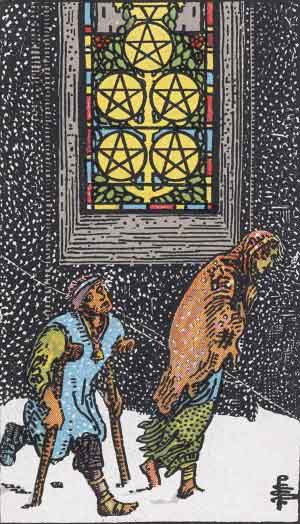
The snow on the card is a sign of the presence of water, the possibility of future purification. Crowley and Philadoro share an interesting observation that the key word of the Five of Pentacles is anxiety, which a person feels due to the loss of an imaginary security that just yesterday defined their thinking (itself being a great illusion). And the root of this anxiety is a lack of faith. It is exactly that which we lose.
After all, in ordinary life, we all "walk over an abyss," all our well-being and life itself can be cut short from hour to hour, but the belief that this will not happen, that everything will be fine, allows us to feel quite carefree, comfortable, and self-confident on our little perch above the abyss. At the moment when we draw the Five of Pentacles, this faith evaporates somewhere and we feel terribly vulnerable, defenseless, and "over the abyss" — the ground we leaned on so firmly and mindlessly suddenly slips from under our feet.
There is an opinion that the Five of Pentacles acts upon a soul slumbering amidst everyday life like a stone thrown into a swamp. No other card will so accurately reflect the state of a hero, crazed by the blissful state of the Four of Pentacles, like the Five of Pentacles. From an astrological point of view, the theme of this card loudly echoes Uranus in detriment in Leo. Where Aquarius would be "absorbed" by a new idea, Leo will get himself a mistress, which is why the Five of Pentacles often means erotic adventures, infatuation, flirtation, love games (and Reversed — disharmony in love, fear, dissipation of energy).
The situation of a rake or a reveler often falls under the Five of Pentacles. The explosion of the calm atmosphere of the Four, of course, does not come without a price. It is often accompanied by financial losses, breakdowns, failures, disappointments, and ambiguous situations. Sometimes the disruption of the Four's peace turns out to be a mistake, and the person only thinks about how to get back (the devil tempted them). At the same time, it should be noted that the Five of Pentacles symbolizes karmic situations, that is, predetermined ones. Paying karmic debts, the theme of the return of the prodigal son.
In general, if the Fours are confidence and orderliness in life, then the Fives are an external impact that shatters the illusion of perfection and plunges one into a depressed state of mind.
The Five of Pentacles means complications and difficulties leading to success and affirmation at a new level (under the Six of Pentacles, this is at least luck in receiving help), or returning one back to the level of the Four. One way or another, the memory of the lived experience remains, regardless of whether it was positive or negative.
The sign of Taurus symbolizes the capacity for creative labor. But true creation is a harmonious union of the material and the spiritual into a single whole. If Capricorn's actions rely on their own inner core and their "I" is capable of leading them to the goal because it turns out to be more significant for this sign than everything else, then for Taurus, their "I" dissolves in feeling and desire.
If a person's "I" is satisfied and nothing else forces them to act, then, in order to get down to business, a desire must arise to do "something" for which the surrounding world will be grateful to you. Therefore, the main task of the first decan of Taurus is to realize one's feelings, to understand the desires that have crept into the soul, and to respond to them. This decan is characterized by enterprise in everything related to the sensual sphere, and therefore it is distinguished by successful functioning and administrative activity in the field of art.
It is also characterized by emotional receptivity, endowed by the search-prone Mercury — its ruler, although a slowness of perception is typical for Taurus. Feeling assimilates information not at the same speed as reason, but firmly: by comprehending, it lays the foundation for the building of the future. Sensual experience becomes the basis of life wisdom. And wisdom traditionally speaks of the frailty of all things perishable.
The card depicts beggars under the windows of a temple. The pathetic figures of the two cripples show to what extent a person has no control over the earthly. Free will often only cripples a person: they are frequently unable to walk their life path without mistakes (and as a result, feel anxiety due to waste and violations). This card shows the space that a person creates themselves, but it often turns out to be far from perfect due to their excessive ambitions and unrealizable desires.
There is an opinion that the two beggars wandering in the snowfall reflect the general state of all humanity. The light in the stained-glass window symbolizes esoteric wisdom, the attainment of which gives liberation from worldly hardships. Alas, the poor fellows wander past, unaware that salvation is near, although a bell hangs on the cripple's chest, symbolizing the voice of intuition.
Light and shadow (advice and warning)
Advice — save funds and do not get into any risky ventures. Now is not the time to test your resilience. Simplify your lifestyle by reducing your needs to the bare essentials. Prefer loneliness over maintaining a gloomy connection. Any material donations now help spiritual growth. Hardships unite you with those who are truly close. Sometimes the card advises asking for help in a difficult situation — the world is not without kind people.
Trap — ossifying in habitual and eternal dissatisfaction (including with oneself), playing the poor man, languishing in a sense of inferiority, panicking at the fear of refusal. Getting bogged down in a hopeless situation. This card is often exactly a warning, an indication of the need to give matters due attention, watch every step, demonstrate commitment at work, fulfill one's duty, and stop wastefulness. Often this is a hint from the cards that we spend our available money on anything but investing it in our own stability, security, and development. The card can also say that unjustified pride prevents accepting much-needed help that has been offered more than once.
"Wow, things are really out of hand."
Catastrophic business failures.
Company bankruptcy. Dead-end projects. Crisis, helplessness, despondency, unpromising affairs, hopeless plans, hostility, and bullying. "This is a beggar's business" — it either literally lacks financial injections, or it is completely devoid of any solid foundation whatsoever. This can manifest, for example, as a lack of demand.
At the same time, surrounded by favorable cards, the Five of Pentacles can indicate a very promising business that has to be "started in a garage," like the founder of Microsoft. At first, it will be hard, some may not understand the intentions and even condemn them; you will have to defend yourself and your convictions while working in a difficult environment.
As a symbol of the collapse of the Four's balanced scheme, it can manifest as anarchy, confusion and vacillation, and the clash of group interests.
Ziegler's brilliant words regarding the Five of Pentacles — "this is a black hole affecting the deepest depths of the subconscious, thoughts wandering in circles in a fruitless inner dialogue while energy is blocked" — can only be truly felt when one finds themselves precisely in such a situation. Difficulties, bullying, expulsion from the group. Problematic communication, its disgusting residual negativity, a sense of losing in an "I'm bad — you're bad" dynamic, which brings a loss of vital energy and joy.
The Five of Pentacles can describe both being overwhelmed with work with clearly insufficient remuneration, as well as dismissal, loss of a job, and unemployment.
It is curious that in modern tarot reading, this is considered a card of sponsors, patrons of the arts, and the purpose of money for the development of art (again, in the sense of sacrificing the material and acquiring the spiritual).
As a symbol of professional affiliation, it can be related to working in a hospital, a nursing home, a hospice, a social center, less often in a church or in organizations providing assistance to refugees and victims of mass disasters.
Monetary losses. Material difficulties. Ruin, poverty. Loss of a roof over one's head. This is a card of poverty, hard times, need, losses, lack of material resources, impoverishment, and lack of prosperity. Unemployment, living on welfare or a small pension. The need to economize every bit of resources (any kind, not necessarily money), dependence on others, being forced to beg (one way or another), the need for charitable assistance.
Tight with money — through one's own fault or due to circumstances. Loss of advantages and a favorable position. The income that was counted on will pass by, invested funds will not return. This can be a situation where a person spends more than they earn. "So interesting, it's terrifying." Being burdened with excessive financial obligations, the need to immediately repay debts, a monetary fine.
The best thing the card can give is freedom from obligations associated with money and property, but few possess such a level of philosophical perception of reality to appreciate this freedom as something particularly positive.
The Reversed Five of Pentacles can mean an unexpected profit.
As for relationships, everyone must still draw their own conclusion based on personal experience.
This card is often attributed the meaning of attachment to a lover or mistress, but this is rather the sense of a strong, inseparable bond between two people who suffer together, unrecognized by society, but who will never part, no matter what hardships their connection entails.
This card symbolizes people (or a person) who have become accustomed to their position and do not even think it can be changed. The foundation of their relationship becomes a joint struggle against a cruel world (therefore, in a Reversed position, this card, promising a general improvement in life, puts such relationships at risk). Sometimes, through it, a person goes through moral torment to a literally hard-won decision.
In some interpretations, it speaks of the legalization of relationships (sometimes it is an indicator of court, legal instances), of obligation, decencies, bonds and connections, of respectability (and only in a Reversed position does it speak of discord, spoilage, chaos, disorder, strife, and ruin).
Sometimes this card nevertheless means exactly deprivation, loss of love, and bereavement. Sometimes the card says that the two are tired of each other and there is not much to wait for right now. Sometimes it is expressed in separation from a partner, and in loneliness, and in a sudden rupture of relationships (the departure of one, the abandonment of the other, the one leaving may feel abandoned, etc.). Other cards in the spread can provide a clue.
This may be a period in a relationship when at least one of the partners cries into their pillow from a sense of defenselessness and self-doubt; they are hurt and scared, and they are tormented by the feeling that they have no place next to the other, that they are unloved and unneeded. An inferiority complex and a victim mentality. Feelings of loneliness, uselessness, abandonment, rejection, and emotional woundedness.
Another meaning is an exhausting relationship in which the partner clearly abuses the querent's resources — money, emotions, sexual energy... whatever the matter concerns, there is vampirism without a glimmer of mercy. The result is a loss of vital energy and joy. Perhaps the lack of money interferes with love. Another meaning is erotic adventures leading to losses in business.
Sometimes — the disconnection of people, problematic communication in a relationship, they are under threat and everything seems completely hopeless and impossible.
However, the Five of Pentacles is not so simple, and it is not for nothing that in ancient times it was considered directly related to the theme of love. It can describe a passionately loving and deeply suffering partner who "stands at the door and knocks" (and sometimes literally is ready to live outside the door on the staircase), while in their heart they are much richer than the one rejecting them. They stand at the locked doors of the other's cruel heart like a beggar, repeating "have mercy!" And in fact, they are asking NOT FOR THEMSELVES. They stand as a beggar for the other, so that something changes in their heart, so that their hand gives them what they ask for, so that they learn this for themselves.
Bad! Serious health problems.
Depression, despondency, a sharp decline in strength. An energy strike.
Complete exhaustion of vital resources, lowered immunity. A chronic illness that drains vital forces. Cancer.
Chronic fatigue syndrome, professional burnout, acquired immunodeficiency syndrome.
The presence of harmful habits that undermine health.
Anorexia, avitaminosis, malnutrition.
Colds, illnesses caused by hypothermia, pneumonia.
Fractures (especially of the legs), mutilations.
Malformations, congenital pathologies.
In a Reversed position, the Five of Pentacles means an overexpenditure of energy, a squandering of reserves, extravagance, vulnerability, and fear. It can symbolize disharmony in romantic relationships. Here, the afflicted sign of Leo or the Fifth House plays out. Traditionally — "shameful love," "a dissolute lifestyle."
The card can also indicate stagnation in affairs, worldly worries, and dissatisfaction. It may happen that the querent sees great opportunities for themselves, but they are not yet fully attainable.
At best, the card can report that the losses are not as great as one might have feared. Getting a job (at least temporary) after unemployment, improvement (at least temporary) of health after an illness, restoration of prosperity after bankruptcy, an amnesty. The prospect of spiritual rebirth, the end of an unfavorable streak. Mary Greer writes that in the Reversed position, the window on the card turns into a door leading to a peaceful sanctuary. Humility, patience, and pacification are attributed to this card.
With Strength — strength, endurance, steadfastness in trials
With The Tower — breakdown of marriage, hard times
With Wheel of Fortune — happy matrimony
With The Hanged Man — danger to honor (with Strength — avoiding dishonor).
With Temperance — restoration of health
With The Sun — vital forces, a strong constitution
With Six of Wands — recognition, fame, the card is considered to weaken the influence of the Five of Pentacles
With Ten of Wands — hard work, attempts to make ends meet
With Three of Swords — refusal, lack of support
With Five of Cups — refusal, loss of approval and support
The sufferings of Job
"The seven lean years"
"Let those who have be as though they have not."