Four of Pentacles
Pentacles — Minor Arcana
Detailed Interpretation
The card describes something built with great effort, yet possessing a certain margin of safety. This could be anything—a business, health, a relationship, or a value system. This "something" looks reliable, but in reality, it lacks elasticity and adaptability. This is a card of possession and preserving what belongs to us, of satisfaction with the current situation and the desire to maintain it. This is where the energy of the person who drew the Four of Pentacles is concentrated.
It symbolizes prudence and careful planning, a readiness to act in order to achieve the desired stability or preserve the existing order. It provides a feeling of solid ground beneath one's feet, but... also the feeling that some factor threatens current stability, creating a need to protect one's domain (akin to the Nine of Wands). Selfishness and greed, the urge to guard one's assets (time, money, various opportunities), the fear of loss, and an unwillingness to share. It is a kind of blockage and stagnation.
Sometimes, interpretations like an increase in income and influence are encountered, but the word "increase" is highly questionable in this context. The core essence of the Four of Pentacles is the fixation on what already exists and the assurance of its inviolability and security. It is resting on guarded laurels (quite decent ones), but this prevents moving forward and preparing for the future.
The Four of Pentacles symbolizes the end of the process whose beginning we saw in the sign of the Ace, and the point of ascent in the Three of Pentacles. The Four says that a person has achieved what they wanted and is no longer striving for new heights: what they have is quite enough. There is no intention to exert any effort to gain more. An old meaning is a person who achieves success, but a minor one. The card symbolizes a certain "ecological niche" occupied by a person in society—they broke through somewhere, achieved something, and are trying to hold on. The success achieved here is logical and is the result of effort.
The best thing the energy of this card offers is stability and order, gaining some control over what causes unrest. Crowley believed that it brings lasting stability and security, but the problem is that a person feels far more anxiety than security under its influence, and it is precisely this anxiety that prompts them to take action for further self-defense. The energy of this card does not tolerate "random accidents," yet there are so many of them in life!
Generally, in dangerous and confusing situations, the energy of the Four of Pentacles is good and can even be a lifesaver. It helps to keep from going crazy, to hold boundaries, to stand one's ground, and to protect against external threats. At the same time, the meaning of a vicious circle and playing the "yes, but..." game is quite strong in it.
Sometimes the card foretells a clash with "law and order," interacting with some bureaucratic, administrative structures.
One of the traditional meanings is an expensive gift. Generally, in ancient interpretation manuals, exclusively positive meanings are attributed to the card, especially from the perspective of people of that era—property, receiving an inheritance; reward, benefits, services, favors; as well as the absence of worries, reliability and order in the house, a solid position. One can almost picture a respectable bourgeois, perhaps even of nobility (the character wears a crown). It's a bit difficult for a modern person to directly identify with such an image, so the appearance of this card in a spread has increasingly come to be perceived negatively—something like a run-in with a miser who will refuse a loan.
The mystery of this card is a closed circle, a confined space.
Fixated, wary, and possessive—like the feeling we experience at an airport or train station when worrying about the safety of our luggage. This is a card of control and anxiety. If the Four of Pentacles appears, there is an existential fear, profound hidden anxiety, and an acute need for protection. It expresses suspiciousness, stubbornness, and a massive reluctance to take even the slightest risk.
All energy is spent on preserving the status quo (nothing leaves, although nothing can come in either). We walk in circles, clinging to the current situation out of a desire for stability and security that has turned into almost an obsession.
The person of the Four of Pentacles does not let go of their bags—and they won't drop a suitcase without a handle either. In this sense, they are like an immovable fortress. A "first-rate miser," that's what comes to mind to say. They are afraid of falling into poverty in their old age. They are afraid of losing anything at all (if the Nine of Swords is nearby, then it's sheer panic).
It is natural for them to tremble over their money if they are a businessman, over their loved ones if they are a father, over their place in a troupe if they are an artist (and the status of a prima will only intensify their fears)... the list could go on endlessly. Perhaps the querent is currently defending against some attacks directed at them. Through this card, it is common for a person to exercise extreme caution in everything, trembling over their possessions, as they understand them.
It describes selfishness, greed, narrow-mindedness, and pettiness, but what these will apply to—money, relationships, etc.—is another question. Loyalty to one's habits, a reluctance to change anything—this is one of the main keys to this card. A "crusader of their own principles," and even more accurately, a "tank" (having armor, a narrow field of vision, tight quarters, all while being fixated on their "combat mission").
Power and an inflexible approach in the struggle for order, stability, and structure in life. Maintaining these standards seems more important than cheerfulness and humanity.
The person of the Four of Pentacles definitely has character, albeit a rather unpleasant one, and they know what they want and what they don't want, sometimes even too well, and ultimately it all boils down to serving their beloved self.
The best this card can offer is practicality and organizational talent within narrow limits, the ability to rely solely on oneself, the achievement of material security, and the ability to cope with any difficult life situation while maintaining control. The worst is the wretchedness of greed, expressed in complete distrust of others, reducing everything to money, and a readiness for any baseness for the sake of one's own interests.
At the same time, the person tends to lack compassion and nobility, justified by plausible excuses ("I have a family and children," "I earned this with hard work and I'm not going to share with anyone," etc.). Somewhere between these states lies heightened caution, which can take various forms ("normal heroes always take the bypass" with the Seven of Swords, "how terrifying it is to live" with The Moon, and so on). It characterizes a person who stands firmly on their feet, yet is simultaneously conservative to the point of timidity: they are afraid to take the slightest step aside, just to avoid introducing anything new, and therefore unfamiliar, into their life.
This card can also "catch up with" a creative person (incidentally, one of its meanings is an inherited talent). In this case, it may indicate that they cling to their laurels or to a familiar way of working; it is difficult for them to trust the flow, and they block their own creative abilities within a well-worn rut. There might also be an obsession with some fixed idea, not necessarily material. Although in general, this card often describes that specific degradation of consciousness that overtakes a person if they worry exclusively about money matters from morning till night (whether it's a "piece of bread" or deals with elite real estate)—interests catastrophically narrow, the psyche stops responding to non-material stimuli, and disregard for everything except one's own interests, popularly known as egoism, blossoms in full color. You can't convince a Four of Pentacles person to take a risk, nor to drink champagne (they might end up having to pay for it!)
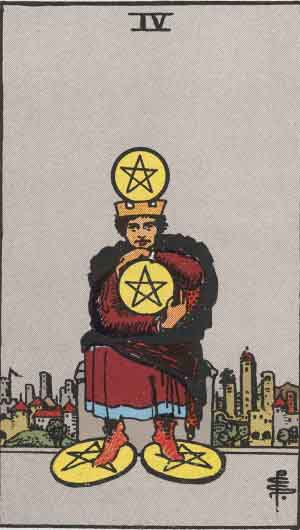
In the Four of Pentacles, the firmness and reality of the element of Earth (pentacles) and the numerological stability and orderliness of the Four harmonize perfectly. This is a kind of compact system with its own boundaries and standards. The card depicts a king with a crown on his head, walling himself off from life with his Pentacles.
He cannot take a step (two pentacles lie beneath his feet), he cannot think about anything else (the third pentacle "presses" on his crown), and he is obsessed with the idea of defending and securing himself (the fourth pentacle covers the center of his body like a shield). At the same time, this image of a crowned figure illustrates the fact that earthly power is often achieved through the concentration of resources, a reverent attitude towards what has been conquered, and a kind of greed.
The Thoth Tarot Arcana symbolically depicts the "divine city of Jerusalem"—the materialization of God's presence on earth. This Arcana raises the question: what earthly things are important to you, and why? A holy place is never empty—where is your "holy place" and what is in it? What gods or idols do you serve and worship? Is it not the golden calf (as an option)? As Banzhaf and Akron write, the power of the Four lies not in matter itself, but in how we give it meaning and place it at the center of attention. People love things, projecting an enormous amount of their psychic energy onto them in the form of attachment.
We are rarely truly attached to immaterial objects (ideas and principles). To material ones—all the time. The soul of another is far more interesting to us if there is a body in which it resides. We idealize the visible, that which can be touched. At the highest level, the "prosaic" Four of Pentacles truly poses "million-dollar questions"—what is the meaning of life? Why do we want to possess what we strive for, and become terribly disappointed if possession is impossible? What is our destiny?
In the theme of the Four of Pentacles, the theme of Cancer and the planets significant in this sign—Jupiter and The Moon—is clearly heard. Through Jupiter, gifts, patronage, social benefits, and humanitarian aid may pass. The Moon accentuates the meaning of home, family, and reliability. Altogether, it is attachment to the material. In a magical sense, it corresponds to material offerings, donations, small items intended for otherworldly inhabitants (including food and drinks), and also all situations where a person "pays off," paying for the absolution of sins in a literal sense (a vivid historical example is the practice of indulgences).
There is an opinion that the card corresponds to the third decan of Capricorn and symbolizes the achievement of tangible material results, reliance on solid foundations, and a firm conviction in the correctness of one's path. This decan is characterized by practicality, constructive use of opportunities, and an objective understanding of one's own benefit. This decan is ruled by The Sun, and it poses the problem of how to manage the material abundance that life provides.
An understanding of the power of material values alternately compels one to hoard wealth out of a fear of poverty, and then to renounce its self-sufficient power for the sake of one's freedom and lose everything completely. Representatives of this decan show an interest in issues of the struggle for survival in extreme conditions, allowing them to reveal those potential capabilities of the personality upon which society imposes limitations. People of this decan possess a natural taste: the imperfect does not satisfy them. This decan symbolizes a person's acquisition of all the material values necessary for life and further activity.
To some extent, the Wheel of Fortune serves as the opposite of this card. It signifies precisely the dynamic of change, not retention but uncontrollability, the relinquishment of control.
Light and Shadow (Advice and Warning)
Advice: a bird in the hand is definitely better than two in the bush (although squeezing this bird to the point of strangulation is still not worth it). The advice is to protect what has been achieved from external threats, to secure yourself and your property, to draw clear boundaries around the perimeter of your territory, to hold fast to what is yours, to maintain composure, to avoid the slightest risk, and to act with absolute certainty in everything. Stick to your plans, do not yield your positions.
Warning: do not acquire more than is needed, do not treat people like things, and do not get stuck in your approach to business. Stubbornness, rigidity, and stagnation are what threaten the endeavor. You shouldn't rest on your laurels—this heavily hinders preparing for the future. Many authors reasonably note that excessive anxiety about the future and a fear of any change are fundamentally hostile to life, because any attempts to "stop the moment" or hold everything as it is are not only futile but also contradict the natural course of things. Thus, the Four of Pentacles is a direct path to The Tower, which signifies the rupture of a hardened crust.
Concepts such as "not my circus, not my monkeys" and "charity begins at home" run through this card. The Four of Pentacles is connected to the concept of a boundary and symbolizes a fence, enclosing, any kind of demarcation of plots. This can apply to both land and work (everyone takes their share). The card quite accurately describes precisely situations of demarcation, the breakup of groups or companies, the founding of one's own firm, the beginning, so to speak, of a "solo career" (sometimes even literally). An unwillingness to share one's power. Hostile relationships within a team.
Narrow specialization, a bureaucratic organizational culture with a tendency towards stagnation. A labyrinth of rules, regulations, and over-precautions, where an atmosphere of stinginess, pettiness, and sometimes corruption and venality reigns.
This card points not so much to "resting on laurels" as to a frantic clinging to those very laurels—feel the difference, as they say. By and large, power and status are visible here (it's not for nothing that Waite's character has a crown on his head), but rather at the level of a petty boss. The best this card can offer is the strengthening of the organization, the concentration of resources, restoring order, and consistent actions to protect one's interests.
Traditionally, it is a card of merchants, shopkeepers, and moneylenders. In a modern understanding, it is most closely related to insurance companies, financial analysts, and professions related to banking and security structures. Customs, inspections. Also—activities related to hoarding and the protection of collections, museums, and galleries.
Traditionally—inheritance, a solid property status. In general, this card favors the concentration of money and other material resources, yet it brings a clear feeling of their insufficiency. Income, but modest. This could be financial stability in the form of a small but regular salary. Although the traditional meanings of this card in themselves are financial success, reliability, order, and material stability.
At best, this card indicates a strengthening of positions, gradual accumulation, and the safety of investments. But it is difficult to actually feel this security through it.
This card symbolizes shelter, so for housing matters, it can perhaps be considered favorable—it might not be a "dream home," but the querent will not be left without a roof over their head. One of the traditional meanings of the card is a dwelling in the city.
An emphasis on the inviolability of property, ownership (robbing the owner of the Four of Pentacles is a difficult task—they will snatch what is theirs right back with their bare hands). This card always says that the property belongs to the person by right.
This is a card of greed, and if the spread is done regarding receiving financial aid, one can hardly count on a particularly good result, although something might come your way (it's not excluded that it will be at a predatory interest rate).
The reversed card is traditionally considered bad for money matters. Unforeseen expenses, instability of material status. An unsuccessful venture, a decrease in previously accumulated capital, financial losses, and with a very negative surrounding context—even up to ruin.
Sometimes, an "overhaul fear" passes through this card that something will happen to the goods, pettiness, dictatorial narrowness of position. An unwillingness to yield anything, to make the slightest compromise, blatant rigidity and inflexibility, volitional stupor. A card of selfishness, fear, control, self-defense, and excessive caution. The pursuit of safety, a total unwillingness to take risks, narrowness of vision, establishing and protecting boundaries.
The Four of Pentacles has quite a few different meanings in the realm of personal life, and almost all of them are rather negative.
First, this is the card of "nay-sayers." Exactly the case when a boyfriend or girlfriend is in no hurry to walk down the aisle and defends themselves against this prospect in every possible way ("I'm fine as it is"). Loyalty to one's habits, an unwillingness to budge, resistance to change—they all trigger here too. The person of the Four of Pentacles believes in the correctness of their chosen path, and there is nothing to "catch" here. Sarah Bartlett writes that the Four of Pentacles depicts the ultimate individualist in the Tarot deck.
The card makes it clear that a person's circle of hopes and dreams is quite limited at the moment, and no matter what they are told about the need to take the next step toward building a relationship, they only wave it off with annoyance. An important characteristic of this card is the inability to share (in this case, it is literally an unwillingness to "share oneself" with another person).
Second, this is a card of possessive feelings in relationships, an urge to hold onto "what is mine," to protect one's living asset (and property). "I will never give you up to anyone." The desire to keep love under lock and key, not to give the partner freedom, not to allow even the slightest bit of such risk. Establishing boundaries for the sake of safety, fear, and a desire for complete control over the situation (even up to baseness), stemming from a love for well-being as the person themselves understands it, and even more accurately, from emotional vulnerability and a fear of the future. Jealousy (if Swords and The Devil are nearby—Othello is ready).
Under the Four of Pentacles, a suffocating atmosphere of suspiciousness is often created, where one must constantly give the other some guarantees and prove their loyalty (read: belonging). Agreements and obligations become extremely important here. As a peculiar consequence, the avoidance of any passion in relationships manifests itself quite vividly, since passion is something that destroys boundaries and the accustomed order.
Sometimes this card indicates a purely marriage of convenience, where money plays the first and last role. In any case, freedom, inspiration, and such things in these relationships are forgotten very quickly. An atmosphere of boredom, greed, and pettiness is not what adorns a life together. Perhaps the only plus of the Four of Pentacles is loyalty. Loving or not loving, this person is inclined to devotion ("But I am given to another, and I will be faithful to him forever"), and if it is indeed a deal, they will honestly fulfill their obligations.
Through this card, a thirst for having solid ground under one's feet manifests itself, as well as a tendency to observe the rules. A person tolerates no uncertainty in matters of love, has no intention of committing rash acts, and in general, the instinct of self-preservation replaces all others for them. "Ground under the feet" and confidence in tomorrow—these are their cult concepts. It is characteristic of them to be unwilling to show their feelings or to be guided by the movements of the soul in general.
The economy of feelings may well lead to a person repeatedly trying to build relationships purely out of calculation and/or remaining lonely.
The key words of the Four of Pentacles are to have, to possess, to belong. It strongly dislikes "giving" and opening up. As a rule, under this card, sex is out of the question; it carries an aspect of rigidity and sensual indifference. In general, it should be noted that Fours (except Wands) appear when things are bad in relationships. Not the most popular, but an interesting meaning of the Four of Pentacles manifests in the fact that it is a card... of intimate stinginess, "withholding," denying a partner their daily sex for one reason or another.
But usually, these reasons lie somewhere in the realm of control, anxiety, blockages, and finally, banal egoism. And then—either their head hurts, or Lent has begun, or hockey is on TV. We return to where we started—this is the card of "nay-sayers" who do not want to share themselves with someone else.
If the card describes family life, then most likely it looks like stability and order, the price of which is the loss of novelty, stagnation, lack of movement, a fixation on material values and concerns, on possession and security. In the house, a somewhat "hoarder" atmosphere is typical, where it is very difficult to throw out even the most useless junk. This is the case where relationships are strong—like a good prison.
They function, yes, but they absolutely lack fresh air to truly develop and flourish. The Four of Pentacles often describes something that is firmly stuck and moving in a vicious circle. All sorts of "golden cages" (in this case, rather—gilded ones) and "sitting under lock and key" (but "as if behind a stone wall") also fall under this card (and the temperature of this wall most likely corresponds to the material from which it is built).
A situation when a person is quite capable of working, but is forced to protect what's left of their health and treat it carefully. This could be the condition of an older person who is still relatively strong, or someone suffering from a chronic (or even incurable) disease, with which, given the right behavior, it is quite possible to live a long and quality life. The typical meaning of this card is the norm on the verge of pathology.
In general—blockages of energy flows, all sorts of blockages, clogs, constipation. Slagging of the body, it has accumulated a lot of things and is unwilling to give them back (this could also be excess weight, for example).
In the Reversed position, the Four of Pentacles points to the negative manifestations associated with the sign of Cancer. This includes financial losses and family discord. Quarrels over inheritance or property issues. The cessation of a steady income. Aimless spending of money, useless purchases, extravagance. The inability to set boundaries in a confrontational situation. Disorder in affairs, the inability to pull oneself together, disorganization, slackness.
The most traditional meaning is delays, postponements, obstacles, restrictions, being "surrounded on all sides." The mechanism of action of this card is close to a clogging, a jam, constipation, a "traffic jam." This can be, for example, in full accordance with the suit, a system failure and a delay in payments. Also, one of the meanings of the card is failure in exams (also, literally, "did not pass"). Again, a loan is unlikely to be granted under this card.
At the same time, this card can also have a positive meaning from the point of view of psychology—a person is learning to open up, share, and step over the barriers of their own fears and defenses. The surrounding cards can tell what will come of this and how the world will respond to the attempt to break out of the shell.
This can be an indication of a readiness to take a risk, including in terms of gambling and speculation. With appropriate surrounding cards, one can expect a more open expression of feelings, a rejection of total defense.
With The Tower – payback for clinging and stagnation, unexpected loss of what one had managed to achieve
With The Moon – a cowardly stance in life
With the Seven or Nine of Wands – "not an ounce to the enemy!", the motive of defense and protection intensifies
With the Two of Swords – a gift from friends (from an ancient interpretation manual)
With the Four of Swords – advice to "lay low" and attract as little attention to oneself as possible
With the Knight of Pentacles – a useful gift
After a reversed King of Cups – the need to give a bribe
Daedalus, the forefather of Greek sculpture and architecture, who built the labyrinth for King Minos.
King Midas, who turned everything he touched into gold, not excluding close relatives.
An amazing phrase in which someone managed to combine as many as two "Four of Pentacles-like" sayings: "It chokes me with greed to render unto Caesar what is Caesar's."