King of Swords
Swords — Minor Arcana
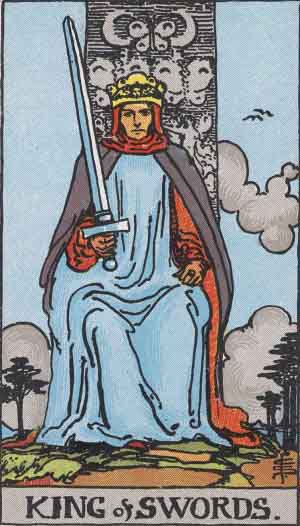
Detailed Interpretation
In the most positive sense, the King of Swords speaks of being inspired by new, serious ideas and striving toward new goals. This card brings a need for knowledge or understanding of something, a multitude of ideas, and the ability to act assertively to realize them.
When the King of Swords appears in a spread, it reveals the strategic precision of what we are doing—it is clearly being carried out according to a plan and with a specific purpose. Cold-bloodedness, a critical approach, and most importantly, the exact execution of one's decisions. The most valuable gift of the King of Swords is the ability to take the NECESSARY action at any moment (not just any random action or whatever comes to mind, like the Page or the Knight). Under the King of Swords, the most painful problems are sorted out, and the most complex issues are resolved (often through forceful methods or on the verge of it).
The King of Swords possesses a ruthless ability to make difficult decisions. The appearance of this card in a spread may indicate that we are facing the exact need to make such a decision, relying on logic, facts, or principles.
The King of Swords always strives to be as efficient and precise as possible in everything he does. He can also act as a peacemaker, but even here, he will act from a position of strength. In a spread, this is sometimes the Third Force balancing out two others that are in conflict.
An invited experienced professional, an authoritative problem-solving expert, a seasoned advisor... the softest interaction with whom leaves the sensation of being scrubbed with sandpaper.
The King of Swords also symbolizes all authority: the power of a father, a boss, a judge. He bears the burden of responsibility and is fully aware of it. This card represents the most seasoned professionals, aces in their field. People who lack the same clarity and speed of thought often simply get lost around them. They instantly notice anything illogical, inconsistent, or inefficient everywhere. Kings of Swords are generally correct people who keep their distance, responsibly fulfill their duties, are capable of handling difficult situations, and are detached from their own needs and feelings. They are characterized by masculinity, adherence to principles, and fearlessness.
They know how to suppress their anxieties, but as a rule, they also do not tolerate the weaknesses, fears, and doubts of those around them.
If the question is about a person, then here he is, if you please, on duty, armed, and quite dangerous. He is characterized by a rather aggressive and calculated single-mindedness—to achieve his goal, he breaks down resistance. He knows how to operate with convincing arguments, astutely and fundamentally getting to the root of things.
He is completely committed to his concepts and convictions, and without hesitation cuts off everything that seems superfluous to him. Because of this, many respect him rather than love him, and some simply fear him—after all, to play on the same field with him, you must be as well-armed as he is, and with his own weapon, which is not a given for everyone.
If the matter is not about a specific personality, the presence of the King of Swords in a spread can indicate that this is an absolutely matter of principle, in a good or bad sense. There is an idea, an inner goal, or a principle for which a person is ready to go to great lengths. At this stage, a final decision is made and the "work front" is defined. There is already a concept for an action or process, everything is very concrete, the time for worrying and hesitating has passed, and it is time to act. Whether true success will be achieved (and at what cost) will be suggested by other cards in the spread.
The traditional meaning of the King of Swords is negative, and this is not surprising. Historically, he corresponds to the type of a medieval monarch or at least the head of an arrogant knightly clan, expressing his life positions and intentions primarily with fire and sword. If this card becomes the indicator of a question, ancient interpreters say that the situation is potentially dangerous, dubious, fraught with grief and disappointment, "it can even be a matter of life and death."
Sometimes the King of Swords brings back the memory of a wound, mental or physical. In general, this is a card of phantom pain existing in our mind, when what has already been severed still makes itself felt.
Gloomy and resolute. Under the King of Swords, fears always retreat (sometimes even too far). Intelligence and maturity, harshness and hostility, experience and authority, fearlessness and readiness to act manifest themselves. Shrewd, calculating, clear thinking, analytical and rationalizing abilities are revealed.
Activity and strength, bravery and genuine courage, enterprise and resourcefulness, an objective view of the world awaken. An obvious flaw of this King is the tendency to punish rather than pardon (all else being equal). This is how he differs from Justice.
The King of Swords is a strong and energetic person, authoritative, imperious, accustomed to giving orders and seeing them obeyed, implementing his decisions, sometimes overly cruel and inflexible, but at the same time thinking logically. His distinguishing feature is that he ALWAYS relies on himself more than on others (no matter what he says or does). He is characterized by enormous personal resilience and fortitude. Often, this person is physically, intellectually, and spiritually stronger than most people around him.
He perfectly understands the limits of his own capabilities, but also the limits of those around him, so it is not easy for him to rid himself of a certain veneer of arrogance and contempt for humanity, so foolish and weak... He can greatly irritate "weak humanity" by testing its endurance, throwing challenges at it, baffling it, or living by standards unattainable to it.
Many people of a similar disposition can be found among heroes, ascetics, and leaders asserting their power using overtly forceful methods. Very often, not just gossip and rumors, but rather myths and legends are created around the King of Swords—he truly provides both the grounds and the plots for them.
He wraps himself in a cloak of impenetrability and mystery, and this only encourages "folk art," attempting to somehow comprehend his personality and deeds. His goals usually exceed the level of typical human desires, and he considers himself worthy of more, or at least something different, than the usual fate of his contemporaries.
He is capable of planning out a large part of his life and methodically moving toward his intended goal. Personality indicator: typically an adult male, usually of air signs (Gemini, Libra, Aquarius), less often Aries, but there can be other options. However, this is primarily an indicator of such a character, and it can manifest in a person of any gender and any Sign.
The King of Swords is the masculine manifestation of the air element, dynamic, creative, and all-pervading. He carries a thirst for knowledge and the spirit of storm winds. This is the power of a sharp, quick, flexible, and subtle mind, expressing itself here both in its creative, versatile, and often unpredictable form, and in the form of cunning and ironic audacity.
Such a mind is an excellent tool for cognition, understanding, analysis, logical reasoning and abstraction, mathematical and purely practical calculation, solving and comprehensively resolving any problems. However, where it dominates over all other abilities, its negative sides also manifest: extreme intellectualism, coldness of feelings, caustic and cynical fault-finding, a fascination with playing with words.
The sky in this card is covered with sparse cumulus clouds that occur in cold and windy weather. The weather is unfriendly, just like the King of Swords himself: rarely does anyone seek interaction with him of their own free will (and when falling out in a spread, it hints that avoiding him won't be possible). The King of Swords usually works with dense matters, so his deeds are generally visible and understandable to those around him. He emphasizes rational consciousness. Here, thought is so strong that it not only penetrates the essence of things but also changes them. But its limitation becomes obvious when attempting to comprehend the unknowable exclusively from a rational point of view (this limitation is known to anyone who has experienced the splendor and misery of scientific psychology, for example).
The King of Swords embodies the traditional symbol of Justice in the Minor Arcana, acting as its plenipotentiary representative, as it were. He passes judgment on situations and those around him, yet in his eyes, what is just is what he considers to be so. It's just that when the mind is so sharp and emotions so tightly reined in, the degree of objectivity is still above average. In a mystical sense, the spiritual host and blood oaths fall under this card.
A gleam of the fire element can already be felt in this card. In some decks, the King of Swords rushes across the sky on a warhorse with his cold steel, transforming into a whirlwind mid-flight. For him, reality is merely a field that is half battle, half game, where he can twirl his sword in all its glory. His thought reaches dizzying heights where no one can keep him company. At worst, a harsh and inflexible system of thought that does not foster development is created at this unattainable height.
The King of Swords sometimes describes a state of almost complete detachment from reality and a flight into the mental plane, which happens to a scientist completely absorbed in their research ("You haven't eaten, slept, or bathed for three days... just reading all those books... what for?" - "I want to acquire universal wisdom!"). Having become accustomed to soaring on the wings of intellect in transcendent realms, the person then "comes in for a landing" with great difficulty.
It is very difficult for him to feel earthly gravity again, his own weight, and the material limitation of existence; the reaction to the disrupted balance is depression, dryness, and irritability, betraying an unconscious longing for the flight he experienced and an impatience with everything slow, heavy, and mundane. The true causes of the detachment and tension of "know-it-alls" are essentially closest to decompression sickness.
Light and shadow (advice and warning) Advice: treat the matter as sensibly, coolly, and critically as possible, prove your astuteness, keep your head on your shoulders. Distance yourself and look at things detachedly, from the outside. If this is hard to do, seek advice from a knowledgeable person who will provide such a perspective for greater objectivity. Implement the difficult decision you have made. Shadow: excessive assertiveness, intolerance, dogmatism, certainty in being right. Hardening, coldness, aggression, inhumanity. Painful cynicism for others, rudeness, violence. The tyranny of the mind and deadening of feelings. A decision is made through purely mechanical calculation, without taking into account non-formalizable factors. Warning: if a rival or enemy is involved in the matter, he is truly dangerous. You should not take the matter to extremes.
This card covers project management, independent entrepreneurship, and all sorts of consulting. Solving problems purely analytically, by the power of the mind. Development and implementation of strategies and concepts (this card can indicate various meetings regarding this). Well-calculated undertakings. All those fields of activity where there are schedules, instructions, unambiguous standards, clear-cut definitions, and absolutely strict rules (for the non-compliance of which a kind of "tribunal" usually threatens).
Pilots, including military ones ("kings of the air"). The military as such, law enforcement agencies (and especially the commanding staff). People who have a professional relationship to aviation, meteorology, communications, and tracking services. Surgeons. Police officers. Auditors.
Lawyers, attorneys, writers, editors, reporters, critics, philosophers, psychoanalysts, and, no offense intended, other "smooth-talking" professions that require eloquence and quick thinking. Mathematicians, IT specialists, developers of expert systems. In general, all professions requiring self-confidence, a sharp mind, and extensive knowledge. Researchers, experimenters, all specialists who master scientific methodology. As a rule, the person denoted by the King of Swords is the ultimate authority in their field.
Talented businessmen who are inclined to increase their influence at any cost. Their weak point is an unwillingness to make any compromises or cooperate; they win by proving the superiority of their offer over those of their competitors.
Sometimes the King of Swords signifies experts, analysts, advisors, mediators, people capable of giving good advice and leading to a competent resolution of an issue.
The need for tough, calculated decisions in this area of life. Profit from businesses related to information technologies, communications, and transport. E-commerce. Intellectual capital.
Traditionally, this is not the best card for relationships. In them, a bit of haze is often a good thing, but here there are no eyes—there is an X-ray! The King of Swords sees right through, both in the dark and in the fog; he always gets to the core of things. He speaks the truth to your face from the position of a judge, not inclined to mercy.
Not a single flaw, shortcoming, or weak spot will be hidden from him, and seeing them too clearly rarely fosters love. He is demanding and critical both as a spouse and as a parent. Receptivity, a special trust in feelings, as well as children's and women's tears are not valued here.
Next to him, you always have to become significantly stronger and smarter, and this can be very useful for general development, but you will not be able to warm up and romantically "melt" next to this rocky nature. In relationships, he has to be "interested," and the emotions that make up their fabric rarely interest him; an alienating mind treats them carelessly. The King of Swords is generally not the most sociable fellow, and the card itself is associated with a place of solitude (moreover, located somewhere high above the ground). Independence and a love of freedom are characteristic of him.
The lack of love, empathy, and sensitivity takes a toll on him, but before he learns to somehow accept all this, let alone give it, he has to go a long way.
The King of Swords indicates a very passionate and very cold person. However, this quality is characteristic of all "sword-bearing" court cards. All of them are flame beneath the ice. It's very difficult, almost impossible with them, but for those who have tasted this flame, much else later seems strangely bland. A heart inadvertently cut while trying to break this ice will bleed for goodness knows how long. These are literally "Spade persons."
All ancient interpretations unanimously advise staying away from them, or "a sword shall pierce through your own soul also." It seems they have nothing to do with love, yet they are the very ones who inflict wounds with their bewitching swords that never fully heal.
The King of Swords is characterized by hidden passion, but any sentiments and weaknesses are absolutely alien to him. He is closed off and proud. If he deems it necessary, he will perform surgery with an unwavering hand on any relationship, and the motives for his behavior will remain a mystery. For example, he will say goodbye without hesitation if the relationship interferes with his career or other interests.
He might show his joy and love with almost nothing during a sunny phase, but crush everything in a fit of cold fury if something happens to rub him the wrong way. He can seem like a soulless machine implementing its decisions, but these decisions themselves are generated by the strongest feelings hiding God knows where. These unapproachable depths of the soul and heart are like a mirror reflection of the unapproachable peaks where his spirit and mind practice alpinism.
Astounding calculation and equally astounding fearlessness are combined in him. In relationships, this cold Ivanhoe can commit to things that a hot Romeo could never even dream of. As a rule, he has very firm principles in his personal life and very clear concepts of marriage (not necessarily favorable ones). If he makes it a rule "not to get involved," he will limit himself to the most superficial contacts that imply no responsibility. In this case, he can give lessons in the art of rejecting.
Since youth, he has been accustomed to hiding any manifestations of feelings. It is useless to extort these manifestations from him. "The less we love a woman, the more she likes us" – the secret of the King of Swords, which works for him alone. And how it works is simply astonishing! His charm consists of wit, independence, and cold-bloodedness
There is a highly effective attraction in his habit of keeping his distance, his reserve, and his funereal chic; his hidden sexuality significantly affects the subconscious, and the energy he spends on curbing and restraining it is even more impressive. The King of Swords is endowed with masculine chastity.
Revelry is alien to him. At the same time, this must be correctly understood. The King of Swords, without batting an eye, can spend a night of convenience or enter a marriage of convenience. He has enough restraint for that. However, if it's not a matter of restraint and calculation, the King of Swords belongs to the type of men who give their word once, take their marital duty quite literally, and do not take off their wedding ring under any circumstances.
Moreover, what compels them to behave this way is sometimes almost impossible to understand, because the marriage seems to have long turned into a wind-dried desert. The King of Swords is also not inclined to remarry, so the card often describes a person who remains alone for a long time (the "mystery of the Widower," just as the Queen of Swords is the "woman in sorrow").
The King of Swords rarely has many children. Sometimes he becomes an indicator of difficulties with conception, a mysterious infertility, the cause of which is extremely difficult to establish.
As a rival in love, he is dangerous, not because he will plunge a dagger under your ribs, but because a strange magic is inherent to him—even while loving another more, a woman somehow goes down the aisle with him specifically. And then it will be too late, as the song goes, "someone else's wedding, someone else's wedding - well, that's it, you are married now." But even if this does not happen, and the woman does not marry him, she will apparently never be able to truly cast him out of her heart. Even without loving him. Even not seeing him for years. Even already forgotten by him. How, why – it's a mystery! Swords are dangerous, they pierce the heart.
Generally speaking, the card is more conducive to the destruction of relationships than to their creation.
The King of Swords is indifferent to health as such. From his perspective, life is a war, and he who spares himself on the battlefield is worth nothing. He despises pain and endures it stoically.
He looks into the eyes of his own death without fear and takes another's life without trembling. He believes that scars adorn him and wounds another without a second thought. Therefore, in ancient interpretations, he describes a life-threatening situation, and in modern ones, a situation fraught with surgical intervention.
Colds, illnesses stemming from piercing winds, hypothermia. Joint inflammations, osteochondrosis. Old injuries. Seasonally, the King of Swords corresponds to autumn—and all those ailments that make themselves felt especially at this time of year.
This card can indicate that the time to act has not yet come, as there is no specific formulation of the task. Everything is very global and vague.
While the Upright King of Swords presented an energetic and circumspect person, clearly aware of his own capabilities, the Reversed King of Swords is either completely devoid of this quality or, conversely, is overly circumspect and fearful.
He is at odds with both his emotions and his head. Strategic thinking fails, calculations are flawed, and emotions express themselves in the form of angry outbursts and tantrums (something like the Führer in 1945). He is unshakable in his actions and devoid of sympathy for others, but essentially—a cruel tyrant.
Hypercriticism, biased judgment. A false course of reasoning; instead of facts, assumptions are used and accepted as truth. Under this card come conflicts that defy rational resolution, trouble with the law, persecution, lost cases, encounters with dangerous people (what is called "showdowns").
Maliciousness, deceitfulness, dishonesty, lack of principle, hence—victories at intermediate stages, but a high probability of defeat in the end. Treachery, cruelty, anger, possibly a crime. Clashing with dishonesty in structures responsible for ensuring law and order. In the most acute cases, death or "hara-kiri," a brutal reprisal against oneself, even if in a figurative sense.
Actions contrary to well-known laws, rules, and standards, attempts to "fight the system," dissidence.
With the King of Wands - an honest judge.
Reversed with the Three of Swords - the retreat of an enemy.
Reversed with the Seven of Pentacles - an offense.
PER ASPERA AD ASTRA ("Through hardships to the stars," the motto of the British Royal Air Force).
Hermes.
Odysseus.
Napoleon Bonaparte