Queen of Swords
Swords — Minor Arcana
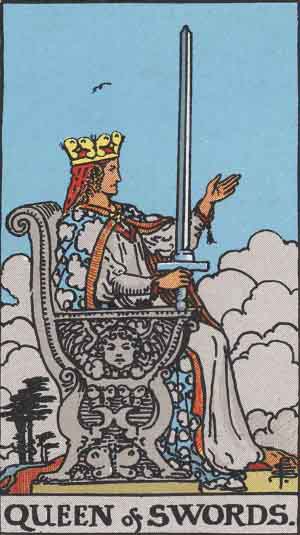
Detailed Interpretation
The Queen of Swords doesn't have a particularly good reputation in spreads, and this has been true since ancient times. Who doesn't know that you shouldn't expect anything good from the "Queen of Spades"? In all traditional interpretations (which shouldn't be discounted), this card predicts a bitter experience. This could be some kind of personal loss, sorrow, bereavement, hardship, or grief. The appearance of the Queen of Swords can indicate a readiness for conflict, excessive demands, and the inevitability of critical remarks. When it appears in a spread, it indicates that the situation is emotionally destructive and can turn into a misfortune (if the King of Swords is dangerous as an intellectual rival, and the Knight is physically dangerous, the Queen speaks of emotional danger).
The appearance of this card can indicate a readiness for conflict, difficult negotiations, and fierce confrontation. You shouldn't expect easy results—things are moving, but within the framework of undeniable prohibitions and strictly following accepted rules.
In a positive sense, the Queen of Swords points to the importance of logical arguments, independent actions, and rational decisions. Upright, it can mean the clarification or clearing up of a situation, as well as complete control over yourself, your reactions, and actions, which in practice usually means the success of the planned endeavor.
In an unfavorable spread, it points to someone's malicious will, ill intentions, or a person capable of causing great harm.
The Queen of Swords in a spread for a situation can speak of objections encountered and the influential role of a person who behaves emotionally detached and unfriendly, yet is ready to be a completely objective expert.
Another meaning of this Arcana is emptiness, vacancy, an unfilled space, unemployment, or the absence of something.
The Queen of Swords can point to both sorrow and tears, or to coldness and bitterness when there are no tears left. This largely depends on a person's ability to adapt the energy of Swords within their inner world (the less familiar it is to them, the more asthenic and "tearful" the reactions will be; if these vibrations are customary, the person easily puts on armor of ice). Under the influence of the Queen of Swords, we turn into insightful perfectionists who are hard to please—after all, reality is so imperfect, and people are so full of flaws! The typical state of the Queen of Swords is skeptical and controlling, and therefore dissatisfied.
Its appearance in a personal spread is a sign of an extraordinarily serious nature, an ability to set goals and achieve them. This card betrays a habit of keeping emotions under control and using intellect to get the desired results. In any case, this person knows what they want, and even better—what they don't want. Everything undesirable is cut away; everything desirable is obtained through calculation and scheming.
This is a businesswoman (although sometimes the card can also indicate a man), successfully building her career, a professionally calm, sensible person who achieves what she strives for. Often in the querent's life, the Queen of Swords acts as the person "with a stick," who prevents them from straying from their intended path.
The Queen of Swords is eloquent, ironic, and usually formulates her thoughts very precisely. Moreover, unlike the Page of Swords, this won't be just a dig for the sake of a dig, but a remark that hits the nail on the head. Here we see the effect of the subtle water element, flawlessly picking up on weak spots in the behavior and soul of another. That's exactly why she "sees right through you"—it's more than just intelligence. Roughly in the same way, the Queen of Swords discovers inaccuracies in a financial report, inconsistencies in a suspect's case, mistakes in a school dictation, fabricated news, photo manipulation, runs in stockings, lip-syncing, and a thousand other things and phenomena. The "Water of Air" possesses an exceptional, hopeless insightfulness. You cannot fool her.
The Queen of Swords is a good organizer and an extremely purpose-driven person. Usually, this is a woman with authority and power, who uses them to achieve her own goals. She is courageous, decisive, stern, impenetrable, and can be ruthless because she doesn't allow emotions to affect the decisions she makes. Another aspect of this card: she always represents a maximalist, a person for whom half-tones and indulgences do not exist. The Queen of Swords is competent and focused on high standards. It is impossible to "knock" her off this orientation—she might put on a mask of leniency, but deep down for her, "almost good" and "truly good" will never be equal. She sees everything perfectly, even when she turns a blind eye to something.
On a deeper level, the Queen of Swords is close to Justice. She similarly clutches a vertically raised Sword, and her upraised hand seems to hold invisible scales. Before us is a "woman in sorrow", but a very strong woman. She is not depressed, broken, or wallowing in self-pity. You only need to look at the sword in her hand pointing straight up (even the King doesn't hold it so firmly and upright), and at her arm adorned with a mourning band. This hand is by no means lowered or dropped helplessly into her lap. It is raised to meet the wind—her element—accepting all that it brings, letting go of all that it takes away. Her element does not imply clinging to anything, including one's own suffering.
The Queen of Swords is a balance between the nature of the Cup and the effectiveness of the Sword. The card describes the ability to become fully immersed in an idea (Water) and then examine it with clear eyes from all sides (Air). This is the feminine manifestation of the air element, presenting us with the difficult task of establishing a direct connection between feelings and thinking. Old proverbs saying "The heart is no match for the head" illustrate just how complex the task embodied by this Arcana is. This is the hardest inner alchemy—creating harmony between the intellectual and emotional centers. The Queen of Swords foreshadows a time of self-determination, moments of extremely important and profound realizations in life. She personifies mind, openness, independence, imagination, and quick-wittedness. This is an expression of our ability to solve problems using logic, to ascend to ever-higher levels of knowledge without getting lost before an influx of ideas and doubts. In contrast to the former perception of the Queen of Swords as an "evil woman", we see in her a woman (or the feminine principle in a man) who frees herself from dependence thanks to the power of her mind. Only in some cases does the negative side of this card reveal itself to us: it is most often the "snow queen", whose outward attractiveness hides cold calculation and almost insurmountable alienation. She is quite capable of "mentally castrating" anyone else, demanding accountability from them, dominating intellectually, and diminishing their dignity to a negative value, like an overly cruel mentor grinding a student to dust.
In the Queen of Wands, there is a kind of wise capriciousness. The Queen of Swords is not even capricious in the sense of spontaneous infatuations—serving her element does not require this. The Queen of Swords is usually proud—but not of herself, rather of her element. She is a subtle and fearless researcher and analyst, capable of intuitively sensing the original source of life (water) within the mind (air). Contemplating the beauty of a system, she surrenders completely to a mystical experience, similar to contemplating the Creator through creation. This kind of profound rapture is inaccessible to any of the other Queens (and, by the way, even to the King of Swords, because he lacks "water" as a receptive element). She knows the half-intellectual, half-essential orgasm of comprehension ("And ye shall know the truth, and the truth shall make you free").
The card depicts a woman in royal attire, wearing a crown and holding a sword. In some variations of the cards, her costume is complemented by certain details of knightly armor: a shield, shoulder pads, or armguards. A soaring bird above the Queen's head and a sylph adorning her throne are symbols of the Air element. The sky on the card is covered with cumulus clouds rising at the horizon: it is cool, windy, and rain may start. Clouds are a symbol of the losses, tragedies, and life storms that the Queen deals with.
The message of this card is the clarity of feelings and actions, the harmony between the inner and the outer, and the freedom as a consequence of all these qualities. The Queen of Swords faithfully serves her element, just like any other Queen. She is often credited with suppressing her feelings, but in reality, they are simply not the most precious thing she possesses. She doesn't serve them. She serves knowledge, freedom, and truth, and asserts them entirely independently of how others feel about it. The spirit of the Sword always brings splitting, separation, and disidentification. Water merges, air distances. The Queen of Swords describes the ability to put an end to anything and play your role with full awareness, without identifying with it. The idea that the body is merely clothing we take off at the moment of death to put on something new completely aligns with the spirit of the Queen of Swords.
While the Queen of Cups doesn't understand the essence of boundaries, and the Queen of Wands tolerates them poorly, the Queen of Swords is a master at establishing them and ensuring they are followed. She favors any occupations where protocols, codes, methodological guidelines, registers, inspections, exams, certifications, audits, and reports are relevant. Here, her proximity to the Major Arcana Justice is evident. She loves methodical work, repetitive and regulated tasks, detail-orientation, and logic. The absence of the latter causes her genuine irritation and a headache, quite literally a physical protest in the convolutions of her brain (this emotional reaction reflects the water element that all Queens partake in). Where logic and a system do not exist, she will create, invent, and build them. There is no better specialist in data processing and protection—she literally perceives them as a mother would, nurturing, guarding, protecting, delving into, caring for, and watching over them. She anticipates problems and invents solutions. The difference from the King of Swords is that he would rather first create ("forge") an abstract system, a principle "out of thin air," in pure mental space, while it is difficult for the Queen to create in an untouched void—she will more likely engage in organizing and rationalizing the already existing mess called reality (and create a system for it and tailored to it). People who are incapable of reveling (water) in the mental realm in its purest form (air) and who don't understand how it can be "living water" for someone else often have a hard time tolerating the Queen of Swords with her rules and demands, assuming that this manifests her personal desire for dominance. However, the Queen of Swords is impersonal; the only thing dear to her is the dominance of her element (the mind is the head of everything), and not a sense of personal importance at all. As long as people submit to her element, everything is fine, even if the Queen herself is unnoticed and unacknowledged—she is modest and easily gets by without signs of personal attention. But just try to make a misstep! Her personal attention is immediately guaranteed to you, and it will resemble a laser beam or a well-sharpened scalpel.
The Queen of Swords personifies aptitude for mental creativity and research. This could be an engineer, mathematician, architect, or a specialist in the fields of medicine, jurisprudence, information technology, and systems. She excels at journalism, writing, and working in education and science. She is good anywhere that requires mental sharpness and the ability to generate ideas.
Ziegler writes that the Queen of Swords is an excellent consultant, therapist, and advisor because she possesses crystal-clear penetration into the depths of a situation or a person, yet she doesn't allow herself to get stuck or emotionally "tangled" in them. Through this, she earns genuine trust and retains the real ability to offer help.
If the spread is for a specific situation, the Queen of Swords is more likely to manifest unfavorably, as a risk of falling "under the knife" of cutbacks and dismissals, dislike from management, nitpicking, or excessive demands.
Advice: push your mind and analyze the situation carefully and critically, freeing yourself from illusions. Keep your distance, be on alert, and firmly stand your ground.
Trap: suppressing your feelings for the sake of feigned indifference.
If the question is pressing and specifically concerns finances, then the Queen of Swords can be interpreted as an unfavorable indicator—a risk of losing money or housing, falling into unfavorable circumstances, a difficult situation, or distress. The Queen of Swords can point to the need to avoid any slippery deals or dubious schemes—the probability of exposure and losses is very high.
Generally speaking, this is advice to keep your eyes open, not to show excessive gullibility in financial matters, to take matters under control, and if necessary, turn to a knowledgeable specialist.
The Queen of Swords is considered a traditional symbol of widowhood and mourning, divorce, and childlessness. It clearly shows the need to rely only on oneself (the hilt of the sword rests on her own throne). Modern tarotology, compared to ancient times, naturally offers a wider range of interpretations. However, one cannot disagree that, by and large, she corresponds much more to a bachelor life than to a married one. Realizing your dependencies and breaking free from them, severing any restricting or oppressive relationships—this is the essence of this card.
The Queen of Swords is a strong indicator of a breakup and parting ways, and it isn't necessarily true that this will happen tomorrow. She "loves" to mark doomed marriages, where one of the partners is cold to the other. In cases of quarrels, disagreements, or divorces, the Queen of Swords usually announces that there is no turning back, or at the very least, that the crack is very serious.
For people who haven't formed a couple, the Queen of Swords is an indicator of a tendency towards solitude, not even so much an event-based one as a psychological one ("loneliness for two" is also possible). Like the Queen of Wands, guided by the masculine element of fire, the Queen of Swords, governed by the masculine element of Air, is distinguished by a high ("unfeminine") inner sovereignty. She is independent. You can't even say about her that she often gets disappointed in people—she sees them too clearly to be charmed by them in principle. She is discerning and impartially sees through any masks. Combined with a tendency for an impersonal stance in general, this makes her "uncomfortable" for close relationships. In them, a certain haze, a touch of dependency, an ounce of delusion are good... you won't find any of that in the space of the Queen of Swords. While the Queen of Wands radiates at least cheerfulness, warmth, and the heat of desires, the Queen of Swords offers none of that, plus the coldness of pure insight, a firm position, a tendency to control everything, and fearlessness in terms of speaking out. She doesn't bring thrilling emotions to life, nor will she carry the hero away toward a goal... rather, she will see with absolute precision where he miscalculates on his way to it. If the hero has the courage to survive the ego-bruising discovery that he has miscalculated somewhere, and while he doesn't see where, she does, then the Queen of Swords can turn out to be a gift of fate (although upon first impression, this gift is best described by the words "a rude awakening").
From time immemorial, the Queen of Swords has been considered a card pointing to a friend's betrayal, to an unfaithful and treacherous confidante-rival in the querent's circle. Appearing to a man in a love spread, the Queen of Swords usually points to the indifference and coldness of his partner, simply put—that he is not loved by the woman he is asking about. This card can sometimes describe something very alluring but absolutely inaccessible on the love front. Traditionally, a man is advised not to establish close relationships with the "Queen of Spades"; it will only bring him suffering.
At the same time, this figure can be relied upon in terms of a specific inner honesty. She will not fake an orgasm if there wasn't one. She won't stay silent if she doesn't like something. If she disagrees with something, you cannot force or intimidate her. The Queen of Swords is ready to continue her path alone if something doesn't suit her. She is on friendly terms with her head, and sometimes—only with it.
The Queen of Swords has a brilliant mind. She is interested in many things, but above all else in the world, she values her independence. Wide open space in a relationship inspires her far more than the "clinginess" of the "I love you so much I can't breathe" variety. A self-sufficient and independent partner retains his attractiveness in her eyes and stimulates her to radiate her northern charm. An overly bright display of feelings seems unnatural to her. The Queen of Swords keeps people at a distance to preserve her full ability to do whatever her heart desires. Love, by and large, means much less to her than accomplishing the various tasks she sets for herself. It is not entirely accurate to say about the Queen of Swords that she has "sacrificed" marriage and motherhood for something—she simply passes by because it doesn't particularly interest her. If it is a sacrifice for her, it's along the lines of "here, Lord, take what I have no use for." She doesn't particularly need warm relationships. Fervent passion quickly bores her, since it barely feeds her leading element—air and mind—and for her, it is akin to being in an oxygen-deprived environment. At the same time, she is capable of maintaining a truly passionate relationship for years with some publisher, academic advisor, co-author, partner, or colleague—the same kind of investigator-researcher as herself, causing jealousy in anyone who doesn't understand why they sometimes call each other at three in the morning, struck by an idea, or spend twenty-four hours together on pure coffee and cigarettes, barely catching their breath after another intellectual orgasm when it "worked out," "was found," "was understood," or "came together." What they do is sex, even though the participants are buttoned up to the neck. What they feel for each other is love, although they will never say it to each other with the intonation that lovers use. Love and sex in this form never bore the Queen of Swords.
The Queen of Swords is not a cheerful optimist, is not prone to self-promotion, and doesn't captivate with artistry or closeness to nature... there is nothing to cling to in her, except for a somewhat cold charm and strength of character. According to Toni Wolff, if the Queen of Wands builds personal relationships with an individual (like a hetaera inspiring a commander), then the Queen of Swords is a master of impersonal relationships with a group (a good example might be a teacher in a classroom). It is very difficult to scratch beneath the surface of her personality, although she, of course, excites, and one really wants to "personalize" her in one-on-one relationships (it's no coincidence that a strict teacher so often becomes an object of sexual fantasies). Despite an almost insurmountable alienation from those around her, it isn't hard for her to remain demanding and objective, giving everyone their due. This connects her to the Justice Arcana. Deep down, the Queen of Swords always strives for freedom and justice, independence and truth. She rarely allows herself to be deceived by others and even by herself—in this sense, she is honest. More than anything else in the world, she hates illusions ("all those rose-colored glasses, tears, snot..."), including within herself. Her element simply cannot tolerate such things. However, this circumstance is perceived as coldness and rigidity, arrogance and unapproachability. The Queen of Swords is usually not as presumptuous as the Queen of Wands, who is convinced that absolutely anything is possible if you only wish for it (the suit of Wands rules desire). Unlike her, the Queen of Swords clearly understands what is in her power and what should be abandoned. She is capable of valuing platonic relationships and does not need another for self-realization.
As an indicator of disease, it can speak of disorders in the lungs, colds, asthma, and also allergies. Cold air, dampness, or mold could be to blame for everything. In general, this is a universal significator of hypothermia (and especially as a result of sitting on something cold).
May indicate surgical intervention.
Traditionally considered a card of infertility.
Most often, the reversed Queen of Swords represents the same purposeful personality as the upright one, but she acts against the querent. Sometimes this is a person whose love has turned into hate for one reason or another. Or it is a person incapable of constructive action; moreover, the most important attribute of the reversed Queen of Swords is the deprivation of something: this is a person acting not out of abundance, but driven by a lack, a shortage of what is vital to them. Hence the difficult character, narrow-mindedness, and destructive behavior of an embittered outsider.
In the reversed position—an exaggerated desire to control everything, which actually leads to a loss of control over the situation, and thus to losses.
The reversed Queen of Swords becomes distracted, prejudiced, and exhausted; her mind is misdirected (which can look like pretense, treachery, and revenge). At the core of this may be unfulfilled ambitions, disappointment, toppled ideals, or untapped abilities.
The card announces that your action was started without a clear idea of the goal, wasting effort, or it reports a situation of unjustified risk. One of the ancient meanings: cunning, deceit, criminal intentions.
The reversed Queen of Swords can mean negative thinking and its destructive influence, as well as evil words that can "kill."
Hypocrisy, bigotry, double standards.
The meaning of this card can be softened by positive Major Arcana (such as "The Star", "Temperance").
Old and dusty interpreters provide the following interpretations:
With the reversed Five of Cups – a close female relative will be widowed.
With The Magician – the husband will die before the wife; with The High Priestess – the wife will die before the husband.
With the reversed Page of Pentacles – the husband is a squanderer.
With the Three of Cups – harm from a female detractor
With the reversed Nine of Wands – there is nothing to fear from her