Knight of Swords
Swords — Minor Arcana
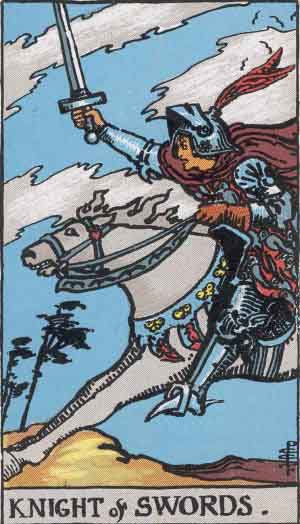
Detailed Interpretation
As with the meaning of any other card, the meaning of the Knight of Swords must be compared with the current circumstances and other cards in the spread. However, his appearance is rarely a "passing" one - he reacts with exceptional precision to the emergence of heated situations in the querent's life, and in combination with unfavorable cards, indicates that the situation is desperate. The spread will tell you what the matter is about – difficulties at work (Wands), personal relationships (Cups), or financial troubles (Pentacles).
This Arcana marks rapidly developing stressful situations, the vicissitudes of fate, getting caught in the center of some peripeteia. Its appearance in a spread means that the querent (or someone involved in the situation) is simply "burning" with their ideas and goals. One could say that they currently have their own reality, in which they are absolutely convinced. It is not a given that reality coincides with their perception of it.
The Knight of Swords signifies a furious, indisputable confidence in one's own righteousness, imperceptibly turning into righteous anger and a swift, "headlong" offensive. It is always something cold, sharp, bringing discord and disputes, capable of poisoning even those areas of life that have hitherto served as a reliable, cozy refuge. The cold he symbolizes can, of course, disperse the fog and bring to the light of God everything that has so far seemed unclear; however, most often in this card, the element of air turns its negative side towards us. This means the coldness of alienation, heated discussions, harsh expressions of disagreement, an evil tongue, and caustic irony. Therefore, the Knight of Swords often foreshadows a quarrel, a breakup of relationships, fierce polemics, and sometimes even human baseness. His old meaning is someone capable of causing harm, humiliating and insulting, an open dangerous enemy, a bully.
It often predicts that some unexpected conflict situation will arise out of nowhere. If the situation about which the question is asked is initially heated as such, then the Knight of Swords predicts that the matter will go very far, up to destruction and complete collapse. Historically, his domain includes dangerous situations, wars, fights, battles, and even death (it is clear that the latter can be considered only with serious indications in the spread as a whole). A milder option is some decision made not in favor of the querent.
Nevertheless, Upright, this card always points to a high intellectual potential that can be used for "peaceful" purposes. Sometimes this card reveals phenomenal resourcefulness, quick-wittedness, and getting a thousand things done in a unit of time completely unsuited for it. The Knight of Swords is good when we need the strength to resist someone or something, faith in our own righteousness, and a fearless drive for victory over some "monster." No one surpasses this Arcana in the art of dueling, combat, or battle. He rushes along his path regardless of the weather conditions depicted on the Arcana – against opposition, cold, and storm. Therefore, if "this is our final and decisive battle," then the appearance of the Knight of Swords is opportune (especially if cards of a favorable outcome and reward are visible nearby).
Like all other Knights, the Knight of Swords can foreshadow a trip, usually urgent and stressful. The Knight of Swords speaks of events happening quickly and unexpectedly.
"The scoundrel is out of his mind." To use the language of NLP, this is a state in which the map replaces the territory for us. About a person in this state, one can say "he has his own reality." Gloomy, malicious determination, a fierce attitude, audacity, desperation, drive, the ability to "show teeth"... and flagrant short-sightedness.
When we are in the mode of the Knight of Swords, it seems to us that we know everything and can do everything ourselves; however, by rejecting the help of those around us, we invite losses and produce absurd changes in life (other cards in the spread, however, will help to judge the results). This card indicates an increase in cruelty, aggressiveness, and assertiveness. Under the Knight of Swords, we are gripped by the expectation of an "enemy" and an irritated readiness for mobilization. The jurisdiction of this Arcana includes logical, authoritarian, insensitive actions, "attacks" on others, uncompromising and aggressive behavior, irritability and harshness, nothing Christian, and a readiness to fight with anyone. The ability to humiliate, insult, frighten, and drive to a nervous breakdown.
Historically, the Knight of Swords is a crude, cunning, willful, and treacherous barbarian, having difficulty reincarnating into a duelist and a bully (though with at least some kind of code). He is a "crazy but glorious youth" - somewhat wild, unceremonious, impetuous, restless, unbalanced. If he has nothing to do with himself, he furiously throws himself forward without thinking, often for no particular reason, but with a great desire to accomplish something. I dare you to jump on a motorcycle from this roof to the next?! (a distinctive feature of the "airy" Knight of Swords is the urge to walk on the edge of the abyss, he is drawn by height, open spaces, but also by speed, swiftness). About such a person they say "reckless." By this he often complicates life for himself and those around him. For example, it could be a person with great intellectual potential who is always starting nervous discussions, grabbing at projects without material resources, not caring about the feelings of those working with him. His old appraisal is a clever but vulgar person, selfish, cruel, treacherous. He is cunning and active, does what he wants, tests his abilities, is less scrupulous and more cruel than the King. Relying on him as an ally is more trouble than it's worth; as a result, you can suffer greatly.
The Knight of Swords is a worthy offspring of his complex symbolic parents, the King and Queen of Swords, who is not alien to dreams of omnipotence. He is a stubborn and willful know-it-all, not taking those around him into account and with great difficulty tolerating (more accurately, not tolerating at all) weaker partners in the game (they all seem to him "slow" and "not catching on," in full accordance with the symbolism of this Arcana flying at full speed). In a kind of individualistic frenzy, he isolates himself from everything else. He splatters poison, irony, and sarcasm, which sometimes charms his "followers," however, in reality, there is no one and nowhere for them to follow.
The Knight of Swords is not a team player. He is a lone hero, and "hero" is sometimes in quotes. On his own, he is capable of stirring up such a mess that even a regiment won't be able to sort it out later. Usually, only his symbolic parents and masters – the Queen and King of Swords – can handle the consequences of his actions. He is an energetic and deft person, devoid, however, of those qualities that would allow him to become a leader. He is sharp-witted, but his mind lacks the depth and breadth that is characteristic of the King of Swords. Often this is a "chess player" who views any situation only as an opportunity to outplay the opponent, and even better – to defeat them.
At best, this is a person simply "without a king in his head" - hot-tempered, impulsive, and prone to sacrificing excellent plans for the sake of a momentary mood. At worst, this is a bully type, unbearable in peaceful life, or a person with criminal inclinations, living in his own reality of permissiveness and impunity... for the time being.
The Knight of Swords embodies the "airy" aspect of Air (while the Queen is the "watery" one, and the King is the "fiery" one). The doubling of the influence of the leading element stimulates him to create purely mental concepts detached from reality. These are principles for the sake of principles, ideas for the sake of ideas, and if suddenly facts contradict his theory, so much the worse for the facts. Categorical and militant philosophies (Nietzsche, Fichte, Schopenhauer...) absolutely correspond to this Arcana. Sometimes the Knight of Swords is his own worst enemy because he refuses to back down from the image of the world and the perception of the situation that he has invented for himself. He believes that it's not worth bending to a changing world - and is ready to fly head-on at it with his brightest dreams or misanthropic preachy speeches, sincerely confident that the world will swerve first. He wholly, completely, and totally believes in the victory of justice (as he understands it) and the triumph of the convictions he shares. In spirit, he is a true crusader, an irreconcilable fanatic. Archetypically, this is the knight who swore to kill the dragon. His campaign may be noble, but on a higher level, the Arcana poses the question - are there ever righteous wars?
The Knight of Swords personifies a mental plane activated to the extreme. His task is to break through the web of ambiguities and the fog of omissions and mysteries with his sword. He is like a detective investigating a crime. For now, he is unable to do this by pure deduction without leaving the house (or without getting up from the throne - that is the level of the King of Swords), but thanks to his tirelessness and fearlessness, he digs down to the truth, making a bunch of enemies along the way.
"Air of Air" obliges us more than anyone to remember that the map is not the territory. There are models of reality and reality itself, which they describe more or less successfully, but never completely. The Knight of Swords is an exceptional master of creating mental models, concepts, and ideas about reality (popularly they are also sometimes called "roaches in the head"). At the same time, his highest task is precisely to break through old models of perception, destroy stereotypes and limitations, and gain a new clear vision. This Arcana teaches that we do not simply fall into situations by chance (especially the complex and difficult ones it symbolizes); we create them around ourselves based on our beliefs about reality. If we look more closely at those sides and qualities of ourselves that do not satisfy us, we will see that every uncomfortable and unworked-through situation serves to reflect our own incorrect concepts and models of perception like a mirror. As soon as we see them soberly, as they are, we can discard them and move on, freeing our thinking and spirit.
In a profound sense, the Knight of Swords is like The Tower. He is the essence of a storm. How much the air will clear and warm up after it will be shown by the other cards in the spread. The Knight of Swords nurtures the wildest dreams, realizes ideas that seem impossible. He is possessed by the spirit of invention. Creative thinking requires unlimited freedom, so the Knight unhesitatingly severs any ties and ideas that limit his progress or pull him back. In armor, with a raised sword, he rushes at an invisible enemy. Around him is a storm: pines are bending, shreds of clouds are flying, birds are darting about in the stormy sky. Large trees bent under the pressure of the wind speak of the inevitability of sad events. The furious gallop signifies the fierce determination with which the ego (the rider) pursues its goal. He is a fighter, a rebel, he knows no mercy, attacks first, and is not afraid to die: his motto is to conquer or die. The white horse is a symbol of purity of heart - the Knight believes in what he is fighting for. The red cloak, the raging wind - evidence of passion and impulsiveness. The Knight of Swords, for all his intelligence, is reckless and lacks foresight. This is still an unordered power of thought, changeable, lacking a main priority, a clear system (the status and capabilities of the King of Swords have yet to be lived up to). Keeping this stream in a given direction is very difficult – "Air of Air" is highly unstable. One thought destroys and nullifies another in the absence of an ultimate goal against which they could be correlated to be evaluated. Instead of development and "growing up," ruin awaits them. The Arcana of the Knight of Swords embodies the principle of the instant obsolescence of knowledge, the rapid "wear and tear" of any trends, the fleeting nature of innovations. "A spoken thought is a lie" - while you are expressing it, it has time to undergo a metamorphosis, become outdated, and collapse, ceasing to correspond to itself. Banzhaf and Akron write: "Preventing ossification and stagnation, he nevertheless embodies the negative aspect of the mind. A dry technocrat, an impudent know-it-all, a cynic, and a brawler, he is in any case a victim of his destroyed emotional world. His life story is written by our aggressive, exploitative technocratic time in a clown suit." "Air of Air" consists of pure mind games devoid of any morality. He does not even argue with it, just bypasses it. The typical preaching of the Knight of Swords: the end justifies the means, and winners are not judged. At best, he is a strong-willed, fast, subtle, and skilled warrior. True, even in this case, he is equally brave and corrupt. You cannot rely on his principles, but you can rely on his professionalism. Unlike the King of Swords, he is not a strategist, but a tactician, as he is able to see only one goal at a time, but at least he sees it perfectly right in the optical sight.
The card symbolizes, as a rule, a young person at the beginning of his career: he wants to show himself and others what he is capable of. He has both competence and skill, but they have not yet reached the highest level of development symbolized by the King. He is not an expert. However, he is a master at falling into a professional frenzy, and will unhesitatingly badger everyone to complete amazement and "brainwash" the lazier and slower ones around him so that what must be done gets done. In a professional sense, he is more like an assistant to an experienced police inspector – he acts on the principle of "grab and go," he completely missed half the subtleties, overdid it regarding the other half, put forward a hundred and five incorrect versions, but... he is still a specialist, knows what he is doing, and learns rapidly.
The Knight of Swords' thinking is swift and often ahead of the situation's development. The plans, reforms, and innovations he proposes may be too ambitious, cardinal, and bold, which is why their implementation is currently meeting resistance and being postponed. Plans and projects are subjected to severe criticism. At a thesis defense, the applicant is leveled to the ground and has to defend himself almost with the help of makeshift furniture. The Knight of Swords reports that it is too early to judge the results of the undertaking - time will tell. This is only the halfway mark to the goal.
The Knight of Swords can foreshadow a change in duties or work environment. This is a card of competition and confrontation. As a boss, the Knight of Swords has all the powers of persuasion and coercion, but followers gain no more benefit than enemies.
This Arcana can describe a broker, an analyst, a chemist, an IT specialist, a bailiff, an investigator, a sharp-tongued blogger, or a stuntman. The Knight of Swords "loves" professions associated with business trips, travel, the need to quickly process and transmit information, and generally "tearing oneself to pieces" for the cause. Under his jurisdiction are all sorts of professional feats from the "do or die" series, doing the impossible, getting things done that were due yesterday.
The Knight of Swords often describes explosive and hasty intellectual activity. Évariste Galois comes to mind – the forever twenty-year-old father of modern higher algebra, scribbling the most intricate of his works the night before a duel. The phrase "brainstorming" describes the spirit of the Knight of Swords with unusual accuracy. Under the Knight of Swords, we are often faced with the need to quickly deal with matters, but haste deprives us of a sober assessment of the situation and forces us to take rash steps and look for momentary solutions.
Historically, it is the significator of a military man. It could be a mathematician wanting to prove something at any cost, or a lawyer fixated on winning cases.
Advice: determination and purposefulness of action are the key to success. Do not fold under pressure, bravely take risks, do not fear confrontation.
Warning: less fearless charging ahead and more diplomacy. Curb a tongue that is too sharp. The trap of the card: a blind thirst for destruction.
Sharp jumps in income. The need for serious and urgent correction of financial plans. Old meaning – wasteful extravagance.
Among the traditional meanings of the Arcana: war, ruin. Therefore, even now it can be an indicator of robbery, burglary, assault, racketeering, money extortion.
The Knight of Swords is definitely unfavorable for any kind of relationship. A hot head and a cold heart create the wrong atmospheric combination. An explosive situation of hostility and confrontation, conflict; the presence of hatred, animosity, taking pleasure in skirmishes, and harboring vengeful designs. In an unfavorable spread, it warns of violence, and sometimes of mortal danger. This card reports that the "hatchet has been dug up" in the relationship at this time. Whether it will be an angry five-minute bickering or a war of attrition, other cards will tell.
The Knight of Swords is quite a "character" in general, and in close relationships in particular. It's not that you can't build anything with him; rather, you'll have to clean up the mess afterward. One of his few pluses is that he is usually as plain as day, for he does not hide his emotions and thoughts. He says what he thinks, and sometimes what he didn't think. The Knight of Swords is definitely a master of blurting something out (in terms of careless criticism) that leaves scars on his partner's soul, while he easily ignores the fact that he offended them. He doesn't even try to pretend to be a harmless sweetheart, so in this case, we can be firmly sure from the very beginning that we are nursing a viper in our bosom. And then, as they say, it's our own business - running around the house screaming "ouch, I got bitten!", cursing fate, biting back, or humbly keeping the antidote in the cupboard (the main thing is that it doesn't turn out to be strong alcohol).
On a personal level, this can be a person who does not know how to adapt and prefers to escalate relationships. He is not afraid of conflicts and loves to win at any cost, believing that the ends justify the means. Because his own emotional world is destroyed, he does not stop at destroying someone else's. Enmity is his natural state, and the desire to show off is one of the strongest feelings in his arsenal. Therefore, before deciding to enter into a closer relationship with this person, it would not be a sin to think about this: it will be impossible to remake the Knight of Swords. Such people, as a rule, are very satisfied with themselves and are absolutely not eager to change to please others. Regret and remorse are completely not their genre. Very few can constantly tolerate a Knight of Swords next to them. He is an unpleasant and callous partner, he is not interested in someone else's opinion, it is difficult to insist on your own next to him, and the risk of physical and sexual violence must be taken into account as a "keep two in mind" calculation, just in case.
The Knight of Swords is proud, but not gallant. Women's (as well as men's, children's, and the elderly's) tears do not bother him, and the word "tact" is unknown to him. In the case of unwise urgings, he will quite fully and exhaustively explain why he does not love, what are the cardinal advantages of another (man or woman), or – what is even more terrible – why and for what he loves... for the time being. Unconditional love is unknown to him. He always loves something and for something, and, in general, objects are interchangeable for him. With a similar set of specifications, what's the difference between Manechka or Varenka? The Knight of Swords is definitely a "muchacho malo" (bad boy). And as with all "bad boys," there is something attractive about him, so for all his unbearableness, he is often not alone.
Intimacy with the Knight of Swords is a nervous and pivotal undertaking. It is also a duel. "All is fair in love and war." He bends the one who went to him like the wind bends a tree, generally loves thunderstorm and stormy nights, darkness and pain, and sex after chasing each other, spontaneous flights and rushing about train stations and airports, after preceding quarrels and breakups. On such extreme nights, he can prove to be exceptionally high and beyond competition, gifting such a piercing sensual combination of rage and fragility that it sticks in the memory forever like a splinter. This is as reckless and impetuous a dash into intimacy as into everything else in his life. He remains tough and impenetrable, and yet through his recklessness shines a despair that speaks louder than love. In ordinary everyday circumstances, however, he is an average lover: nervous, impatient, insensitive (at worst, rude), selfish, and demanding, for whom, in addition, the partner is always to blame for everything. He does not accept refusals. Drama suits him better than everyday life, however, speaking of dramas - in a relationship with the Knight of Swords, it is still better not to discover to what limits he is capable of going when there is nothing left to lose. In his cold, indifferent mode, he is much more pleasant than in a state when he is not indifferent (that is - jealous, insulted, his pride hurt, experiencing bitterness and anger). All kinds of Sicilian habits and blood feuds up to the seventh generation begin. This combination of cunning cold-blooded calculation and absolute frenzy of deeds is his trademark. No one can ever compare with him in cruelty and ruthlessness. He truly stops at nothing. Nothing at all. He, you see, is completely incapable of doing anything with his own suffering - cannot make sense of it, use it for growth, drown it out by switching to other things (as Wands and Pentacles would do), or digest it, pass it through the heart (Cups are masters of this, but not Swords). The only thing he can do with it is objectify it, see it on the outside as the suffering of another (the one who is to blame), as something alien, foreign, "outside of himself." And instinctively he knows that until he sees a fresco painted with the enemy's blood on the wall, his own pain will not subside.
As an indicator of disease, it can point to all sorts of "mind games," mental disorders, up to schizophrenia, delirium, and insanity. Gambling addictions, internet obsession that endangers health and even life.
In a physical sense, it is an indicator of wounds, fractures, trauma (mostly as a result of falls or speeding), and accidents.
The Knight of Swords describes dangerous and extreme situations, and when confirmed by other Arcana with negative energy, it can also turn out to be a messenger of Death.
Reversed, it can indicate psychogenic impotence (the problem is not in the body, but in the mind).
Reversed, the Knight of Swords loses the remnants of his prudence (of which he didn't have much anyway) and usually his characteristic competence. This is an insolvent person, incapable of what he encroaches upon. The reversed Knight of Swords is like a failed murder: the knife is bloody, but he couldn't manage to actually stab someone.
Traditional meanings - rashness, carelessness, extravagance, a ridiculous situation, irrational arguments, delusional statements. A wild goose chase (like the Knight of Wands). Stupidity, dullness, misunderstanding, an erroneous line of thought, nonsense. Excessive rivalry and envy towards those who have followers (or more of them).
The reversed Knight of Swords is a person who simply cannot decide whose side he is on and who he is with. It is also a sort of noble hooligan-robber who passionately (deep down, of course) dreams of being re-educated (the role of educators is usually played by either the King of Swords or the Queen of Cups). It can also be a weak, indecisive person, often paired with the Queen of Swords, who makes him even weaker and more indecisive. If in the upright position we have a reckless slasher ("why think, we need to act!"), then reversed, an indecisive "daredevil": "What if something happens to me because of this?" or a wounded fighter who only wants to crawl further away from the front line. These are setups and showdowns out of nowhere, not playing by the rules.
For women, historically it was considered an indicator of a struggle with a rival; for men, an indicator of a dispute and even death because of a woman.
Traditionally a bad significator for trips.
With the Nine of Cups – a feat and a reward. In general, with positive cards – this is receiving a reward for a brave act.
With the Knight of Cups – the arrival of an important person.
Berserkers, assassins
Galahad
Bohemond, Tancred, and their like from the history of the Crusades, as well as almost the entire directory of figures from the time of the Hundred Years' War. An example is Étienne de Vignolles, a comrade-in-arms of Joan of Arc, known by the nickname La Hire (from Old French ire — wrath/anger).
Tybalt Capulet
"Wind, wind, all over God's world!"
"Rebel Without a Cause"
Mass anthems (in fact and in essence), like the Marseillaise and the Internationale.
The type of a crazy inventor: Nikola Tesla, Alan Turing, and others and others. Behind him stands the archetype of a young genius, a "child of God."
Not a brilliant song, but one that exactly matches the spirit of the Arcana "about close relationships":
Don't worry so much, I am not your enemy, I simply don't give a damn, Full face or in profile, I read you between the lines.
I'm not leaving and I'm not slowing down, I simply don't give a damn, You're a pro at this, Draw the bottom line.