Page of Cups
Cups — Minor Arcana
Detailed Interpretation
All Pages are "servants" and messengers of their suit, heralding some events related to it. The Page of Cups serves the "kingdom" of emotions, relationships, and feelings, and foretells certain events or opportunities in this realm. Generally, these are pleasant experiences—fresh feelings, new acquaintances. It could also be something new in existing relationships—a gift, a declaration of love, a marriage proposal, or news of a pregnancy... other cards in the spread can offer a clue.
Like the Knight of Cups, the Page can indicate that good news, a tempting invitation, a sincere compliment, or someone demonstrating their favor is on the way; a person who will show us open friendliness and sympathy. The old meaning of this Arcana is help, a favor, a person who will assist and perform an important service in the affairs of the querent, doing so, as they say, out of friendship rather than obligation.
Traditionally, the Page of Cups is a young man or woman, someone perceived by the querent as a son or daughter, a younger brother or sister. Modern tarotology usually examines the portrait of a Court Arcana more broadly. The Page of Cups is someone showing a sincere disposition towards us or trying to charm us. In any case, his appearance in a spread is a good sign. He usually communicates that we have a "support group," people who readily empathize with what is happening to us and who welcome our ventures. If the querent is concerned about how their initiatives, business or romantic, will be received, the appearance of the Page of Cups is a confirmation of good assumptions.
The Page of Cups is the bearer of a loving, or at the very least, simply kind-hearted impulse, a friendly gesture. Sometimes the Page of Cups in a spread indicates longing for someone and a strong desire to be together. One of the old meanings of the card is: "sweet dreams," a surge of romantic feelings, a promising start to a romance, someone's declaration of love.
The Page of Cups carries the desire to smooth out tormenting contradictions, a reconciliation in tense situations, or, at the very least, signals the opportunity to take the first step, the fundamental existence of a possibility to negotiate and reach a mutual understanding.
If nothing contradicts it, the appearance of the Page of Cups in a spread promises a fulfilled, joyful, and carefree life. He communicates the emotional fullness of a situation, the openness of the heart to loving impulses. Together with other favorable Arcana, it can indicate the fulfillment of a cherished wish, obtaining what the "soul yearns for," something long-awaited and desired.
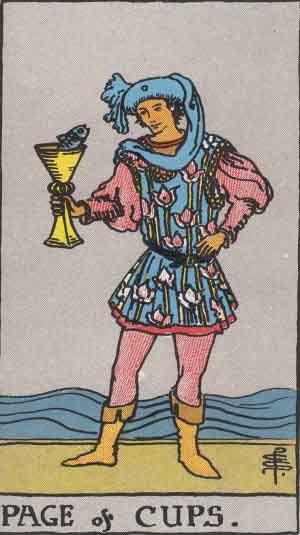
All Pages in a spread can represent children, and in the case of the Page of Cups, the image of a "little fish in a cup" transparently hints at pregnancy and the arrival of a newborn. Sometimes the "pregnancy" is symbolic—the card reflects a certain creative concept, an idea that the querent dreams of realizing.
It may turn out that the Page of Cups is a person obligated to the querent (sometimes dependent on them).
Wildly bohemian and romantically poetic. A dreaminess that interferes with coping with the realities of this world, poetic longing, and enchantment. This card brings a striking, "childlike" softening to a soul hardened in the arena of life. You begin to feel pity for those you would not otherwise spare a thought for at another time, let alone a feeling. You want to care and be the object of care. You want to caress and be caressed. Kindness, responsiveness, and care, without a second thought about where such behavior will lead.
The Page of Cups is very emotional and trusts his intuition. This is a friendly, approachable, carefree, and highly charming personality. Tenderness, gracefulness, and gentleness are characteristic of him. The Page of Cups is a playful, charming, and seductive companion. In the Venetian Tarot, he is Casanova himself. Unmasked. Genuine. Purity, kindness, and openness are inherent in his instinctive nature. This is a tender heart, ready to enjoy life and bring joy to those around him without an ulterior motive (which the Page of Swords will inevitably have). The Page of Cups wants to trust and pour out his soul; he is a good listener and confidant.
This is a card of a spiritually developed person with highly pronounced intuition and excellent creative potential. He charms with his inner light and subtle emotionality. The Page of Cups can be either a sensitive girl or a soft, gentle man. The important thing is that near them, the soul softens and it is discovered that the heart is not made of stone. This is one of those miracles that happen near all representatives of the Cups (Water) suit. Suddenly it turns out that someone finds us interesting, someone is ready to listen to us just because, and not because they need something from us (or we from them). This is that very "happiness when you are understood," and that true luxury of human communication, which life does not abound in very often. The Page of Cups possesses an exceptional ability to provide moral and spiritual support simply through his presence, by virtue of his kindness, receptivity, and ability to tune in to another.
The flip side of this gift is that it is difficult for the Page of Cups to defend his positions. He lacks proper self-respect, and it often seems that others surpass him. He is trusting and often puts himself in a vulnerable position. He is attractive and prone to falling in love, and his sweet coquetry serves as bait for internally hardened people seeking to "regain their soul" through him. With the Page of Cups, we genuinely begin to listen again to our desires and aspirations, and this can be experienced as a "return of the soul" and inspiration.
The Page of Cups carries you far from the shores of everyday life (if only for that brief moment when a deeply moved listener leaves a grateful comment on a good song online).
The archetype of the Page of Cups is the muse, the inspiring dreamer. The Page of Cups helps to manifest and voice certain previously hidden aspects of the soul. The curious little fish peeking out of the cup symbolizes the images of the subconscious "peeking" out from there into consciousness (and striving to survive there). The Page of Cups on the card regards it favorably and thoughtfully. His figure personifies the diligent contemplation of visions generated by the unconscious, a mediumistic cooperation. The fish is a creature that lives in the depths of the sea, symbolically connected to the unconscious. This card symbolizes creative contemplation, meditation on the contents of one's own soul—fantasies, feelings, ideas, images. One is simply drawn to draw them, write them down, reflect them in music, or capture them in some other way. The Page of Cups has an extremely rich inner world, and he enjoys plunging into its depths for another "catch." For him, dreams are more real and more valuable than omnipotent reality.
At the same time, the Page of Cups embodies the "earth of Water." Under his influence, a gradual crystallization of inner values occurs, opening the inner world to reality. According to legend, the Undine (a female water spirit) received an immortal soul after she found a husband among humans, a companion (and victim) of flesh and blood. Our unconscious deeply stores old truths, and the only reliable instrument capable of bringing them to the surface is the physical body. It is truly wedded to the soul and often becomes its victim, "paying" with gastritis, migraines, and insomnia for its yearnings and anxieties. At the same time, this Arcana helps us realize the wisdom of the body as a necessary starting point for returning to spiritual heights. In a mystical sense, it embodies the desire to find a connection with the cosmos, the desire to find something greater than love itself, to plunge into an infinite source.
Another archetype of the Page of Cups is the dreamy inner child. He is the only one of the Pages who is more concerned with the inner world than the outer, and his dreams, desires, and reveries relate precisely to the inner success called happiness. He dreams of that kingdom of the Grail, of the eternal ideal love, which is the domain of his symbolic father, the King of Cups. Therefore, the Page of Cups draws, plays music, reads, writes poetry, and composes songs about love—this is what keeps his soul alive—while the Page of Swords learns to monitor his surroundings and "crack" puzzles, the Page of Wands to make an impression and achieve success, and the Page of Pentacles to master practical skills and do something "real and useful." Like other Water Figures, the heart of the Page of Cups is selflessly given to something unattainable. Traditionally, he personifies an innocent child, a virgin princess, open to all and inaccessible to anyone. At the level of consciousness, the Arcana corresponds to the ability to be a conduit, a medium. The Page of Cups symbolizes the gift of foresight. He is capable of very sensitively predicting the first signs of personal changes long before they actually happen to us. One of the archetypes of the Page of Cups is Eros, the divine child with a bow and arrows, capable of producing radical changes in the human heart, inflicting a "wound" upon it and making it receptive to what previously left it cold. In this sense, the Page of Cups is a messenger of the Wounded King, the King of Cups, the senior Figure of the "water" suit.
From ancient times, the Page of Cups has been considered a trustworthy worker, a useful person eager to offer his services and apply effort toward achieving a specific goal. His ancient appraisal is: "a hardworking soul." The only important thing is that the work resonates with this soul. Then he worries positively about everything, about every aspect, delves deep into it, and strives to improve it.
In business situations marked by the Page of Cups, partners are ready to take a step forward or formulate an attractive proposal. This is a card of readiness for cooperation. By and large, he favors non-profit projects more, but does not exclude business success, especially when confirmed by other cards in the spread.
With the Page of Cups, just as with other Figures of Cups, a lot of emotion is invested in the work. This is a card of true flair, of trusting one's feelings.
The Page of Cups patronizes all occupations that require imagination and an aesthetic approach. He can be an excellent florist, a draftsman, a specialist in selecting music for events, or a wardrobe consultant. Intuition, receptivity, sensitivity, and taste help him properly attune to the client.
Artistic creation, humanities, various arts, including the art of divination, psychological counseling. The Page of Cups can adorn the stage or various events.
It is believed that the Page of Cups is a good student and that the card speaks of diligence and application in the sciences. The student mode is generally characteristic of the Pages. The Page of Cups connects to the subject with his heart; he only learns what finds a response in his soul.
Advice: open your feelings, fulfill your cherished desires, trust your intuition.
Pitfall of the card: having no self-respect, not trusting yourself, and trusting others without any grounds to do so. Naive self-deception.
Naivety in financial matters. Excessive gullibility. Insufficient skill in managing capital. It can indicate a lack of legal support, a failure to observe all the details of executing a transaction due to amateurism, or an ignorance of the rules and intricacies.
The Page of Cups is not yet a victory on the love front, but, if one may say so, a "draft notice" to this front (a chance for love offered by external circumstances). This is undoubtedly a card of tender feelings. It carries a desire for closeness and union, mutual understanding, and a truce. This card is characterized by an exceptional note of sympathy and empathy. It describes an affectionate and responsive attitude, the ability to rejoice and bring joy to another. Its domain includes emotional and spiritual intimacy and gratitude, the rebirth of feelings.
The card describes a dependent partner, emotionally, financially, or otherwise feeding off their "dominant" (gender plays no role here). But this is usually not a calculating exploitation—the Page of Cups truly feels affection. If the card describes a lover, it is the kind about whom you want to say with a smile, "A child!", because he is young, slightly naive, and very receptive. He may be inexperienced or clumsy, but this absolutely does not spoil the impression—he is so tender, affectionate, and unselfish. One of the old meanings of the card: "childlike love" (both as a person and as an event).
The Page of Cups, more than anyone, risks getting "the bitter experience of youthful days" due to his naivety and vulnerability. While the Page of Swords usually doesn't let anyone near him, even after a long sniffing out ("And yet, no!"), the Page of Cups gives himself entirely and without looking back, without really figuring out his partner. He is inclined to take emotional risks, not always even realizing them and diving headfirst into the whirlpool of emotions, and this is not the best foundation for acquiring strong relationships (as noted by Mary Greer, "a slavish submission to the first impulse of love," which only at the level of the Queen of Cups becomes a unique ability to feel any partner).
At the same time, the Page of Cups corresponds to the demonstration of feelings (the fish pokes out of the cup, unable to stay hidden in it), a sincere amorous impulse, the beginning of a romance. This could be a thoughtless flirtation without a thought for the future, or a prologue to something serious—other cards in the spread can provide a clue. The only drawback to the situation described by the Page of Cups is that it is not yet known what will be discovered when the initial romantic fog clears and the contours of reality begin to emerge from it—the more ideal everything was at first, the greater the risk of a subsequent mismatch of outlines. However, the Page of Cups perfectly expresses the spirit of the mocking proverb: "No matter how many times you step on a rake, the heart still believes in miracles!" Such miracles are entirely in the power of the Figures of Water (or Cups).
The Page of Cups can be an indicator of emotional difficulties, oddities, or deviations, and can also point to emotional experiences from which a person could not protect themselves, as a cause of illness. This defense lies within the realm of the nervous system, and the Page of Cups can indicate nervous diseases, autonomic disorders, and psychosomatics. In the old days, it was believed that under the Page of Cups, a person pines away from love. By and large, unrequited, rejected, or unfulfilled love can indeed lead to a range of health disorders, starting from heart palpitations and ending with congestive processes.
The reversed Page of Cups resembles a small soap bubble. He is like that fleeting experience we have when impulsively making an unnecessary purchase. This card can indicate that emotions are not deep, that everything is very fragile, hazy, and will soon change.
Traditionally: fickleness and promiscuity in love, slipping down a slippery slope. Deceit, cheating, falsehood and flattery, betrayal, heartache. Other traditional meanings: loss of innocence, loss of trust, attraction to the "wrong person," an effeminate youth easily yielding to someone else's influence and risking being used. In modern interpretation, it can also hint at an attraction to children. One of the old meanings of the card represents addictions threatening to destroy a person's life, pathological inclinations, very strong passions, and temptations.
The card can indicate self-doubt, "buried talents" (just like the reversed Page of Pentacles), and a fear of love, an attempt to become emotionally invulnerable. A person hopes for nothing ("Marriage proposals not accepted").
Refusal of a reconciliation or proposal, unwillingness to listen, to make contact, or to go on a date. Rejected confessions and gifts.
The card can also describe a vulnerable, ridiculed child who finds it difficult to stand up for himself. Mary Greer also points to escapism, the desire to "retreat into a private inner kingdom populated by imaginary friends, and slam the door behind oneself."
Breaking off relationships, engagements, a revoked invitation, cancellation of a social event, postponement of a date.
Some old meanings attribute to the Page of Cups such manifestations as style and luxury, taste and various penchants. These can also be vain attempts to "make everything like in a dream," empty infatuations, chasing after "soap bubbles" like unrequited love. Sometimes the "bubbles" turn out to be not this kind of love, but vain attempts to trade it in and forget it... In any case, the reversed Page of Cups indicates a sort of "emotional hole" in the querent's astral body (though, once upon a time, the presence of such a hole was considered practically mandatory for a young man, was poeticized and even glorified).
With the Two of Cups – marriage (from an old interpretation manual)
After the Page of Wands – a dangerous rival in love
Reversed with the Nine of Cups – cooling off, disappointment
Undines, mermaids, naiads, nereids, souls of the dead (from ancient times, one of their symbols was small dolphins).
"Elusive beauty"