Knight of Cups
Cups — Minor Arcana
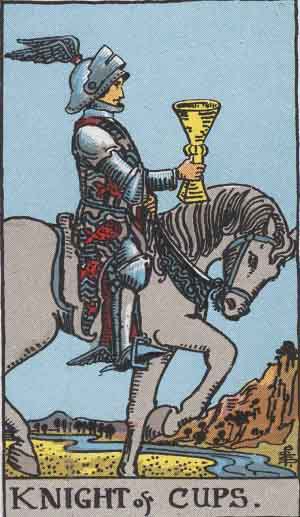
Detailed Interpretation
In the modern understanding of Tarot, Court Arcana are usually seen as character traits of the querent themselves or the people around them. However, since ancient times, they all have a strictly event-driven meaning as well. The appearance of the Knight of Cups in a spread has always signified news or an offer (usually excellent ones). This is the card of love letters and seductive invitations. Under the Knight of Cups, we rush to a romantic date (if the Knight of Wands is also nearby, we do it at breakneck speed), we court, and we accept courtship.
This is the card of a "new spring," a romantic wind blowing through life. It reacts exceptionally accurately to approaching the romantic and mystical side of life, an emotional uplift (sometimes reaching cloud nine). This Arcana can indicate that the querent's actions are driven by feelings coming from the depths of their soul.
While the Knight of Wands has traditionally always been interpreted as someone absent or "on the run," the Knight of Cups has the opposite meaning—it is the arrival, the approach of something or someone pleasant.
For both men and women, the Knight of Cups has traditionally been interpreted as the "Messenger of True Love," and usually mutual love at that. Hence the more modern interpretations, which are fully justified in practice: a messenger, a loyal ally, a visit, as well as a drawing together, reconciliation, alliance, and the successful resolution of pending issues in relationships with those around. An atmosphere of goodwill, cordiality, and warmth. The Knight of Cups is exceptionally favorable in spreads regarding conflict situations, foreshadowing reconciliation and agreement, the elegant settling of differences, and the finding of a valuable compromise.
Surrounded by negative cards, the Knight of Cups becomes a seducer and deceiver, a reckless reveler or a "good guy whose affairs are in a bad way" (and the querent is invited to play the role of his helper or savior).
The Arcana foretells a time unburdened by any complications, good mood and heartfelt communication, as well as romantic interest. Leisure and entertainment, the satisfaction of emotional needs, and the joys of the soul fall under this card. Receiving and buying perfumes and outfits, pajama parties, going to theaters and restaurants, strolling through Montmartre, or admiring the sunset over the nearest pond—all that matters to the Knight of Cups is that the activity caresses the soul and "turns on" an unrealistic, dreamy mode. And then—it could be gazing at Christmas shop windows, a Viennese waltz, or watching "Amélie" for the hundred and tenth time. Perhaps it is French culture that possesses the almost magical ability to create the vibrations of the Knight of Cups out of thin air, literally from nothing... which is what it is famous for. What is so romantic about untidy Montmartre? What is so special about all those Cardin scarves and Dior perfume bottles, croissants, chansons, champagne, the coarse-sounding speech... you might not understand it, it's enough just to listen. In a German detective story, the main thing is the unyielding police; in an English one—an inheritance and poison; in a French one—love, and an almost inevitable romance with the criminal. The Knight of Cups is a permanent "Midnight in Paris." To see it and... come alive.
"On cloud nine." Even if it is not head-over-heels infatuation (to which the card responds very sensitively), it is an emotional uplift, carefreeness, dreaminess, a good mood, a light heart, peace and harmony, a very celebratory and happy state. A completely non-businesslike mood. A creative binge, where the imagination is entirely at the mercy of feelings. This is a card of poetics, inspiration, romance, as well as healing from heartbreaks suffered in the past.
The power of emotions and creative imagination, renewal. And, oddly enough, in this rather euphoric state, one can put things in order and successfully do and resolve a great deal. Perhaps this happens because a harmony of mind and heart reigns; they do not interfere with each other or create internal barriers in one's affairs.
The traditional human roles of the Knight of Cups are a kind brother, a true friend, or a lover. As a character, the Knight of Cups is very charming. He can do practically nothing to achieve this, stay silent, be dressed haphazardly—all this will go unnoticed. It is very easy to project one's desires onto him, to hear words he did not say, and to attribute feelings to him in accordance with one's own expectations and desires—it is not without reason that this card embodies the ideal of a lover. There is always an element of an enigma, a mystery in him, but not a tense or disturbing one, unlike The Moon, for example. Rather, this has to do with the fact that the sensitive and creative Knight of Cups always remains a bit of a mystery to himself. He is not at all characterized by the typical masculine self-assurance in the spirit of "I am my own master, I know everything about myself, I am an open book." The Knight of Cups knows that there is still much within him that can surprise both himself and those around him.
It is difficult for this person to decide on a profession or a relationship (and sometimes even on their sexual preferences per se). He is not malicious, but he does not stand out for his stress tolerance, as he takes everything to heart and is easily frightened by difficulties. This is precisely the type of "wonderful person" for whom it costs nothing to drink themselves into ruin (while the bitchy Knight of Swords is more likely to drive those around him to the bottle instead).
The Knight of Cups embodies traits such as romanticism, sensitivity, and dreaminess. Even if he lies, he does so while believing in what he is saying himself. Calculating cynicism is absolutely alien to him (but he has more than enough imagination divorced from reality).
By and large, this is a very bright person, kind and affectionate. He is happy when surrounded by friendly attention, and to his credit, he knows how not only to consume this attention but also to give it to others. He is always ready to do a favor, to do something good, and he suffers if his motives are misunderstood. He is the first to press the button in the elevator not because he is currying favor with the boss, and he gives a woman flowers not because he is sexually obsessed. He is elegant and polite not because he is gay. Gallantry is in his blood.
This is a seducer, a comforter, historically—a courtly ladies' man. It goes without saying that sending such guys into battle was more trouble than it was worth, but at court, they were indispensable. The ladies would get bored, the court would lose its luster and turn into a barracks.
The Knight of Cups is a wonderful lover, though rather in the old-fashioned sense than the modern one. This is a lover not for a glowing complexion, but for the blossoming of the soul. He is a master not so much of satisfying the body as of gladdening the heart, and he captivates more with tenderness, kindness, and sensitivity than with sheer masculinity and primal rage (for that, please go to the Knight of Wands). He is instinctively perceived by a woman as a gift, as a psychological salvation, as a ray of light in a dark kingdom, and in general, this corresponds very accurately to his archetype. The only trouble is that in the beam of his light, practically all other kingdoms begin to seem dark. That is exactly why a couple of absolutely innocent dates with him can provoke the most terrible jealousy in a representative of the suit of Wands, Swords, or Pentacles. They, one might say, broke their backs laying the groundwork to build their serious masculine kingdoms, including for their lady, and then this smooth talker showed up, and that's it! The lady is like she's drunk... she needs nothing else, only him. It is easy to get angry here (a classic of the genre is "Assa"). Like the King of Cups, he plays on the field of feelings, which is directly inaccessible to the other suits.
The card describes that period in spiritual development when the time has come to bring oneself into harmony with one's strongest feelings and try to express them in life's creativity at the highest level. Desires and feelings are the omnipresent force of life; they can be mastered only through attention and awareness, but not through suppression and oblivion. They help us travel in our inner world, just as they help us to hold our ground and create in the outer one. The Knight of Cups inspires us to acknowledge our emotional needs, passions, and sufferings, and to live through them with full awareness, completely surrendering to this experience and observing ourselves within it.
The Knight of Cups embodies the airy (mental) aspect of Water, and therefore corresponds to the peaks of the development of imaginative thinking. This gift can be successfully applied in practice, but its role is most significant in spiritual development. The Knight of Cups personifies the noble seeker of the Grail, "having his head in the clouds" and worshiping the eternal feminine aspect of God. Esoterically, this is Lohengrin, the son of Parsifal, who had to leave his bride immediately after the wedding because, despite the prohibition, she asked him about his true name. The Knights of the Castle of the Holy Grail help others incognito, anonymously, that is, this happens only as long as they are unrecognized. They keep their true high rank as the greatest secret. This self-denial corresponds to the highest aspect of Scorpio (the hypostasis of the Eagle, stepping beyond the ego). The Knight of Cups embodies the core of courage—idealism and tenderness, the ability to remain kind and noble both in pain and in happiness. In a metaphysical sense, it is a symbol of a neophyte, full of idealistic aspirations, strong feelings, and the hope for initiation.
In a deep psychological sense, the Knight of Cups builds bridges, reuniting the archetypal energies of the masculine and the feminine. He has not fully reconciled with his inner femininity, but the process of seeking this reconciliation turns him into a very creative and charming person capable of displaying immense kindness.
This is the card of Pisces—emotionality, intuitiveness, imagination at the mercy of romantic feelings, creative powers. He describes the cult of emotional lightness, the illumination of the waters of the unconscious with the light of consciousness (the Knight's helmet on his head is crowned with wings—a symbol of the airy conscious element). The blue-toned cloak decorated with scarlet Fish, the river, the symbol of the Cup astrologically refer to the sign of Pisces. This is the final sign of the Zodiac, embodying the victory of spirit over matter, the achievement of an absolute merging with the flow. The white horse is a symbol of the nobility of intentions. The direction of his movement is opposite to the zeal of the Knight of Wands and the Knight of Swords. From the mystery of self-assertion, he returns to the eternal Source, to the bottomless Utopia of Love. The highest feat of the Knight of Cups is to give his life to it.
Professionally used imagination and creative talents. All occupations related to the expression of feelings and the satisfaction of people's emotional needs—artistic, poetic, psychotherapeutic. In particular, this is a card of actors, as well as musicians. Artistry and the ability to hear the music of the spheres as a guarantee of success. Dancers, poets, aesthetes, less often designers, restaurateurs (the energy of Pentacles is also needed), or showmen (with the energy of Wands). Consultants, diviners, fine arts teachers, travel and pilgrimage specialists, organizers of meetings and dating.
Productivity dependent on emotional comfort and creative inspiration. Often, this card hints at the need for the support of a skilled manager, patron, or impresario, since the independence of the Knight of Cups is creative, but not administrative.
Work in the social sphere, providing assistance to people, the status of a companion, human resource management. This card can describe a small business focused on leisure or personal development with an emphasis on harmony, health, and beauty.
An atmosphere of goodwill and cooperation within an organization. Flattering offers, gentle negotiations, diplomacy, and a readiness to meet halfway.
Advice: don't worry, be happy! "Relax and enjoy." The Knight of Cups advises forgetting about problems, meaning—to enthusiastically and totally seize new opportunities without hesitation. And, of course, to try to fulfill one's promises. To go for reconciliation.
Warning: idealization and feigned feelings. We see something in a highly idealized way, through "rose-colored glasses." One should not wallow in their fantasies, substitute reality with wishful thinking, and be led solely by feelings.
A quick receipt of money or at least a lucrative offer, encouraging information. This meaning clearly works in practice. An advance payment.
The reversed Knight of Cups (like the reversed King of Cups) has long been considered a sign of loss, especially as a result of fraud, swindling, or freeloading. This is the card of kept people of all stripes, including gigolos and marriage scammers.
"Honeymoon." Harmony, a pleasant pastime, a warm spiritual atmosphere, unity, and closeness. The Knight of Cups uncontrollably idealizes his partner and inclines them to do the same.
Actually, this card represents happiness in romantic relationships, an emotionally intense connection with a creative, dreamy person. The most traditional meaning of the Knight of Cups is a marriage proposal. If the Ace of Pentacles is nearby, it will most likely look like a diamond ring as a Christmas gift. Poems, letters, confessions, various manifestations of sensitivity and enthusiasm, declarations of love, open expressions of feelings come under the Knight of Cups. Fullness of feelings, peace and tranquility, a good mood, care, comfort, and affection.
The Knight of Cups can also describe a less advanced, yet very real stage of a relationship, akin to a honeymoon, when nothing bad happens because both are intensely projecting exclusively positive things onto each other and seeing only the good in one another. All Court Arcana of Water deal not with reality, but with a projection, a specially inspired way of seeing it, substituting what is desired for what is real. Here there is infatuation, attraction, a draw toward each other, open expression of feelings, a great desire to spend time together, romantic charm, feelings close to a culmination. Under the Knight of Cups, sympathy is not hidden, but expressed—with bouquets and chocolates, romantic invitations and meaningful gifts, compliments, poems, and kisses. A symbol is extraordinarily important here. Sometimes its meaning grows simply to mythological proportions, and some attribute (a ring, a cross, a bracelet, a key, a mirror, a photograph), a certain dress or shirt, a specific date, name, place, ritual, or a concrete detail of appearance begins to play an incomprehensibly global role, disproportionate to its objective scale. It seems like a trifle. A little blue handkerchief... Diamond pendants...
Sometimes the "symbolism" of the Knight of Cups, combined with the projections typical of the water element, produces an unexpected effect—the relationship itself becomes merely a symbol of something. The range of manifestations is surprisingly wide, starting from their "substitute" nature (the male or female partner does not even suspect that they serve merely as a more or less pale copy of some other person with whom the Knight's relationship was once cut short, fell apart, or did not work out) and ending with "being in love with Love itself" (the object is clearly secondary). Sometimes this character finds himself involved in an affair against his will, drawn by the complexes of the unconscious and unable to say a firm "No." It is characteristic of him to pity and to help; he can caress and sleep with someone out of compassion, becoming "medicine for the wounds"—and ending up sealed in a bottle and put away in the medicine cabinet for a decade. Now he is the one who requires a savior... In general, it is interesting to wonder what literature and cinema would do without the Knight of Cups? His plotlines can be exploited ad infinitum, because the Water of their emotional development is fluid, and the opportunities for new awareness and rethinking (Air) are enormous.
In love, the Knight of Cups is much more romantic, idealistic, and delicate than the Knight of Wands. Here, instincts manifest more gently and refinedly. He is tender, cordial, and romantic. The high ideals of love are close to him, and he does not consider them "naive" at all. You can safely trust his love (even if the relationship ends in the future, he will do everything so as not to offend in any way).
As a lover, the Knight of Cups can be insecure, shy, silent (which for some reason does not diminish his attractiveness at all). He is frightened by relationships with persistent, strong, and tough people who can gain power over him—and, naturally, it is exactly those whom he attracts with terrible force. He is capable of behaving altruistically and self-sacrificingly. In sex, he gives himself, regardless of gender (and feels "taken").
In general, the Knight of Cups takes his feelings very seriously and sincerely believes that they will last forever. How serious everything is will be prompted by the other cards in the spread.
As a significator of a problem, the Knight of Cups can point, first and foremost, to emotional disorders, all kinds of complexes, and emotional wounds (drowned in alcohol, sleeping pills, and other "auxiliary" means), as well as to the instability of the affective sphere as such (tossing between depressions and ecstasy).
It may hint at anemia, overwork, a cold. In a reversed state—a hangover, poisoning, overdose, intoxication.
This card warns the querent about dangerous illusions, as well as revoked invitations, difficulties in establishing contact. An offer or opportunity turns out to be very deceptive, and good intentions, promises, and motives—illusory. This is also a lack of loyalty to one's own ideals, betrayal of oneself, emotional dishonesty.
A trip or anticipated news is delayed, postponed. Something prevents the meeting from taking place, despite all desire.
Insecurity and timidity that prevent achieving what is desired. Escape from reality, inactive dreaminess. Hypersensitivity, self-doubt, a tendency to obsessive fears. Sometimes—an indicator of addictions to sex, alcohol, drugs, and other things, mainly out of fear of reality. The reversed Knight of Cups usually has something to hide. It could be cheating or an unapproved romance, a drug addiction, financial difficulties.
According to Mary Greer, this card has one traditional interpretation—"the love that dare not speak its name" (as same-sex relationships were called in the 19th century). In combination with The Tower, it could perhaps be interpreted as coming out.
A poser, a flatterer, a treacherous and deceptive young man, a schemer. Duplicity, showing off. Incomprehensible feelings and sensations, unclarity, clarification is necessary. Deceit, fraud, cunning, sleight of hand, tricks, swindling, lies.
Deceptive or unrequited love, feelings that have cooled. Manipulations with love, emotional cruelty. In the worst case—a broken heart, emotional damage (and a lesson) for the querent.
With The Chariot – a favorable outcome of the matter.
With the Seven of Pentacles – a profitable visit.
With the Ten of Pentacles – returning home.
The Liberation of Psyche by Cupid
Paris, the lover of Helen of Troy
Saint Francis
The Knight on a white horse, savior and liberator
Troubadours, minnesingers, "enchanted wanderers"
Happiness is a state of mind. If you want to be happy, be it.