Queen of Cups
Cups — Minor Arcana
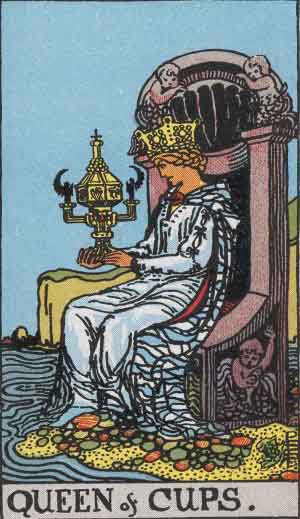
Detailed Interpretation
Traditionally, like all court Arcana, this card is interpreted in a spread primarily as an indication of a specific person "encoded" as the Queen of Cups. As a rule, this is a woman—sensual, kind-hearted, intuitive, artistic, creative, soft, and gentle. She is kind, ready to help, and can give wise advice in matters of the heart (and not only, as she has good intuition in general). With her, you can feel cozy and safe. She is good. She differs from The Empress and other queens in that she has her head in the clouds to a much greater extent and is much less distinct and structured in her manifestations. She is entirely filled with spirituality, manifesting most of all in spiritual (and sometimes—fantasy-like, serving as material for creativity) relationships, in which she is usually absorbed.
Traditionally, the Queen of Cups is the significator of a loving woman or a woman for whom the querent feels love. The Arcana can also indicate a man, but in this case, the cards want to convey that this is a person of the "lunar-Venusian" type—gentle, soulful, affectionate, vulnerable, possibly overly emotional, living by feeling rather than reason, trusting his intuition. He can act as a "shoulder to cry on," someone to confess to (for a woman, this is the type of a non-traditional best friend, although this meaning is not strictly necessary). This is a person ready to come to the rescue. The traditional interpretation: a person who will render an invaluable service to the querent.
Beyond personal interpretations, it is believed that the presence of this card in a spread emphasizes the meaning of the neighboring Major Arcana. And if it is another "female" Arcana, say, The Moon or Strength, then her role is noticeably amplified.
It also indicates that the emotions associated with the subsequent cards have already been born and set in motion (a rather vivid emotional reaction, "experiences," are present).
In a spread for a situation, the Queen of Cups gives a favorable forecast for the future, but one should not count on overly significant results. What has been achieved will bring a lot of joy and pleasure, but for more serious success, one will have to work quite hard. However, the surrounding cards may also indicate the potential for turning dreams into reality.
The presence of the Queen of Cups in a spread gives reason to believe that in this situation one can feel safe and trusting, there are no hidden traps and secret enemies in it. This card emphasizes a peaceful and harmonious environment, comfort, and safety. It can also express the need for understanding and love, falling under the influence of feelings, susceptibility to outside influence.
A blissfully contemplative and non-businesslike mood, having one's head in the clouds at the mercy of moods (and sometimes—feelings), staying in touch with one's inner world, following an internal rhythm. Escapism, retreat from harsh reality into the subtle world of mysticism, riddles, creativity. In essence, this is a state of peace, waiting, thoughtfulness, listening to oneself, readiness to encounter the unconscious, for inner discoveries. Dreaminess, a tendency to fantasize and to prophesy through things like prophetic dreams, astute guesses. A state in which feelings and intuitive perception clearly become more refined. For a woman, this is more natural, but for a man, this state may seem uncomfortable, and the more rational he is and prone to tough decisions, the sooner he will define this state as a weakness. This card carries the gift of clairvoyance and love, and a touch to the mystical side of life. But adapting to all these phenomena (love, clairvoyance, and subtle alignments) is a separate task altogether. For some, they are as natural as breathing, while for others they become a real ordeal (although in general, the Queen of Cups is a card of emotional well-being, and through it, a person is ready to follow their feelings).
A rich imagination, meditative states, contemplation of genuine images of the collective unconscious in the mirror of the soul, boundless mediumistic fantasies. The desire to experience the full depth of internal feelings, a sense of immersion, peace, and happiness, the opportunity to relax, feel rest and contemplative comfort in safety. A creative sabbatical to solve spiritual tasks.
The Queen of Cups describes a person endowed with a vivid ability for empathy, sensing another, and a subtlety of intuitive understanding. With almost mediumistic insight, he or she catches the most secret feelings, desires, fears, and hidden pain of another person. Their own emotional reactions serve as a guide in the world of undercurrents, but sometimes this guide leads into the thickets and swamps from which it is difficult to get out. The Queen of Cups easily identifies with the moods of others, catching the projections of other people, reflecting their unconscious needs, and taking almost any shape. If she wishes, she easily establishes a connection, sometimes not knowing herself why she is doing it (meaning—why she needs it; it is enough for her that someone else needs it). The Queen of Cups does not have a strong individual foundation of her own. If it were pronounced, it would prevent her from perfectly tuning in to another. At the same time, she prefers one-on-one communication, rather than with a group of people, where she loses her mediumistic power, because it is impossible to connect to everyone simultaneously, and "to everyone" (that is, to a group) is not her genre. She individually guesses and reads the person next to her, becoming imbued with the unconscious of the other person and living it through her own experience. One can project a desired image onto her and see it for a long and persistent time, because her real personality is so unstable that it does not present any tangible obstacle (later, of course, it may turn out that this personality does exist, but the hero will consider it nothing more than a female whim, and this is where things will get very difficult for the Queen). The hero willingly projects his Anima onto her and remains in an enchanted kingdom alone with his own soul, forgetting about heroic deeds (by contrast, the Queen of Wands projects her Animus onto the hero and literally pushes him out to meet heroic deeds, awakening him from his slumber).
The Queen of Cups is a sweet, friendly, romantic, and gentle personality. This person is loved and adored, most likely by many; there is a mesmerizing charm in them. They can be shy and trusting at the same time. They are characterized by aesthetic flair and refined taste. Most likely, this is a woman (in the latter case, she is a wonderful mother and a loving wife). This card can also indicate a very good friend, regardless of gender. Traditionally, it is considered to be the significator of a Libra or Aquarius woman, but from a modern point of view, she leans more towards water signs than air signs. She is kind, cordial, poetic, soft, sympathetic. The traditional description of the Queen of Cups is simply touching: "a seductive blonde, completely at the mercy of dreams." It also emphasizes honesty, propriety, and virtue in every possible way.
The Queen of Cups is the image of a woman who is commonly called "emotional." She is usually inclined to exaggerate the virtues of the people around her, to idealize, to fantasize, to get carried away. Listening to her talk about another person, it is impossible not to be amazed—where did she see all this? She does not judge, not out of diplomacy, but out of kindness; she can be completely blind to the flaws of those she cares about and for whom she creates the most harmonious environment, if not in a domestic sense, then at least in an emotional one. The mood swings she is subject to are unpredictable both to herself and to others; she is reproached for absent-mindedness and self-indulgence. She follows the lead of her feelings. She can be indiscriminate in choosing partners—it is hard for her to push someone away, she is inclined to think people are better than they are, and sometimes pays the price for this (in extreme cases, tearfully declaring that she is "a doormat that people wipe their feet on"). She heals by sacrificing herself. In another case, she herself might seem flighty and unreliable. In any case, she is affectionate and ready to open her heart and door to those who need warmth and love, without thinking too carefully about whether they deserve it (or rather—not framing the question that way at all). It is important to understand that this very creative woman is driven primarily by the need to erase obstacles, expand boundaries, and blur the line between what is and what should be from the perspective of a loving heart. This can be called dreams, illusions, and fantasies, but it is also the wisdom of the heart, its devotion to its own intuitive knowledge of how wonderful people should be, how wonderful the love between them should be. She is driven, perhaps beyond her consciousness, by this inner light, this mystical vision. Anyone who knows the same will never throw a stone at her.
The path through water cleanses and renews the soul, makes it more refined and sensitive. This card embodies the power of Mah, the Moon, the feminine aspect of the water element, symbolizing a healing, strengthening force, as well as looking inward, diving into the deep layers of the soul. Thus, she rules the unconscious forces of the soul. She is a fairy and a wise sorceress living within us, a prophetess interpreting our dreams, a clairvoyant helping to find the way in the fog. She is sometimes called a "dark card" because the origins of her wisdom are hidden, and it is impossible to know them through rational thinking; this brings the Queen of Cups closer to The Moon and The High Priestess. She is also called the "mother of the inner secret" (the fact that the Cup has a lid hints at an understatement, an elusiveness, a hiddenness). The Cup that the Queen holds in her hands is an instrument of meditation and magical vision of images of the past and future. She also beautifully embodies the mother of our inner child. The Queen of Cups can describe a caring person who in every way supports development—tells fairy tales, takes you to theaters, teaches you to draw or play music, takes you on trips. Their perception of their ward is always somewhat idealized, but in return, the ward truly loves them and accepts them as they are.
The Queen of Cups is a muse who intuitively feels what abilities, dreams, desires, and talents are enclosed in another person close to her. Her sensitivity and sympathy make people open up around her.
If the Queen of Pentacles is the earthly hypostasis of Mother Nature, then the Queen of Cups is the Anima Mundi, the Soul of the World. The image of a shell often symbolizes the sexual organs; it is also a symbol of resurrection and is often one of the attributes of the Virgin Mary. The island where the Queen of Cups dwells is a symbol of Avalon, a supernatural place unattainable in ordinary reality. Her enormous cup is decorated with crab claws, hinting that it is not so easy to break free from her bewitching kingdom and the hero always retains a tendency to return to her (Cancer symbolizes backward movement). At the same time, the claws resemble the astrological signs of the White and Black Moon (Selena and Lilith, respectively). The former is responsible for the devotion of the heart, sacrificial love that seeketh not her own, practically on angelic vibrations, while the latter is responsible for compulsions, obsession, the inability to break free, whims, being subject to jealousy and similar low-frequency impulses. Well, the journey into the inner world brings more than just pleasant surprises. Subconscious urges and desires can also turn out to be dark, but interest, observation, and a "maternal" attitude towards them can come to the rescue (after all, they are also "children" of the psyche, symbolized by Water).
The Queen of Cups embodies the mystery of spirituality and sensuality at the same time, the readiness to perceive and surrender, to seduce and to heal. This is a person whose expectations and hopes are coming true. They have not yet realized this, are not sure of success, but feelings outpace consciousness, and they feel harmony with the surrounding world, the fullness of being. The true meaning of the concepts of "love" and "happiness" opens up to them.
Can mean brilliant intuition, hence—success in the conceived endeavor. Self-realization in creative professions, activities related to imagination, to aesthetics—music, poetry, writing, theater, cinema, the recreation and entertainment industry. It can also be work that helps people find peace and restore physical and mental balance—psychology, social assistance, healing, meditation, SPA, as well as a "spa for the soul"—all sorts of creative clubs, interest-based activities associated mainly with creativity or esotericism. Sometimes it is literally working with women, in a women's medical or psychological consultation, in a department of a store selling specifically women's goods, etc.
Creative sabbatical.
Under the Queen of Cups, it is undoubtedly not easy to "stand one's ground" in defending business interests, but at the same time, she facilitates negotiations, compromises, and a peaceful resolution of problems. Troubling business and professional situations under this card are usually resolved with "little blood." On the downside, it can mean the formlessness of plans, uncertainty in practical actions, and a tendency to take the path of least resistance.
Advice: develop within yourself all the best female qualities (regardless of your own gender)—receptivity to the needs of the surrounding world, intuition and softness, trust and compassion. A time to give oneself up to love, sensuality, creativity, poetic foresight, to be sincere in one's feelings, and to enjoy the situation without the thought that something is threatening. There are no hidden traps, unexpected enemies. You can trust and feel at home.
Warning: do not have your head in the clouds.
An environment in which the querent feels safe, cozy, calm, and protected. A flexible and rather intuitive, than rational and practical, solution to financial issues (and with what success the other cards will tell). The Queen of Cups can be a bit naive, not of this world, and in financial matters, she usually needs an assistant.
The Queen of Cups is considered a card of boundless love, unconditional acceptance. She describes the state of a loving person who is very attentive to the other. In her jurisdiction are subtle feelings, eroticism, trust, as well as grace and compassion.
A wise choice in personal life, prompted by the heart.
A gentle and attractive woman (as a rule), a very good friend. A loving, virtuous wife, a wonderful, devoted companion (for a man—a promise of true love), a good mother. As a relative, she can give wise advice in matters of the heart. For a woman, this is either a friend or (rarely) an honest rival.
In books, one can find the indication that the Queen of Cups speaks of a nascent feeling of affection, when everything is still quite vague and uncertain, but according to our observations, we are talking about much more formed and deep feelings. This is understanding each other without words and a strong desire to be together, soulfulness and eroticism, an irresistible thirst for merging and uniting with another person.
Since the very essence of the Queen of Cups is directly related to love, additional information can be gleaned from the "Personal State" section.
Water metabolism disorders, swelling, sometimes—poisoning, intoxication. The card can indicate psychosomatic disorders, the causes of which lie in the realm of emotions, and energetic infections (illnesses of others "pulled" onto oneself). Occasionally—sexually transmitted diseases.
This is also the significator of an unconscious state, fainting.
If in her natural state the Queen of Cups is a devoted woman, a cordial spouse, and a wonderful mother, then in a reversed state she gets closer to the modus operandi of a party girl, a hysteric, and a scandalmonger. She is a vicious, dishonest, corrupted, depraved, unscrupulous woman, as the ancient interpreters report. Guggenheim puts it more mildly: "a lady with an unstable psyche, fleeing from her problems into an illusory world." She has her own reality. If she usually gravitated towards harmony, mutual understanding, and the family hearth, here alcohol, drugs, and promiscuity as an artificial search for inspiration and harmony can manifest (the woman may well belong to bohemia, be an actress, sing, dance... "scribbling, daubing, strumming"). Sometimes this is being calibrated by psychological trainings and "how to be happy" books to a state of permanent psychosis.
As Mary Greer writes, in Victorian literature this is a woman seduced and abandoned by a demonic lover, who commits suicide by throwing herself into the sea. There she turns into a mermaid, an insidious siren, in turn seducing and luring into fatal abysses. An important motive here is self-pity and a vampiric approach to reality: first she gave more than she should have, now she is ready to take much more than is needed. Perhaps the image of Anna Karenina in all its dynamics fits the reversed Queen of Cups very well (one of the ancient definitions of this card is "a married woman of high social rank offering her love to the querent").
The reversed nature of the Queen of Cups does not automatically turn her into the Queen of Swords, and one should not attribute qualities like harshness and rigidity, cold-bloodedness and the denial of emotions, overcoming illusions and suppressing manipulations. What is triggered here is a deeply emotionally conditioned combination of alienation and clinginess, blurred boundaries, touchiness, blaming others, tossing about—in short, different vibrations that have little in common with the Queen of Swords.
The following remark is also interesting: "The habit of spiritually merging with the object of one's desires can lead to the body turning out to be 'empty', and completely foreign entities will quickly settle in the vacant space." From a magical point of view, this card can speak of an astral marriage with a more or less benevolent spirit, a daemon. In the highest sense, it is deep faith requiring the sacrifice of personal feelings.
The reversed Queen of Cups can say that the feelings indicated by the content of the subsequent cards have not yet manifested, have not been recognized, or they are simply inadequate to what is happening (this is how sometimes great love starts with a scandal, and future close friends meet by having a fight).
Among the traditional situational meanings are scandal, a dubious affair. Dishonesty, unreliability. Illusions, wishful thinking. Invented feelings, groundless fears. A person who should not be trusted and certainly should not be confessed to or have one's soul poured out to, as their moral principles leave much to be desired. The desire to meddle in other people's affairs. A tendency toward forbidden techniques, vile methods, blackmail, deep dishonesty. Begging.
With the Ace of Cups—a female friend met at a feast, at a party.
Reversed with the Two of Cups—(for a man) marriage, (for a girl) jealousy.
Anima Mundi, the Soul of the World
Virgin Mary, Queen of Angels as a medieval archetype
Erda (wife of Odin, able to foresee future events, although her name corresponds to "earth")
Venus in a chariot drawn by swans
The archetype of the prophetess—Cassandra, Sibyl
Moirai, Norns (Goddesses of Fate)
Avalon
Calypso
Garden of the Hesperides