Page of Wands
Wands — Minor Arcana
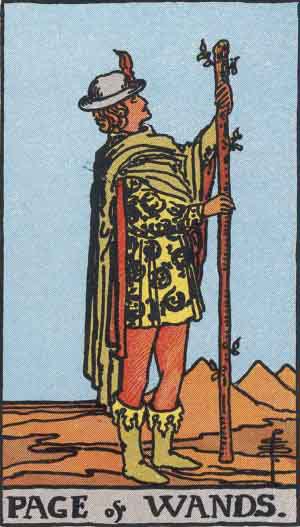
Detailed Interpretation
The most traditional meaning of the Page of Wands is a traveler, a messenger, a good friend, an emissary, a foreigner, long-awaited news, a herald bearing tidings. He is like one who, striking his wand on the floor, announces the arrival of a new guest at a grand ball. This card speaks of the emergence of new movement in a situation that seemed completely deadlocked, the awakening of new interest and enthusiasm, and a fresh perspective on things. This can be a minor "challenge" situation, a temptation, a test for a passionate nature, a trial of strength, an unexpected and exciting event (the scale of which may be indicated by other cards in the spread), or an attractive chance. The Page of Wands brings creative enthusiasm and a desire to head in a new direction. During the period it describes, we are besieged by exciting new opportunities and ideas, eager for development and realization. In accordance with the suit, they usually concern business, work, career, advancement, and self-realization.
Messengers or Pages personify the inspiring prospects that open up to us on life's journey. Wands represent the element of fire, and the chance presenting itself here takes the form of some captivating idea or proposal that we accept with delight. Usually, this is an opportunity to step outside the usual sphere of interests, an invitation to an adventure requiring courage and a willingness to take risks, a bright splash of color against the backdrop of grey everyday life. This could very well be, for example, participation in a contest, a sports competition, some other opportunity to test one's strength, some unusual experiences, a small "discovery of America." This is a period of creativity, changes, the spontaneous beginning of something new, the thrilling anticipation of something. This card might advise waiting for an external stimulus, some "hot news," important information, or an exciting offer from the outside that will influence the undertaken enterprise and awaken a new desire to work.
If there is not a single Court Card older than the Page of Wands in the spread, this may indicate that we are not yet ready for active steps to realize your plan. It is worth waiting for some time, after which another attempt can be made to "break through to the goal." Diving headlong into new events would be premature—there is a lack of maturity. Neighboring Arcana can tell of the favorable or unfavorable outcome of plans. And above all, one should be guided by the meaning of the Major Arcana—it is precisely this that describes the general state of affairs. Given the positive nature of such an Arcana (for example, The Star or The World), you can take a risk and set about realizing your idea. Otherwise, no matter how attractive the offer may be, it is not a reason to blindly agree right away.
Mischievous and sparkling. Naive and enthusiastic. Spring in the heart, the joy of life, spontaneity, and inspiration. The card can describe a reckless mood, excellent spirits, fun, and euphoria. In the state described by the Page of Wands, we are ready to rush into a whirlpool of adventures, we eagerly go to meet the unknown, and we welcome freshness and novelty in all their manifestations.
Like the Knight, the Page of Wands is characterized by impetuosity, impulsiveness, and spontaneity. He is cheerful, open, straightforward, prone to improvisation, and radiates an exciting and charming spirit of liveliness. He does not have the same restlessness and competitiveness as the Knight, but he is just as fond of showing off and acts without preparation (unlike, for example, the Page of Swords, who will definitely build a system of moves at least three steps ahead, will think through exactly what needs to be lied about in order to be believed, and what to keep silent about in order to drop it later with an innocent look at the right moment). He does not yet have the confidence and power radiated by the Knight of Wands, but he possesses a seductive youthfulness. These are the primary manifestations of courage, beauty, and strength, which will inevitably develop into something greater if nothing interferes. In spirit, he is a hyperactive teenager who finds it difficult to sit still, wants to try everything at once, and immediately receive recognition of his uniqueness. The combination of attractiveness and inexperience, seductiveness and immaturity can play a cruel joke on him and make him bait for older people wishing to take advantage of him.
The traditional formula describing this Court Arcana is: a sensible young stranger with good intentions, an honest person loyal to the querent, a courageous and honest defender of others, a confident, prudent friend who can be trusted. The Page of Wands represents the model of a young person of the type about whom it is customary to say: "with good makings." It is not yet entirely clear whether these promising makings will be realized into something concrete, or whether they will remain undiscovered. This is an energetic, inspired beginner, an enthusiast, but with a schoolboy approach and a somewhat infantile attitude to work and life in general. Traditionally, the Page of Wands personifies a being still immature in age or life experience, but with excellent potential. A good portrait is a young, dynamic, optimistic first-year student full of enthusiastic readiness to learn new things. He is in a subordinate position but is ready to pave his way to the top, driven by "fiery" ambitions.
Pages in Tarot are not the highest, but the purest energy of their suit. Wands, also known as Staves and sometimes Scepters, personify the element of fire—the yang, masculine principle, energy, impulse. It is also a symbol of fertility, flourishing, and creative power, associated with the ancient symbols of the lingam and phallus. This is the highest suit, the highest rhythm of life and human self-realization, and the Page is still only dreaming of expressing himself through these energies (in almost all decks he looks at the top of the Staff, studying it and taking pride in it). On an esoteric level, it symbolizes action on the level of pure ideas. It is followed by the suit of water. But in playing cards, clubs are the lowest suit. This is how the sacred differs from the profane. Here, the suit of Scepters is the final one in the ladder of suits and its symbol is the acquisition of life experience.
The prototype of the wand is a shepherd's staff, common since ancient times among Eastern peoples. With such a staff, Moses tended flocks in the land of Midian, and Moses's staff was destined to become a sign of salvation and pastoral authority over the people of Israel, and the same power was later associated with Aaron's staff. Appearing to Moses in the Burning Bush (note—the element of fire), the Lord imparted miraculous power to his staff. With the Wand, Moses parted the waters of the sea; with the wand, he brought forth water from the stone. The Wand is associated with spiritual authority, wandering, and preaching, the power to guide and to summon. Through connection with the biblical tradition, the magic wand also appeared in fairy tales.
In the opinion of Toni Wolff, the Page of Wands personifies the archetype of the "divine child," simultaneously narcissistic and vulnerable, like a god on earth. This is a fragile source of creativity, pouring forth joy, light, and miracles, and in need of protection.
The Page of Wands is the youngest of the Court Arcana of Wands, representing the fiery energy of life, the awakening of spring. He possesses warmth, enthusiasm, and other typical fiery characteristics: ambitious, cheerful, creative, proactive, easily gaining popularity, and able to captivate others. At the feet of the King of Wands sits a live salamander—an elemental or spirit of the fire element. In the case of the Page, it has a symbolic character, turning into an ornament decorating his shirt. This is a sign of ambition and the desire to be a leader, but for now, they manifest themselves mainly through drawing increased attention to oneself against the general background, as an extraordinary, bright persona (a situation that could well take place in a kindergarten, sports club, or student group). The Page of Wands literally "declares himself," knocking with his wand—I am not like that, I am special, look at me! Am I not the best, or can I not be the best?! He passionately wants to break ahead, to surprise, to become a darling, a favorite, and moreover for merit and by right, and not out of sympathy or pity (which could well be the case with the Page of Cups). If rights, merits, or talents are lacking, he will strive with all his might to charm his elders, using, depending on his age, the ability to make people laugh and entertain, wit, or sexuality.
The Page of Wands is prone to self-admiration, so there is a danger of falling into narcissism. He creates obstacles for himself, and he still has to overcome them in order to finally evaluate himself correctly.
The Page of Wands is a card combining Mercurial and Venusian influence with a slight Jupiterian touch. This is the childish side of the soul, curious and creative, capable of looking at the world with joy and hope, and contemplating joy, truth, and beauty in everything around.
A chance to engage in a fascinating endeavor. This is work that opens up new prospects for creative self-expression and inspiration, valuable new experience, and the initial exploration of new horizons. The opportunity presenting itself, indicated in the spread through the Page of Wands, should be treated as a step in the right direction. The Page of Wands often speaks of the initial phase of some undertaking and the need for learning.
Enthusiasm in work, impulsive inspiration for projects, a student-like fresh outlook on life, a persistent and enthusiastic readiness to learn new things. A beginning, professional training, apprenticeship. A thirst for new experience, a striving to do what one likes, a desire to achieve success. Ambition, courage, determination, intelligence, vanity. "Learning with passion," the start of a professional career, business promotion. The search for understanding, the thirst for honest achievement of goals.
The striving for recognition prompts this "earthly aspect of fire" to express itself through bodily aspects, for example, through dance, fashion, posing. A dancer, actor, model, travel lover.
Advice: wait for news, new information, new people, and new ideas. Explore all opening opportunities and draw inspiration from life's prospects. Take the initiative, be the first to reach out to achieve what is desired, let yourself and your intentions be known. The more confidence and inspiration invested in the matter, the better the result will be.
The trap of the card: an infantile mood that does not allow for building either serious plans or normal relationships.
The enterprise and investments have a chance of success, but their potential has not reached full development, everything is just beginning. The card indicates that one must take a more creative approach to solving issues of well-being and not be embarrassed to learn something new, as well as to play the roles of an ingénue, a beginner, a novice, an apprentice—this will pay off.
One of the traditional meanings of the Page of Wands is a young man from a good family who is looking for a partner; a lover, and a trustworthy one at that. However, modern tarot reading is somewhat skeptical of the latter epithet, rather believing that this is a "one-night stand" (the Knight of Wands will last for a series of nights, but one cannot count on his constancy either).
There is more enthusiasm here than love itself. Crowley points out that in the case of the Page (Princess) of Wands, behind a strong sexual impulse lies an inability for true mutual exchange, a lack of genuine emotional involvement, and sincere self-giving. This happens in the case of a turbulent youthful infatuation, when the initial experience of seduction itself is perceived as an achievement and a kind of social victory, almost regardless of whom exactly it is associated with. The card describes sexual attraction, infatuation, arousal, flirting, primal desire, a sparked "flame," and what will flare up from this spark, and whether it will flare up at all, will be shown by other cards in the spread. The Page of Wands finds it difficult to be devoted. Like a newlywed or a newly-minted parent, he does not really grasp the full magnitude of the task of marriage or parental duty, despite all his enthusiasm (or precisely because of it). This is the typical state of a neophyte—all trials are still ahead.
Crowley noticeably shifts the emphasis of the Page of Wands's trembling readiness for new experiences toward sexuality and passion. This is a spontaneous, childish desire to give free rein to instincts without caring about feelings (they are still a long way off). This impulse reaches its maximum development in the Knight of Wands (the next stage), whose insatiable libido literally sweeps away everything in its path, but the ability and art of loving comes only to the Queen of Wands (the watery aspect of fire finally involves feeling). Like the Knight, the Page of Wands burns with passion exactly until a new Great Love meets him on his way. He is full of hopes and expectations, open to everything, but does not take on any responsibility. His youthful adventurism conquers the heart, but his moral qualities lack depth. However, unlike, for example, the Page of Swords, there is no duplicity as such in the Page of Wands—he is simply fickle.
If the Page of Wands becomes the significator of a partner, it represents a young (at least in soul) person currently living one day at a time, dreaming of seducing the object of their interest and getting pleasure from any sign of attention. They can be delighted with no difficulty, and they are just waiting for this moment.
By and large, the Page of Wands indicates that the querent is young in body and soul.
As a significator of illness, it can report dehydration, overheating, minor injuries, slight burns, and nervous exhaustion.
The reversed Page of Wands personifies a loss of enthusiasm and interest in a matter, fear of change, and "backpedaling."
The traditional meaning of the reversed Page of Wands is bad news, unexpected distressing information (rejections, prohibitions, etc.), as well as gossip. In the worst case, this could be an event that, as they say, breaks the heart (for this, there must be other indications in the spread), at best—a warning that does not inspire tranquility, but nevertheless somehow arms one in a difficult situation. Worries due to intrigues.
The action of the reversed Page of Wands can be compared to the action of Saturn afflicted by unfavorable aspects of other planets. This is a boy with a red beret askew—an undeveloped character, a weak position, deprivation, the simulation of a firm position based on a fervent desire to develop this position within oneself—someone who cannot rely on themselves due to amateurism, negligence, and disorganization. Egocentrism and arrogance compensate for his feelings of anxiety and inferiority. The fire of this Page is unstable, unbridled, and poorly controlled. This is a mannered, superficial individualist, a troublemaker prone to theatricality, emphasizing his superiority and pretending that he has seen everything in the world.
Indecision, fickleness, confusion, psychological unreadiness to play by the rules, childishness in actions, childish antics. What was planned took a wrong turn at some point in time; apparently, the very first step and the first impression made were unsuccessful. Plans do not seem destined to become reality, and if they do manage to materialize, the results will be very far from what is desired. The same applies to hopes for certain processes "launched" by someone else. As a rule, these are comparatively minor losses and missed opportunities.
Misunderstandings, circumstances that will prevent the realization of good intentions: illness, transport workers' strike, nature, weather... Curiosities, predicaments, and situations about which one can say: "What a joke!" One of the interesting meanings of the reversed Page of Wands is a text, tale, chronicle, review, revue, short story, history.
It is generally accepted that, falling in a spread before a card representing a man, the Page of Wands testifies in his favor, reporting that we can trust him and rely on him. But if the Page of Wands follows, then the preceding male card symbolizes a strong opponent, brave, decisive, and exceptionally ambitious. Perhaps this also holds true for "female" cards.
After The Chariot - an upcoming journey.
After Judgement - major acquisitions, purchases.
With The World - a long journey.
Helen of Troy
Judas Maccabeus, who led the Jewish revolt against the Syrians
Lancelot
Lensky
"Only youth has the right to crown a poet with a laurel wreath"
"Forewarned is forearmed."
"Aware of your vulnerability and youth, trust in your strength, the bold conviction in your ideas, your vision."