Ten of Wands
Wands — Minor Arcana
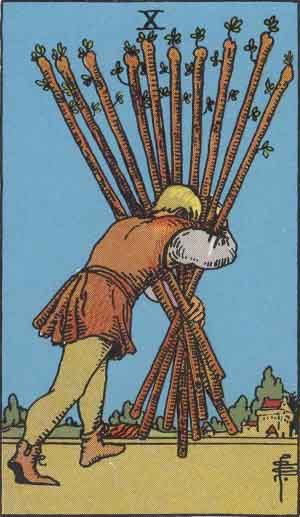
Detailed Interpretation
The Ten of Wands symbolizes the strength, will, and endurance needed to cope with an endeavor started long ago. This is the ultimate test of willpower, courage, and self-confidence that began with the Ace. These qualities are rarely inherent in us in the proper volume; few people possess such strong and easily unleashed "yang" energy, which is why the situation under the Ten of Wands begins to seem heavy and unmanageable.
In the Ten, the energy of Fire has reached its maximum and is now confined within a structure that restricts its freedom, a sort of "straitjacket." Therefore, we feel that our actions are suppressed and our possibilities are limited. Traditional meanings: an unbearable burden and a lack of prospects. A difficult situation where it is unclear when and how it will end. Goals seem unattainable, and the pressure of circumstances appears insurmountable. As a forecast, the Ten of Wands advises that it is better not to undertake the planned venture, because right now it is "too heavy to lift."
"Overloaded" - in both the literal and figurative sense of being weighed down. A heaviness in the heart. The state of a workaholic working 25 hours a day, lost in a labyrinth of tasks that must be done. This card signifies a person who has taken on too much—responsibility beyond their capacity or obligations they are unable to fulfill—and is already starting to slowly lose their mind over it. A certain situation (and it could very well be objectively favorable: a high-level job, love and marriage, studying at a prestigious institution, etc., which other cards will show) is unequivocally perceived as an unbearable burden, an excessive oppression, a heavy load of "I don't want to, but I have to."
A feeling of unpreparedness, inadequacy, and failure to meet the requirements of this life phase. Hence, a depressed state of mind. This is stress, not joy. There is an ongoing struggle to cope with internal tension and the restriction of one's own vital impulses. In any case, the Ten of Wands raises the theme of hyper-responsibility and the desire to do everything oneself out of the belief that it will be better that way.
This is the card of perfectionists who want to do everything at the highest level and please everyone, but end up getting a nervous breakdown and a stomach ulcer. As Uma Thurman noted, "you can not be full-time mama and full-time actress". The Ten of Wands is a card of a rather gloomy mood, showing that we took on too much because we expected too much, and now the illusions have dissipated, but the burden remains. Sometimes this card also means that on the path of their development, a person jumped over several steps at once and now feels like a first-grader who has landed straight in the fifth grade.
Incomprehensible tasks hang like a heavy millstone around the neck, and new ones keep piling up; it is easier than ever to disgrace oneself. In a sense, this card, like the Ten of Swords, reflects the inner turmoil itself. But these are not emotions overflowing the brim, but very specific anxieties: will there be enough money, will I make it in time, will I manage the workload? (Of course, if the Nine of Swords is nearby, panic is evident). Sometimes the card transparently hints at an inability to draw conclusions from past experience and the repeated creation of stalemate situations by the person themselves due to poor organization.
The best thing this card offers is the ability to cope with difficult situations and navigate the current state of affairs.
The Ten of Wands hints that "we got exactly what we bargained for." What once began as a bright idea under the Ace of Wands, be it a business venture or a marriage, has expanded into a mass of projects and accumulated a pile of responsibilities. Managing all of this simultaneously is difficult, and the once-desired goal obscures the surrounding world from the person. Therefore, a materialistic stance halts the expansion of thought. The Ten of Wands concludes the fiery stage of asserting one's material and social "I", and the person turns to their inner world, moving on to the stage of soul development—comprehending the sensual sphere of the water element.
If you have climbed to the top step of the suit of Wands (the Ten), a test of endurance awaits you. Every trial, in the end, comes from God: is your position truly in harmony with "your heaven"? Prove it!
The third decan of Sagittarius, ruled by the planet of completion, Saturn, lays the foundation for the transformation of energy into material results and describes its manifestations on the earthly plane. Saturn in Sagittarius provides ideological pragmatism. The abstract worldview and exalted spirituality of the previous decan become ideology and ritual here, creating support for the idea. For representatives of this decan, more than for previous ones, the embodiment of an idea into reality is important, and therefore, social status and authority capable of protecting the idea in the world are also important.
But... an idea at this level can turn into a dogma, and the preached high principles can cease to align with a rather base and ambitious stance in practice.
This is a case where views are imposed, and any atrocities are justified by a certain higher righteousness (historically - not the best times of Catholicism). This decan is interpreted as arrested development: further movement is suppressed, and the person takes a conservative stance until they receive material satisfaction from the realization of their plans. The idea, the thought leading to awareness, has fully formed and is now perceived as something separate from the Creator. The person separates themselves from their idea, from their creation. This is the stage about which one can say: "Inspiration is not for sale, but you can sell a manuscript!"
Light and shadow (advice and warning)
If the card acts as an advisor, reflecting the behavioral model recommended by the cards, then there is nothing to be done; you must bear this cross. Advice during a crisis in a relationship: even if you do not understand where and for what reason you have to carry this burden, do not see any prospects, do not understand what could unite you - GO forward, day by day do what you must ("I will give my whole life to you, drop by drop, year by year"), even if reaching the limit of your capabilities. Return to the home, do not run away, even if it seems unbearable to you. The crisis will be overcome; it makes sense to endure.
The warning of the card sounds like this: the straw that breaks the camel's back is ready in the hands of fate. Maybe you should throw off this burden yourself? You won't earn all the money anyway, you'll never get all the work done, and you still won't please everyone. It's time to stop bending over backwards. Reflecting a counterproductive behavioral model in a spread, it advises abandoning responsibilities and tasks, dropping the load, and finding time for pleasure, rest, and happiness. And in general, moving from a religion of sacrificial self-flagellation to a religion of rational egoism. At the very least, delegate authority and distribute part of your burden to those around you, despite their urge to nobly refuse. The card warns that the person must immediately give themselves a break; otherwise, health issues or failure in all endeavors await. In fact, it is necessary to distance oneself from daily life and recognize the dynamic of self-destruction that is currently guiding one's actions.
"Success at a high price." By and large, the Ten of Wands is the card of a person who has succeeded in one thing (for example, getting a desired position), but now even greater goals stand before them, and achieving them will be very difficult. Success brings what was expected—an improved standard of living, recognition, power, and so on—but one has to pay for it.
Under the Ten of Wands, there is an obvious professional overload. A burden of overwhelming obligations, the acceptance of which was usually associated with ambitious aspirations. Perhaps the person has now reassessed the prospects or entirely lost sight of the goal, but the burden remains, and now they are using their strength to endure this burdensome situation.
A huge responsibility, possibly exceeding actual knowledge and skills, so the person has to make colossal efforts and give 110% to stay afloat—the typical jitters of a young employee. This card always links excessive activity with things like recognition, respect, reputation, and image in the eyes of others. The desire to stay at a certain level dominates here.
The Ten of Wands can represent not only the difficulties of a beginner, but also the price paid for great and very great success. This is the exact case where a person makes a lot of money, but has no opportunity to spend it; they might own a comfortable house or a tropical island, but they are never there because they have no time, they are working all the time.
The card can indicate an excessive number of projects in which a person is involved, a scattering of energies. Many unfinished tasks hindering forward movement.
Difficult working conditions, lack of prospects, and no opportunities for development.
Preoccupation with property and wealth issues. The oppression of financial problems.
A difficult situation where it's unclear when and how it will end, one can only submit and drag it out (a typical home renovation card). But home is already very close. Right now, there are clashes and overexertion, worries and problems, exhaustion and overloads.
The reversed card is considered a significator of moving, emigration.
The classic card of a domestically oppressed person. Whether it is a man or a woman, the essence of the situation is the same: being overloaded with duties and responsibilities, resignation to the position of a "workhorse" or a "servant for everything," and a slowly growing desire to one day smash this unbearable burden to pieces and leave in an unknown direction. But this desire is unformed and suppressed, as are, indeed, all other desires...
Seeing no prospects, not understanding what is happening (after all, everything started so wonderfully once), the person drags this cart, doing what is expected of them, and often feeling guilty at the same time. And herein lies the main secret of the Ten of Wands. This Arcana does not point to an objective workload, but to blinders on the eyes. It reflects a specific narrowness of thinking and an attitude towards life that the person professes at this stage.
And, in exact accordance with the Holy Scripture, receives in themselves the due penalty for their error. In essence, this burden is merely complexes and fears. The fear of being disliked, of failing to please, of appearing as a bad person in someone's eyes—this is exactly what, coupled with pride ("I can do anything!"), forces one to take on too much. Not to mention the fear that your loved ones will stop loving you if you devote less time to them and more to yourself. It is precisely in family life that the question posed by the Ten of Wands (where have you ended up, and is it worth carrying this whole load further?) turns out to be very terrifying. Rather, the answer is terrifying.
Just as in the case of a profession, the image in the eyes of others and the desire to stay at a certain level, to maintain the achieved position at almost any cost, are very important here. The person uses all their God-given strength to endure this burdensome situation, and makes no attempt to change anything. For a start, they should acknowledge (regardless of how voluntarily they suppress themselves) that they would like to express and experience much more than they do now.
The Ten of Wands can speak of a hyper-responsible attitude towards the union: the person strains themselves, strains the other, and takes everything very, very seriously. Often the motive turns out to be the fear of being left alone or a "pure sense of duty." Affection and serious intentions are wonderful, but under the Ten of Wands there is a kind of heavy and clumsy approach to the matter, which, combined with a habit of pressuring the partner, results in a relationship whose development requires a huge amount of effort and brings neither joy nor pleasure.
Sometimes the card serves as an indicator of a forced union: the relationship was somehow imposed, arose under the pressure of circumstances, the person was nearly roped into marriage by force, and the prospects of all this seem to them either unclear or utterly bleak. Right now they see one thing—the impossibility of getting rid of the burdensome "ballast." In ancient interpretations, the "state" (or as we would say now, official) suit of Wands has a special relationship to the legitimization of ties between people, and one of the meanings of the Ten of Wands is a wedding. But in this vein, it creates the impression that it is the kind of wedding where all the relatives have piled on the poor guy in a heap, and further sealed the deal with an official pregnancy certificate on top.
In the Ten of Wands, an element of violence, suppression, and excess is perceptible, so for intimate life it carries a rather negative meaning, which is sometimes not hard to guess depending on the context of the situation. There is extreme pressure of desire here, a kind of rigidity in demands. It can be an indication of a mismatch in temperament between partners (one always lacks satisfaction, the other feels almost like a victim of sexual assault) and of intimacy occurring on a "voluntary-compulsory" basis.
Chronic fatigue. Professional burnout. Unbearable workloads. Overtraining (for athletes). Long-standing health problems caused by overwork, depletion of resources, and the inability to recover normally. Loss of strength.
The reversed card is considered an indication of a disease against which one has not been vaccinated.
Practically, the reversed Ten of Wands always carries with it some kind of loss: what can you do, Saturn demands sacrifices. Difficulty, resistance, obstacles, inconveniences.
In ancient manuals, the meaning of the reversed Ten of Wands somehow smacks of the vibrations of the Seven of Swords: intrigues, duplicity, betrayal, deceit, cunning, hypocrisy, an encounter with the destroyer of the querent's interests. Misfortune due to envy, jealousy.
On a metaphysical level, the card means the inability of a thought or an idea to manifest itself. In its extreme manifestations, this is the situation of a misunderstood genius; it is a thought expressed at the wrong time, either too early or too late.
In some ancient interpretations, it is the beginning of a rise after a difficult period and even lightness, which is nevertheless hard to agree with.
In modern manuals, two meanings are emphasized: either throwing off the burden, escaping from an oppressive situation (here, perhaps, a shade of "betrayal" and "damage to reputation" is also possible), or an indication that the person has "overstrained" themselves and paid for it with their health or luck. It can symbolize destruction in all its diversity. There may also be a desire to "shift the blame to someone else."
With The Fool – throwing off the burden, readiness to live one day at a time, escape to freedom.
With Justice – hyper-responsibility, taking on an additional burden out of a sense of duty.
With The Hanged Man – release from oppression thanks to a change in point of view.
With The Moon – deception by a false friend.
With the Four of Wands – end of a difficult period, relief, liberation.
With the Five of Wands – struggle, squabbles, complication of the path.
With the Queen of Wands – an infectious disease in the very near future (like a fever).
With the Four of Swords – threat of illness due to overwork, "you will rest in the hospital".
With the Six of Swords – crossing a milestone. An interesting comment by Guggenheim: "fighting alone".
With the Nine of Swords – terrible anxiety over affairs.
Reversed with reversed King of Swords – someone's machinations will be thwarted.
Via Dolorosa, the Way of the Cross.
The Phoenix bird, burning in the flames and rising from the ashes.