The Hierophant
Major Arcana
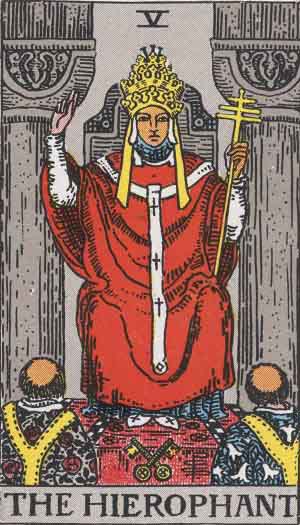
Detailed Interpretation
The Fifth Arcana is in charge of observing prohibitions and obeying commandments - much like Olympic sports rules. Doping is not allowed, the judge must not be interested in a certain outcome, and so on - all for the sake of making the game truly fair, and this is genuinely important because otherwise it all just loses its meaning! Thus, the key words for this card are rules and meaning. The Fifth Arcana is connected with the belief in the meaningfulness of what is happening and its purpose. The Hierophant teaches and educates, and The Devil later tests what we have learned, offering to play around the rules and revealing our weak points in understanding how we should and shouldn't act. Justice in a spread raises questions of fairness, The Hierophant - questions of ethics itself. Justice calls a penalty kick to level out a disturbed balance - that is, it steps in when the Hierophant's "how it should be" has been violated. Any international quality standards, regulations, guidelines, grading systems are undoubtedly The Hierophant. Commissions, inspections, juries - as well. Other cards in the spread can hint at how we will feel when confronting all this and how it will end.
In practical spreads, The Hierophant primarily points to three things: ethical issues, the learning process, and participation in some rituals and ceremonies. This can also include entering into an official marriage. He gives a positive answer to the question about the possibility or necessity of learning or teaching, as well as the possibility or necessity of formalizing a relationship. The deeper meanings of the card are true religiosity, following a shepherd, mentorship and deep knowledge, the search for meaning and finding it. The Hierophant often appears when a person tries to explain what is happening to them in terms of some teaching, be it homeopathy, Orthodoxy, Viennese psychoanalysis, Indian astrology, or anything else (the spectrum is boundlessly wide, and the teaching itself can exist for two thousand years or two months). In other words, a person begins to think, interpret, and evaluate their life experience, seeing some additional meaning in it. Often this is indeed a flash of interest in the church, a turn toward historically significant views and principles. The Hierophant usually smells slightly of mothballs, but there is also a sense of solid quality to him.
In the old days, The Hierophant was considered one of the three guardian angels in Tarot, ensuring a favorable outcome to a good deed and bringing the knowledge of how to act correctly. This makes sense, because trust in general and our trust in ourselves serve as the basis of faith in life, in the future. The Hierophant personifies the world of faith and trust, based on the steadfastness of chosen values. If The Devil in a spread reminds us that we have temptations and weaknesses, then The Hierophant in a spread reminds us that we have a conscience and an inner sense of purity and goodness as opposed to what we consider evil. In addition, this card says that the implementation of plans will go successfully if we prudently play by the rules, adapt to approved norms of behavior. This card speaks of a traditional approach to solving a troubling issue, the "true path," so to speak. The Hierophant appeals to social values and traditions, and everything that fits these concepts or is connected with them. In his jurisdiction are all kinds of foundations, a clear internal concept of "what is good, what is bad." Modern people are not usually characterized by thoughtfulness and scrupulousness in these matters, so The Hierophant often leaves them stumped, and interpretations usually don't go further than it being about a wedding or entering a university - in short, some tradition-sanctioned officialdom is coming.
This is indeed the card of "joining a tradition" or a "school" where there is someone authoritative who knows "how it should be done." This could equally be the Catholic Church and a Wiccan coven, a university faculty and an army unit, hairdressing courses and a religious sect. This is a place where certain higher laws or principles that form the core of the teaching are interpreted in terms of specific behavior, what to do and what not to do. The card really embodies learning, the pursuit of knowledge, and social consensus - imagine the seminars of a fashionable guru, where ultimately there is no place for dissenters, and those who agree vie with each other to please, adjusting their "self" to the preached standards (sometimes not without benefit to themselves). Sometimes the appearance of the card speaks of an advisor, someone with whom it makes sense to talk about a pressing topic. More often - that on the querent's path there will be people who believe they know the truth (you either submit or face punishment). This is someone who teaches, is a master of their craft, and evaluates your achievements.
The Hierophant is devoted to a certain idea and brings its results to people; he is an inspired minister of his "religion" (which can be very far from actual religion), and from the point of view of followers and students, he has knowledge of some truth and the power to determine who is right and who is wrong. The most important phenomenon here is the power over minds, and the most important question is, what is truth? In the jurisdiction of The Hierophant truly lies the mysterium fidei. How do people start believing that another person knows what is right and that their knowledge is true? The mystery of faith! The Hierophant generally oversees socially structured sacraments. The very word "hierophant" means one who reveals sacred things in an accessible form. Baptism and confession, weddings and monastic vows, blessings and absolution are sacraments immersed in everyday life. They truly happen only when there is faith. Without it, there remains only an external ritual, the meaning of which is lost.
The Hierophant can represent a person whom we trust deeply, whose opinion we respect, and who takes a sincere interest in our fate, helping and guiding us. The Hierophant brings contact with a mentor capable of opening a way out to a higher level of achievement, reverence for past merits, obediently following what is said, and often - the continuation of some traditions, the reluctance to abandon them, with all their rituals. And the umpteenth season of "Star Academy" from the point of view of the participants in the process is a purely Hierophant-esque affair. This is a card of agreement (at least external), when the rules of the game are recognized and attempts are made to follow them. It says that a person has signed up for something ("taken a vow") and is following a certain path, quite possibly, at times feeling a lack of freedom and coercion. Often this card shows that we either need the support and guardianship of a more experienced and knowledgeable person, or we ourselves strive to pass on the accumulated experience to others. In its everyday meaning, The Hierophant also indicates the presence in life of some very important union (possibly marriage), or the desire for one.
The influence of The Hierophant, like many other cards, can be twofold and strongly depends on the querent's attitude towards external authorities and on the presence of their own authority in their own eyes (that is, their ability to believe that their own knowledge can be correct - there are people who basically do not allow this and chase this knowledge around study circles and communities, changing "great teachers" like gloves). Depending on this trait, The Hierophant can describe both falling under the millstones of someone else's dogmas and exceptional moral courage and the ability to go one's own way.
The Hierophant can say that we are to play the role of an official and a role model (a classic example is a teacher). He poses the question - how would we act if no one was watching us? Would we act the same way? This is a card of public approval, external decency, and traditionalism, a social contract. Therefore, he is an old significator of a wedding. There is not a single word here about feelings, whatever they may be - the emphasis is on the ritual of exchanging rings and vows in the presence of witnesses. The card can indicate any union akin to a marriage, taking on bonds and obligations (happy or not).
This is a card of a school where grades are given and thus approval or disapproval of your successes is expressed. This card always raises the question of the level of what is happening. Is it really good? Is it really "as it should be"? Sometimes this unexpected question is put bluntly (and in a negative card environment - it backfires). Actually, the appearance of The Hierophant can often be considered a blessing sign regarding the question. He is the significator of the true Faith and the true Path for each specific person, and can be an indicator of the correctness of the chosen direction. It often portends meeting a good person who can help - at least with valuable advice.
Authoritative and edifying - a "prophet in his own country". Ranges from dogmatism and severity to philosophical tolerance and leniency, but the conviction of being right is present in any case. The Hierophant believes in the meaning of what is happening and acts in accordance with his moral principles.
He often highlights an interest in religion (in one form or another, teachings can be very diverse) or indicates that a person is acting, as they say, "by inspiration".
Hierophants are conservative and do not like to adapt. This is easily explained - they know how it should be. This knowledge lives inside them, and it is hard for them to veer off these rails (moreover, they often get no pleasure from this veering off, but rather a clear sense that they have lost their way and urgently need to return). Hierophants are distinguished by the fact that they truly believe in the values they preach and serve them, as they coincide with their inner sense of goodness. There is another feature - Hierophants intuitively have a good sense of history as a connection of times; the legacy of the past enlivens the present for them. They can unexpectedly navigate the history of something very well (this can be a whole era, as well as the history of a certain type of activity, organization, art genre, etc.), and somewhere deep down they feel very well that there is a special significance in this. A natural occupation for The Hierophant is to observe whether everything is being done correctly. He is a mentor, a seeker and a zealot of truth. His natural trait is the special courage that all this requires. At best, he brings the ability to see a deep spiritual meaning in the simple and material, to correctly understand the essence of some life lesson. A characteristic of The Hierophant is that his faith and his concepts practically always become public, displayed for all to see. This is not the case where it's possible to conceal the "fire flickering in the vessel". For example, if he managed to extract some wisdom while overcoming his own suffering, difficulties, or illnesses, he is likely to write a whole book about it, winged and enlightened, which will then go on sale... and off-site seminars will not be far behind. This is how schools, circles, and groups are formed.
It happens that, tired of proving, preaching, and reconciling his conscience with societal standards, and realizing that there is "no prophet in his own country", The Hierophant throws off his vestments and continues the journey in the cloak of The Hermit, no longer relating to anyone and proving nothing to anyone (so to speak, taking the schema and withdrawing into the desert). But in general, The Hierophant is a natural teacher, legislator, and guru. He needs an audience, students, followers, and successors.
As a rule, The Hierophant can be relied upon - he behaves conscientiously and consistently, at least within the framework of his own concepts of what is good and what is bad.
A true Hierophant is highly endowed with life experience, and therefore is capable of giving invaluable advice in the most incomprehensible situations. Looking into his impassive eyes, it is hard to imagine that he went through any collisions and thrashings, but one still has to admit that his stunning wisdom was bought at a considerable price, which is fully known only to him. The Hierophant plays the role of the Master in relation to Ivan Homeless. At best, this is an empathetic and wise mentor, a spiritual guide, a teacher capable of helping and directing... and admiration for him, respect from the bottom of the heart. Through him, one can touch a powerful tradition.
The Hierophant often serves in spreads as a significator of a married person.
The Hierophant – The Awakened and the Enlightened.
This is the great wisdom of a male being. For a modern person, "male wisdom" is personified by The Emperor - here he is, the super-man, what else is needed?
However, The Emperor personifies only a strictly male style of thinking and mode of action (just as The Empress - strictly female) - he must act, steer, sort things out, he has nowhere to go, he has a ton of responsibilities, like the owner of an estate, a father of many children, or the president of a country. Here we have a completely different figure before us. He does not steer here. He is the primordial Priest of the ancient world. Everyday cares do not bother him. Earthly power is only ankle-deep to him. Emperors bow before him so that he can perform the sacrament of anointing for the kingdom and advise on what to do. He is not The Magician, playing with the forces of nature and walking on the edge. He is the one who tells The Magician that he has played too much and announces the conditions for leveling the balance disturbed on the subtle planes. He knows the stakes in the casino where we wager our immortal soul (in this sense, The Hierophant and The Devil are the most closely connected pair in Tarot). The Hierophant corresponds to seer-elders endowed with the gift of clairvoyance, who do not need a sinner's confession to tell him what he must do for his own good (at the same time, they will not turn into a "crying towel" one iota). The Hierophant relates to The Emperor much like Diogenes to Alexander the Great ("Do not block the sun for me"). To the credit of the latter, it must be noted - the young man appreciated the answer and realized that the boundary of all kingdoms passes by the notorious barrel ("if I were not Alexander, I would be Diogenes").
The Fifth Arcana symbolizes the high priests of pagan or Christian Mystery schools. This card symbolizes the initiator (master of the mystery of life), or a spiritual physician. The illusory Universe, in this case, is symbolized by two figures (polarities) - kneeling before the throne on which the initiated one sits, having raised his consciousness to the level of spiritual understanding and reality. The Hierophant embodies the righteousness of man in the highest sense of the word. Unlike the mission of The High Priestess, who passively channels rhythms, The Hierophant symbolizes the principle of activity, being the creator of a new path. There are other people on the card (kneeling monks... or monarchs... or a monarch couple) - the wisdom of The Hierophant is intended for someone, there is no point in it if it is sealed. This is one of the "ternary" cards (these also include The Lovers, The Devil, and The Chariot).
Unlike The High Priestess, he symbolizes the religious authority of a master of mysteries and an interpreter of truth. He has traveled a long way in this system and can now lead others (but also restrict them in some ways). This is not a card of an individual, solitary path, but a card of joining a tradition that existed before you, a certain mainstream, its rituals, and an established system of views. He points the way to a spiritual goal - on this path specifically, he is given the power to decide exactly what needs to be done for successful progress; he brings the interpretation of the law in terms of behavior. This is the charter of a monastery or a spiritual order, not personal gnosticism - liturgical rules, rituals of piety common to all and created before you.
This is the need and opportunity to follow a tradition that grants both initiation and training, and practices leading to your own Grail. People, books, spiritual systems helping a beginner. To walk the great path, one needs desire, intuition, but also the wisdom of predecessors. It is the discipline of practices that helps maintain the connection between spiritual and everyday life. The card can also symbolize the organization itself (religious, educational, philosophical) that has a structure and possesses influence over the minds of followers. In all such organizations, there is a person or a group of people whose views are considered practically absolute truth. They have the power to promote or crush. Others either submit to their word, accepting it exactly in that way, or are declared heretics and expelled. This is a system where there are its own values, its own hierarchy, and formalities, and submission, obedience to them, and conformism are expected.
The Hierophant, like The High Priestess, is Knowledge, but unlike The High Priestess with her prophetic dreams and mind reading, his knowledge is clearly ethically colored; it contains concepts such as responsibility, duty, redemption, justice. He alone mysteriously knows the stakes in that casino where we all try to gamble away our souls. This is the knowledge of "what's what" in this best of all worlds. In other words, a value system. Unlike The High Priestess, the Priest does not need to tune in and meditate - he just knows the answer, at any moment of his life, these answers are sorted out. There remains only one problem - to align oneself with this knowledge, for no knowledge is genuine until it has become a guiding principle in life and a basis for making decisions.
The Fifth Arcana describes a stage of spiritual development at which one is given to know God's will in relation to oneself and to interpret it in terms of personal behavior. Making a decision for oneself whether to live within the framework of the law, whether to fit one's future existence into the law of the world order, or to take full responsibility for disobedience and an individual path... to decide for yourself what your road will be, or to let an authority decide for you... the search for truth and the moral courage to go one's own way if you believe that this is how it should be... the choice is to follow the needs of your soul or to adapt your ego to the demands of others, to tradition... these are the questions that the Fifth Arcana poses to us, and it is assumed that conscience will give the answer. In essence, it is a choice between voluntary obedience and obedience through coercion ("fate leads the willing and drags the unwilling"). One should not think that it is so easy for The Hierophant to sort everything out and act according to conscience. Better than anyone else, he feels the conflict between the ideal truth known to the heart ("how it should be") and what is the truth of life. This conflict represents an incurable "fifth wound" (from the point of view of Christian esotericism - the wound of the Sacred Heart pierced by a warrior). Every patriarch carries this "fifth wound", the "wound of the heart". The Hierophant bleeds eternally under his vestments, he is close to the wounded Fisher King from the legends of the Grail. The "Ring of the Fisherman" worn by the Pope also serves as a reminder of this.
The moral problem of The Hierophant is to listen to the inner voice and be righteous not only in the fulfillment of his task, like The Emperor, but also in relation to himself. His immediate task is that, while listening to himself and his impulses, even the most natural and correct ones, he must not become deaf to those around him, constantly measuring their desires against his own.
The Hierophant can be a Mentor on the narrow path where there is a "yes" and a "no", good and evil, evolution and degradation, and not just neutral "experience" and "growth" to who knows where (after all, a cancer tumor also grows). Personal psychology, for its part, has done everything to free man from evaluative pressure in these matters. Being excessive, this pressure demoralizes and destroys, but its complete absence, generally, gives the exact same effect. If the appearance of the Fifth Arcana in a spread causes a slight stupor (it is unclear what it is about and what to do with it), it means the time has come to dust off such a tool as a conscience - we all periodically need this, even being good people.
On Waite's card, the two keys crossed at the feet of The Hierophant symbolize, according to Guggenheim, orthodox doctrine and the external manifestations of life. The traditional papal tiara denotes power over the three levels of existence - heaven, earth, and the underworld (in a psychological projection - "superego", "ego", and "id"). The lilies on the surplice of one of the kneeling monks symbolize spiritual idealism, and the roses on the vestments of the other - love for people. On Crowley's card, The Hierophant is depicted holding a symbol of the trinity, and below is depicted his female nature, with a sword-thought in her hand, which rules him from within. The wand in The Hierophant's hand (a cross with three crossbars or three intersecting circles - Roerich's emblem) - implies a new incarnation. The wand is usually the symbol of the faith professed by the creators of the deck. It is interesting that in many decks, although The Hierophant is in magnificent robes, his feet are bare - this is a reminder of inner humility and that whatever the external rules may be, the final point for their servant is still a personal conscience, laid bare and felt as "one's own skin". Behind The Hierophant's head is depicted a five-petaled lotus, inscribed in a five-pointed star - a symbol of active participation in cosmic creation. Peeking from behind The Hierophant's back is a furious bull (symbol of Taurus) - a symbol of powerful creative potential, as well as passions and desires, to which The Hierophant astrologically corresponds. In Greek mythology, the figure of the High Priest corresponds to Dionysus - the patron god of all the fruitful forces of the Earth. Taurus is the most "earthly" sign, which matter corrects with its rigid framework, therefore it can "rise" only by embodying unshakeable righteousness on its path.
The Hierophant is not always harmless. He was undoubtedly present during the sessions of the Holy Inquisition and insisted on the stakes into which German students threw the books of Zweig and Mann. Purity of faith, purity of the party, teaching, blood, race - this is his "professional" headache. His worst trait is smugness, intolerance, and exceptional conviction in his own rightness. Lynching, searching for enemies of the people, fighting infidels, witch hunts, tribunals, auto-da-fe - this is his dark bottom or black peak. A question from the Fifth Arcana - why, in fact, are the Tree of Knowledge and the Tree of Life opposed? Why, having become as gods, knowing Good and Evil, shalt thou surely die?
The Hierophant brings another problem into view. An ordinary modern person seems to be deprived of any "visible" ideology guiding them on the "true path" (like the moral code of the builder of communism, staunch Catholicism, or Dr. Goebbels's sermons), and at the same time is often stunningly narrow-minded, intolerant, and crushed by stereotypes - just read the comments on the internet on any "touchy" topic. We seem to live in an era of unprecedented freedom of conscience, but something strange is happening with this very conscience and its freedom. The Hierophant may raise a question about this interesting internal circumstance - why do you disapprove of something so strongly that you would destroy it all with fire and sword, huh? Or why do you rush to defend something with a zeal that would do honor to a participant in a crusade or St. Bartholomew's Night, who imagined he was saving the true faith from heretics? Sometimes The Hierophant in his tiara seems like such an anachronism in the deck, something outdated - but he also says that we have changed not quite as much as it might seem. The right to one's own views and beliefs is de facto welcomed far from always. Freedom of thought and speech in society somehow turns into an avalanche of perception clichés, where there is no smell of freedom of thought; the inability to wisely perceive the true gifts of life goes hand in hand with the pursuit of its free joys... be it simplicity or excess - everything is capable of turning into emptiness if it is inside.
The Hierophant symbolizes correct, important, and responsible steps taken with great faith in one's cause. A strong sense of mission, the significance of one's work (usually in terms of serving people). This is a card of honesty, purity of aspirations, honest deals, and fair play. A confident movement towards a goal with the conviction that the cause is worth it. Serious advancement in professional development.
The Hierophant embodies the traditional education system, school, official learning. It governs passing on one's knowledge to others, as well as the active use of others' experience. Work in the field of education (or at least the kind that genuinely requires a good education and knowledge). Professional connection with cultural or religious institutions (in the worst case, they are dominated by rigid attitudes and the lingering smell of dead rituals that cannot be abandoned). In general, all professions where imperturbability, knowledge, and the ability to persuade are important.
The Hierophant is the significator of all institutions where long-standing traditions are strong, and where there are different "schools", "approaches", and "styles" (in essence, they are like a religion - none is the ultimate truth, although their bearers tend to perceive them exactly as such). This card can signify any profession that implies the ability to interpret laws, traditions, or some cultural establishments.
Hierophants are academic supervisors, consultants, psychotherapists, teachers, and mentors of all sorts. In a general sense, the card speaks of the suitability for the position held and a high professional status. The Hierophant corresponds to large organizations, often governmental ones, and in any case those that were clearly not created yesterday and rely on established traditions (for example, it could be a bank or a mayor's office). The Hierophant favors employees of universities, libraries, archives, museums - all those places where knowledge with a long history is safeguarded. A person denoted by The Hierophant may have a professional connection to religion, or anything related to marriage. Sometimes - a doctor helping to get rid of acquired problems, "absolving sins".
This card can mean that a lot of energy is being invested into a project while it might perhaps need good organization more.
The need to follow instructions, play by the rules. The card does not exclude making a profit, but still guides the querent in the direction that "man does not live by bread alone...", making it clear that money is not the main thing right now. The Hierophant is not a card of business and entrepreneurship.
This card symbolizes the highest spiritual components of relationships and, in a sense, always raises the question of their level.
The Hierophant is associated with community and social laws, therefore in his jurisdiction are, if not love, then marriage vows. Depending on the other cards, it can portend a wedding, a solid marriage, a strong friendship. The card can say that the partners are united by a common goal, a common belief in something, in a word, something more than just sympathy or passion. Sometimes The Hierophant announces that the "right" partner will appear in life when spiritual development reaches an appropriate level so that nothing clouds this connection.
The Hierophant is a great traditionalist, he is impressed by respectability and restraint. He can be a very loyal admirer and an extremely respectable candidate for a life partner. Remember the character from the "Twilight saga" Edward, when he explains to Bella, who is trying to drag him into bed, that he is a man of another era and according to his concepts, everything should happen differently. "I would court you for a long time, we would walk along the avenue and drink iced tea on the veranda, and maybe I would steal a kiss from you. But only after receiving your father's blessing, I would get down on one knee, hand you a ring, and ask if you would do me the honor and marry me." This is The Hierophant. And modern Hierophants of both sexes are deeply indifferent to what century it is outside. They truly lead a life according to their ideals, accepting all the discomfort that may be associated with it. Any problems in relationships, and especially in marriage, The Hierophant solves exclusively through virtue and restraining his impulses. A partner described by The Hierophant card can be trusted. Not in the sense that this is a guarantee of his personal holiness, but for him, infidelity is not unfaithfulness to a partner. It is a betrayal of his own spirit, his own concepts, and high moral principles, and this is a much more intimate and painful undertaking than a careless step on the side.
Usually, The Hierophant has high ideals, and is capable of creating relationships in which everything is "honest and noble." However, the quotation marks here are out of place. Honest and noble. This can be quite a test in itself, if the human capabilities of the other partner are not of such high caliber (and since Hierophants are, generally speaking, a rare commodity and rarely travel in packs, this is usually the case).
Often, with all his might ("Sorry for lecturing!"), he tries to convey his vision of the meaning of the relationship to the other, to show what is important and what is right. He dreams of creating a truly good relationship based on love and responsibility for each other, free from infidelity and grievances.
In the worst case, The Hierophant says that people are connected by the coldest of feelings - a sense of duty.
The Hierophant subjects everything to his beliefs, including diet, sex, and physical toughening, which is why he loves fasting, vegetarianism, yoga, Ayurveda, and the like. It is not a given that the chosen system is suitable. As is well known, what's good for the Russian is death for the German. What works perfectly in India or China might yield far less desirable results for a native of the temperate zone.
As a significator of illness, it can point to age-related problems, for example, arthritis or osteoporosis. Mary Greer writes about "ear-nose-throat" type diseases, about muscle pain and infections transmitted from person to person by airborne droplets (from the speaker to the audience).
In literature, there are remarks about kidney diseases.
If the upright Hierophant is something traditional, then the reversed is non-traditional, so to speak, as an experiment. He can indicate that a person is considering something unethical and unprincipled, workarounds, and playing without rules. Pope Alexander Borgia could be a good example. But it can also be something smaller - for example, some unseemly acts, everyday minor sins that still scratch the conscience... Or maybe it's a desire to escape from school, quitting education. Under this card comes youthful nonconformity, the fight against authorities, eccentricity, individualism, unorthodoxy. In the worst case, appearing in a spread for some undertaking, it shows that the wrong path was chosen from the very beginning.
The reversed Hierophant speaks of a lack of social approval, an unpreparedness to understand and accept some action or a choice made. Perhaps the person is afraid of being rejected, punished, exposed? The reversed Hierophant is essentially an oppositionist and an outsider, he possesses his unique point of view, unaccepted by society. His element is rebellion, disobedience, mutiny, and the fact that all this comes from within does not mean that the person is not afraid of the consequences and is ready to go to the end. There is always some confrontation with the "establishment" here (corporate, academic, ecclesiastical, and sometimes simply familial), sometimes with the state system. He doubts established values, disobeys rules, and wants to create his own. The card can describe something ritualistic, but non-traditional - for example, a same-sex marriage. Sometimes it says that you can do something bypassing the rules, try to solve problems in a roundabout way, and what comes of it will be prompted by other cards in the spread.
Traditionally, in a reversed position, The Hierophant is a symbol of slander, disgrace, dubious advice bringing evil, as well as false facts. The reversed position of the card can also mean excessive freedom of behavior, ignoring the rules of good tone, harmful eccentricity, laziness, irresponsibility, unreliability. If in the upright position it is an upcoming marriage, then in the reversed position - the planned marriage will not take place. Sometimes indicates a divorce. It can also mean that right now the person has no opportunity to study. It might be that the teacher turns out to be a false teacher, the teaching - a false teaching, or simply the person himself is not ready.
On a psychological level, it speaks of excessive kindness and generosity, when kindness annoys and generosity borders on stupidity. Loss of personal authority, conformism, capitulation, weakness - a person betrays his principles. There is an opinion that the reversed Hierophant indicates that at the moment the situation is out of control, so the best thing would be to rely on fate and humbly wait to see what finale the development of events will lead to. But most often it is a hint that the advice given by someone to the querent will not lead to anything good. The reversed Hierophant resembles an academic supervisor who, out of negligence, vanity, or reluctance to conflict, agrees to guide a student's thesis in a field in which he understands nothing. As a result, the process seemingly goes on, but it is impossible to learn, to teach, or to pass the academic test called a defense. Everyone loses, because from the very beginning it was done "as it shouldn't be".
With The Fool – unorthodoxy, unconventionality
With The High Priestess – a very kind sign
With The Emperor – following the canon, rules
With The Lovers – there is an opinion that this combination says primarily that a person will do not as they should and as is expected of them, but as their heart dictates.
With The Hermit – romantic betrayal
With The Devil – collision with a strong personality and the risk of falling under their unfavorable influence. Perhaps a spiritual search took the wrong path.
With The Tower – loss of trust, crisis, losing the ground under one's feet
With The Sun – clear vision of a goal, understanding the meaning
With The World – the matter is nearing a successful conclusion, no serious trials are expected.
With the Two of Wands – superiority, standing out from the crowd
With the Seven of Swords – a lone wolf holding on to his own beliefs and not living by the rules
With the Three of Cups – following public opinion, "adherence to the crowd"
With the Six of Cups, Six of Pentacles – a solid and happy marriage.
With the Three of Pentacles – strong team spirit
With the Eight of Pentacles – a strong combination for studying
Melchizedek
The Pope
An excerpt from the Bible, permeated with all sorts of vibrations of the Fifth Arcana - firmness of faith, the rock of the temple, the church, invincibility to the "gates" of the other (Fifteenth) Arcana, weddings, absolution of sins, cleansing of conscience...: "And I say also unto thee, That thou art Peter, and upon this rock I will build my church; and the gates of hell shall not prevail against it. And I will give unto thee the keys of the kingdom of heaven: and whatsoever thou shalt bind on earth shall be bound in heaven: and whatsoever thou shalt loose on earth shall be loosed in heaven." (Matthew 16:18-19). And more subtly, "For why is my liberty judged of another man's conscience?" (1 Corinthians 10:29).