Blind Spot
4 cardsCategory: Mysteries & the Unconscious
Reveals what a person cannot see about themselves and their situation.
Overview
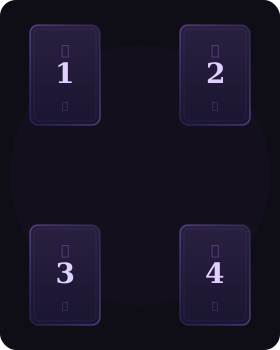
This spread serves for self-discovery. It has a psychological subtext and resembles the famous Johari Window model, showing four aspects of personality. The question this spread answers is: 'Who am I?' or 'What am I like?' Start with card 1, then compare it with the 'great unknown' position. Awareness of this position is the most valuable part of the spread. The other two positions also carry truly valuable meaning — position 3 reflects your self-assessment, and position 4 — how others perceive you. If these messages differ greatly from each other, or your self-assessment is opposite to how others see you, this should be considered a serious warning.
Spread Diagram
Card Positions
Clear personality characteristic
How you perceive yourself and how others see you. This is the open zone — what is known to both you and others. The starting point for analyzing the entire spread.
Blind Spot
What others see in you, either completely unknown to you, or existing only at the level of vague guesses. These are qualities, habits, or traits you are not aware of, but which are obvious to those around you.
Shadow, hidden
Aspects of your inner being known to you, but for certain reasons hidden from others' eyes. What you know about yourself but do not show the world — fears, desires, weaknesses, or secret sides of character.
The Great Unknown
What is unknown to both you and others. Deep potential, hidden possibilities, or suppressed aspects of personality yet to be discovered. Awareness of this position is the most valuable part of the spread. Compare this card with card 1 — their interaction reveals the key message.
How to Read
Shuffle the deck while focusing on the question 'Who am I?' or 'What am I like?'. Draw 4 cards and lay them out in a 2×2 square: card 1 — top left, card 2 — top right, card 3 — bottom left, card 4 — bottom right. Start reading with card 1 (open personality), then immediately move to card 4 (the great unknown) and compare them. After that, examine cards 2 (blind spot) and 3 (shadow). Pay attention to contrasts: if cards 3 and 2 strongly contradict each other — this points to a gap between what you hide and what others see anyway.
Tips & Advice
The 'Blind Spot' spread is based on the Johari Window model — a psychological framework developed by Joseph Luft and Harry Ingham. The four quadrants represent: the open self (card 1), the blind self (card 2), the hidden self (card 3), and the unknown self (card 4). If your self-assessment (card 3) is opposite to how others see you (card 2), this is a serious warning about a deep gap between inner and outer image. Card 4 is the most mysterious — it points to potential you have not yet tapped into. This spread is especially useful during identity crises or before important life decisions.
Other Spreads
Who Am I?7 cards
A spread designed for self-discovery and reflection on your personal development and future plans.
Planets11 cards
Describes a person using the astrological system of ten planets plus the ascendant.
Full Cup4 cards
If you have financial problems, this spread reveals their cause and suggests what action to take.