Tuning fork beats: why two close frequencies pulse
If two tones differ by a few hertz, the loudness starts to “breathe”: as many times a second as the difference between the frequencies. This is not a trick of perception or an adjustment of consciousness — it is ordinary addition of waves in the air, the very effect used to tune a guitar.
At the top are two waves, 136.10 and 140.25 Hz. At the bottom is their sum — what actually reaches the ear. No third tone appears: the waves now line up and reinforce each other, now drift apart and cancel out. Exactly 4.15 times a second, because that is the difference between the frequencies.
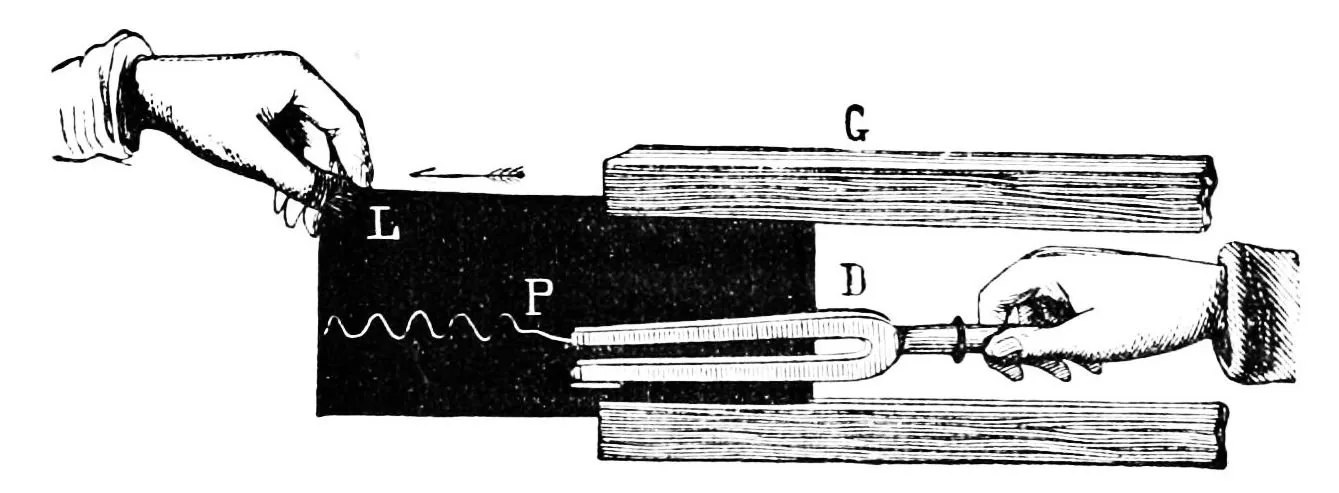
This is how it looked before oscilloscopes: a stylus was attached to the prong of a tuning fork, a sooted plate was drawn along beneath it — and the vibration traced itself. The waves in the pictures above are drawn with the same arithmetic that guided that stylus through the soot.
The frequency difference as a dial for your state
The names of the rhythms are borrowed from electroencephalography, where they label ranges of the brain's own activity. A match of numbers proves nothing by itself — “a sound with a 10 Hz difference” and “the brain's alpha rhythm” are linked by a name, not by an established cause. What has actually been measured: beats in the theta and alpha range moderately reduce anxiety, while trials disagree on whether they do better than ordinary music. For memory and attention, meta-analyses of binaural beats find a moderate effect, but results for individual ranges contradict each other, and EEG studies of these beats have not found the brain locking onto a rhythm in the beta range.
We keep this table on the site not because it is proven, but because practitioners work by it. The difference between “this is what people do” and “this is how it works” is the one thing an honest reference is obliged to spell out.
Advertisement
One pair — three states
This is the method's main technique. Raise a pair by an octave and both frequencies double — and the difference doubles with them. So the same pair of planets gives a different depth while its symbolism stays the same: a whole session can be run on “your own” planets, changing only the octave.
Look at the first row. Jupiter plus 10.60 Hz is exactly the Earth Day tone (the solar day), 194.18 Hz. Nothing was adjusted: two genuine planetary frequencies produce a clean alpha rhythm on their own. Uranus and Neptune line up the same way — 4.08 Hz, theta. These are exactly the pairs the method prefers: they make sense in the tradition and are precise in the arithmetic at the same time.
How is this different from binaural beats?
How is this different from binaural beats?
These are different phenomena, although they are constantly confused. Here, with beats from two tuning forks or from speakers (so-called monaural beats), the waves add up in the air — the sum can be picked up by a microphone and seen on an oscilloscope. Binaural beats are when each ear gets its own tone through headphones: nothing happens in the air, and the pulse is put together by the brain. The practical consequence: two tuning forks need no equipment at all, and a pair of planetary tones from a generator can be played through speakers or headphones alike, as long as both tones go to both channels. Headphones are required only for binaural beats.
Why does it stop being pleasant above 20 Hz?
Why does it stop being pleasant above 20 Hz?
While the difference is small, hearing has time to count the individual beats. From about 20 Hz the beats blur together, and instead of a pulse you get a rattle — what psychoacoustics calls roughness. This is a measurable property of hearing, not a matter of taste: it becomes unpleasant for roughly everyone at roughly the same point.
Can you get any difference you want?
Can you get any difference you want?
With tuning forks, no: the frequencies are fixed, and whatever difference you get is the one you have. With a tone generator, yes, and that is the second way of working: the first frequency is taken from a planet (the “meaning”), and the second is set as the first plus the difference you need. The trade-off is plain — the second frequency stops being planetary, which is worth remembering if the symbolism matters to you.
How safe is it?
How safe is it?
Quiet sound is safe in itself, but a rhythmic pulse is not for everyone: people prone to seizures should start it only after talking to a doctor, although, unlike flashing light, a pulsating sound has not been established as a seizure trigger. Add the usual volume rule: you should be able to hear your own breathing over the sound. The full list is on the safety page.
Comments
Comments are temporarily closed — the site is in development.