Tarotalyze

Jupiter tuning fork — 183.58 Hz

183.58 Hz is the tone of Jupiter, which circles the Sun in 11.86 years. Jupiter in astrology stands for growth and expansion, and the same theme carried over to the fork: the pair of Om and Jupiter is called the “chord of abundance”.
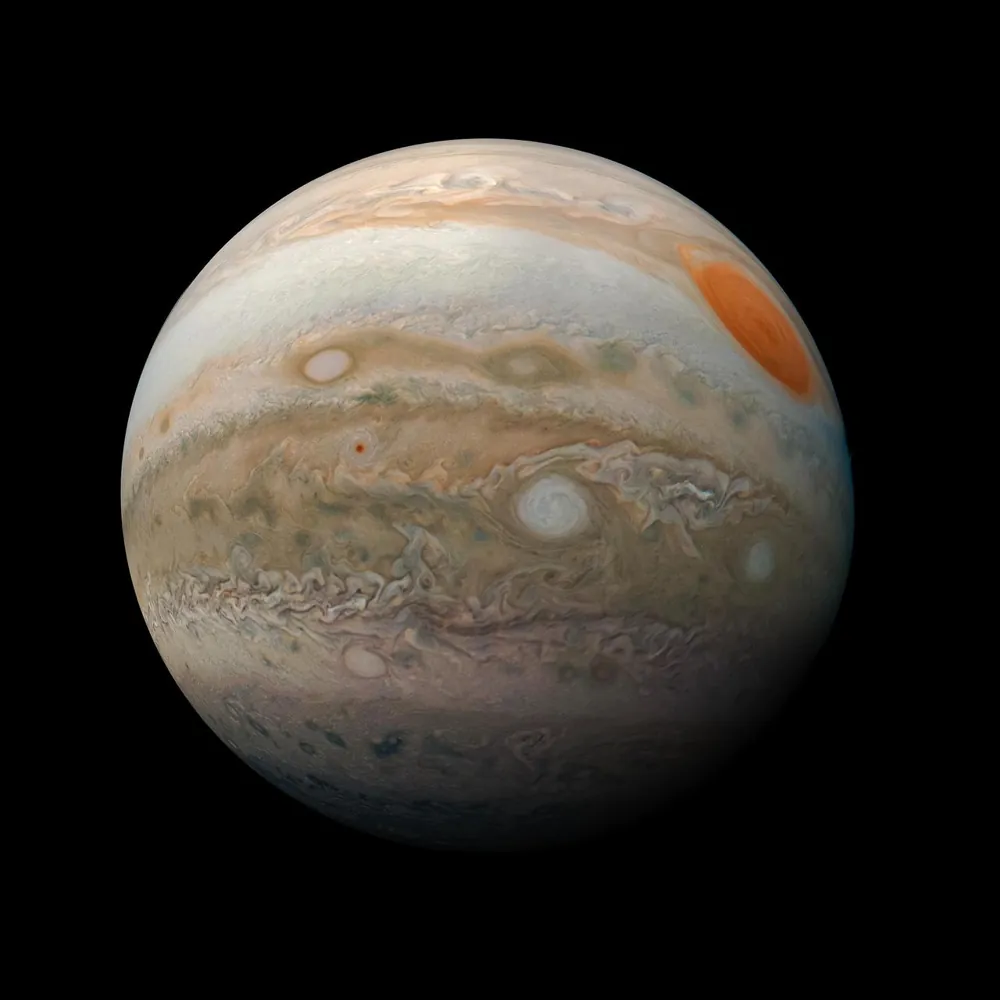
Jupiter with the Great Red Spot
Jupiter with the Great Red Spot · NASA/JPL, public domain
Frequency (middle octave)183.58 Hz
NoteF# · −13 cents from standard tuning A = 440 Hz
Tuning in which this is an exact noteA = 436.62 Hz
Cycleorbit around the Sun11.86 years
Doublings from the cycle's frequency36
Color (the same frequency as light)red · 743 nm
Paint on the Acutonics tuning forkdark blueshade measured from photos in the school's catalog — this is NOT the computed colorcolor name “Ultra Marine Blue” — school pagecolor name “Cobalt Blue” — Acutonics Canada
What can be checkedReproducible

This frequency has a neat coincidence that makes it a favorite for work with beats: Jupiter plus 10.6 Hz is exactly the tone of the solar day, the Earth Day fork at 194.18 Hz. So the “Jupiter + Earth Day” pair is both meaningful in tradition and gives a clean alpha pulsation without adjusting a single frequency.

An octave lower, the same pair gives 5.3 Hz, which is already theta. The same meaning at a different depth: this is the method's main practical technique.

How this number is obtained

middle fork band, 120–240 Hzstart8 doublings16 doublings24 doublings32 doublings183.58 Hz0.000 000 002 67 Hz: the frequency of the cycle itself36 doublings → note F#
The axis is logarithmic: each doubling raises the sound by exactly one octave. The pitch goes up, the note stays the same.
Given: the period of Jupiter
11.86 years = 374 336 251 seconds
1The frequency of the cycle itself: how many times it repeats per second
1 ÷ 374 336 251 = 0.000 000 002 671 4the same in short form: 2.67 × 10⁻⁹ Hz

A tiny number that cannot be heard: human hearing starts at about 20 Hz. But it is a real frequency, and we can keep working with it.

2Raising it into the audible range: each doubling is one octave up
0.000 000 002 671 4 × 2 = 0.000 000 005 342 81st doubling
0.000 000 005 342 8 × 2 = 0.000 000 010 6862nd doubling
0.000 000 010 686 × 2 = 0.000 000 021 3713rd doubling
⋮32 more doublings just like these
91.79 × 2 = 183.5836th doubling: now it is in the middle fork band
Or, in a single line:
0.000 000 002 671 4 × 2³⁶ = 183.58 Hz
where 2³⁶ = 68 719 476 736, the number of times the frequency has grown

The value Cousto published is 183.58 Hz. It matches.

3Which note it is
12 × log₂(183.58 ÷ 440) = −15.13semitones from A
nearest whole number: −15 = F#and that is the note
remainder: −0.13 of a semitone = −13 centshow far the tone is from the note

One hundred cents make one semitone. Planetary frequencies almost never land exactly on a note: orbits know nothing about musical tuning.

4In which tuning it would be an exact note
183.58 ÷ 2^(−15 ÷ 12) = 436.62 Hz

An ordinary piano is tuned to A = 440 Hz. Here the tone gets a tuning of its own, and for the Om tone it is exactly the much-discussed 432 Hz.

5Color: the same frequency raised all the way to light
183.58 × 2⁴¹ = 403 689 802 864 139 Hzthat is 4.04 × 10¹⁴ Hz, already visible light
299 792 458 ÷ 403 689 802 864 139 = 743 nmwavelength → red

Divide the speed of light by the frequency and you get the wavelength. This is a model, not the measured color of a planet, but the arithmetic is exactly the same as for sound.

Octave ladder

OctaveFrequencyHow it is used
2^3322.95 Hzbelow or at the edge of hearing
2^3445.89 Hzbelow or at the edge of hearing
2^3591.79 Hzlow: stronger vibration on the body
2^36183.58 Hzthe main tuning fork
2^37367.15 Hzhigh: work in the field above the body
2^38734.31 Hzhigh: work in the field above the body

Advertisement

What tradition ascribes

Tradition

Growth, expansion, abundance.

This is a system of correspondences, not the result of a measurement: controlled studies of planetary frequencies do not exist. We present the tradition because it exists and the practice is built on it — but we call it tradition.

Intervals with this tone

IntervalPairRatioDifference
Om / Jupiter 4Om + Jupiter1.34947.48 Hz