Tarotalyze

Venus tuning fork — 221.23 Hz

221.23 Hz is the tone of Venus, which circles the Sun in 224.7 days. By reputation it is the “softest” row in the set: love, beauty, attraction, the feminine principle.
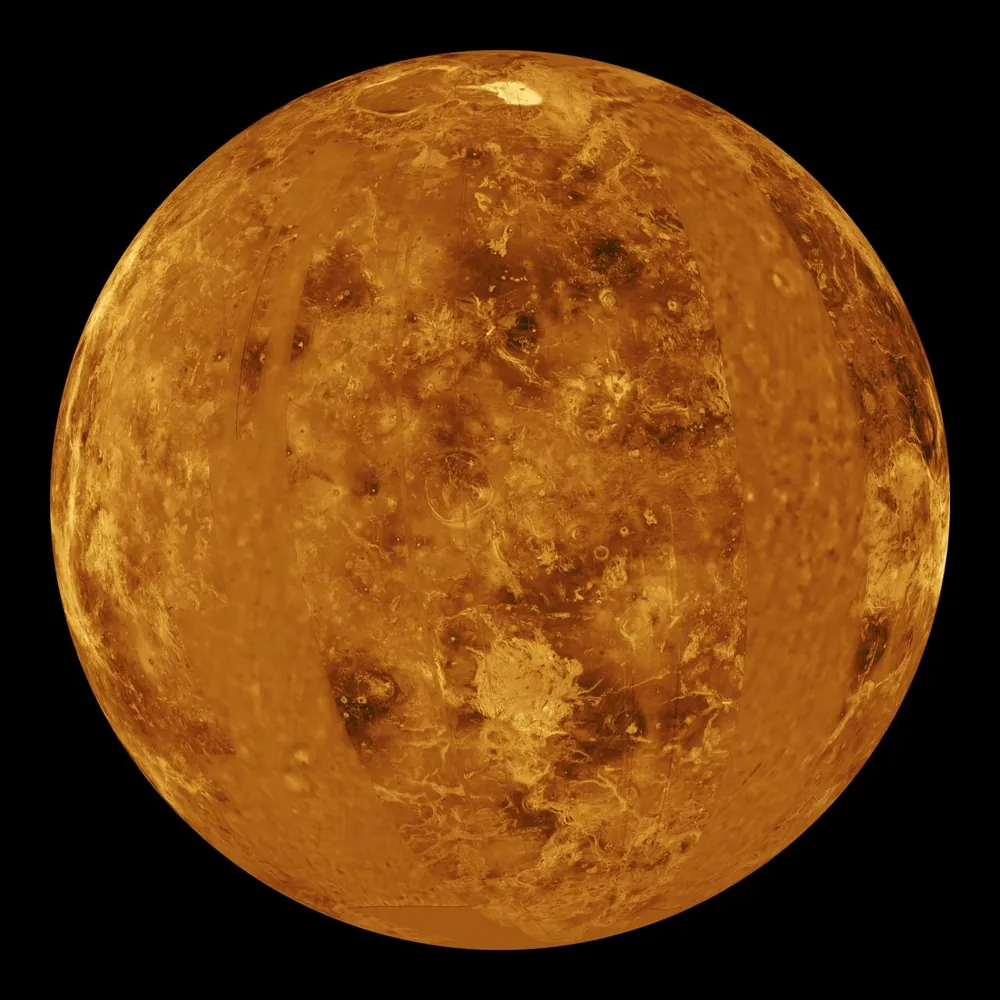
Venus beneath its clouds, with the surface reconstructed from Magellan radar data
Venus beneath its clouds, with the surface reconstructed from Magellan radar data · NASA/JPL, public domain
Frequency (middle octave)221.23 Hz
NoteA · +10 cents from standard tuning A = 440 Hz
Tuning in which this is an exact noteA = 442.46 Hz
Cycleorbit around the Sun224.7 days
Doublings from the cycle's frequency32
Color (the same frequency as light)yellow-orange · 616 nm
Paint on the Acutonics tuning forkpinkshade measured from photos in the school's catalog — this is NOT the computed colorcolor name “Rose Pink” — school page · Acutonics Canada
What can be checkedReproducible

There is a mix-up hidden here that rarely gets mentioned. In Cousto's system the match is unambiguous: Venus is the third eye, and that is exactly what his booklet prints. The Acutonics school, however, pairs a chakra not with one planet but with a SET of planets and intervals: Venus appears in the sets for the root, sacral, throat and brow chakras, and for the heart chakra it appears in pairs with Mars and with Jupiter. The school does single out the throat: on its Venus fork page the throat comes first in the list of anatomical correspondences, and its Venus gong page mentions the throat chakra. That is where articles saying “Venus rules the throat” come from. It is not made up, but it is not a replacement either: the third eye has not disappeared from the school's scheme, and for Cousto it is the only one.

The pair of Om and Venus is a sixth, not a fifth, even though it is constantly called the “Venus fifth”. The frequency ratio is 1.63; a fifth would be about 1.5. The mistake is widespread, which is why the project's main reference table corrects it on a line of its own.

How this number is obtained

middle fork band, 120–240 Hzstart8 doublings16 doublings24 doublings221.23 Hz0.000 000 051 5 Hz: the frequency of the cycle itself32 doublings → note A
The axis is logarithmic: each doubling raises the sound by exactly one octave. The pitch goes up, the note stays the same.
Given: the period of Venus
224.7 days = 19 414 166 seconds
1The frequency of the cycle itself: how many times it repeats per second
1 ÷ 19 414 166 = 0.000 000 051 509the same in short form: 5.15 × 10⁻⁸ Hz

A tiny number that cannot be heard: human hearing starts at about 20 Hz. But it is a real frequency, and we can keep working with it.

2Raising it into the audible range: each doubling is one octave up
0.000 000 051 509 × 2 = 0.000 000 103 021st doubling
0.000 000 103 02 × 2 = 0.000 000 206 042nd doubling
0.000 000 206 04 × 2 = 0.000 000 412 073rd doubling
⋮28 more doublings just like these
110.61 × 2 = 221.2332nd doubling: now it is in the middle fork band
Or, in a single line:
0.000 000 051 509 × 2³² = 221.23 Hz
where 2³² = 4 294 967 296, the number of times the frequency has grown

The value Cousto published is 221.23 Hz. It matches.

3Which note it is
12 × log₂(221.23 ÷ 440) = −11.90semitones from A
nearest whole number: −12 = Aand that is the note
remainder: 0.10 of a semitone = 10 centshow far the tone is from the note

One hundred cents make one semitone. Planetary frequencies almost never land exactly on a note: orbits know nothing about musical tuning.

4In which tuning it would be an exact note
221.23 ÷ 2^(−12 ÷ 12) = 442.46 Hz

An ordinary piano is tuned to A = 440 Hz. Here the tone gets a tuning of its own, and for the Om tone it is exactly the much-discussed 432 Hz.

5Color: the same frequency raised all the way to light
221.23 × 2⁴¹ = 486 486 659 851 607 Hzthat is 4.86 × 10¹⁴ Hz, already visible light
299 792 458 ÷ 486 486 659 851 607 = 616 nmwavelength → yellow-orange

Divide the speed of light by the frequency and you get the wavelength. This is a model, not the measured color of a planet, but the arithmetic is exactly the same as for sound.

Octave ladder

OctaveFrequencyHow it is used
2^2927.65 Hzbelow or at the edge of hearing
2^3055.31 Hzbelow or at the edge of hearing
2^31110.61 Hzlow: stronger vibration on the body
2^32221.23 Hzthe main tuning fork
2^33442.46 Hzhigh: work in the field above the body
2^34884.91 Hzhigh: work in the field above the body

Two values, and both are “official”

chakra: the third eye, and only the third eye (Cousto: one planet, one chakra) and five chakras in different sets; the product pages single out the throat (Acutonics: a chakra is matched not with a planet but with a set of planets and intervals).

This is not a dispute about a fact but two constructions that cannot be compared. Cousto's match is unambiguous. Acutonics matches a chakra with a SET: Venus appears in the sets for the root, sacral, throat and brow chakras, and for the heart chakra in pairs with Mars and with Jupiter. The school does single out the throat: on its Venus fork page the throat comes first in the list of anatomical correspondences, and the page for its Venus gong mentions the throat chakra. So “Venus is the throat” is not made up, but it is not a replacement either: the third eye has not disappeared from the school's scheme. The two systems cannot be compared line by line.

the school's article on chakras · Venus Middle fork · Venus gong

Advertisement

What tradition ascribes

Tradition

Beauty, attraction, self-acceptance.

This is a system of correspondences, not the result of a measurement: controlled studies of planetary frequencies do not exist. We present the tradition because it exists and the practice is built on it — but we call it tradition.

Intervals with this tone

IntervalPairRatioDifference
Om / Venus 6Om + Venus1.62585.13 Hz
Mars / Venus 5Mars + Venus1.52976.51 Hz