Chiron tuning fork — 172.86 Hz
172.86 Hz is the tone of Chiron, a body with a period of about fifty years that carries two official names at once: (2060) Chiron in the catalog of minor planets and 95P/Chiron in the catalog of periodic comets. It is both at the same time, and it is the only object in the set of which that can be said.
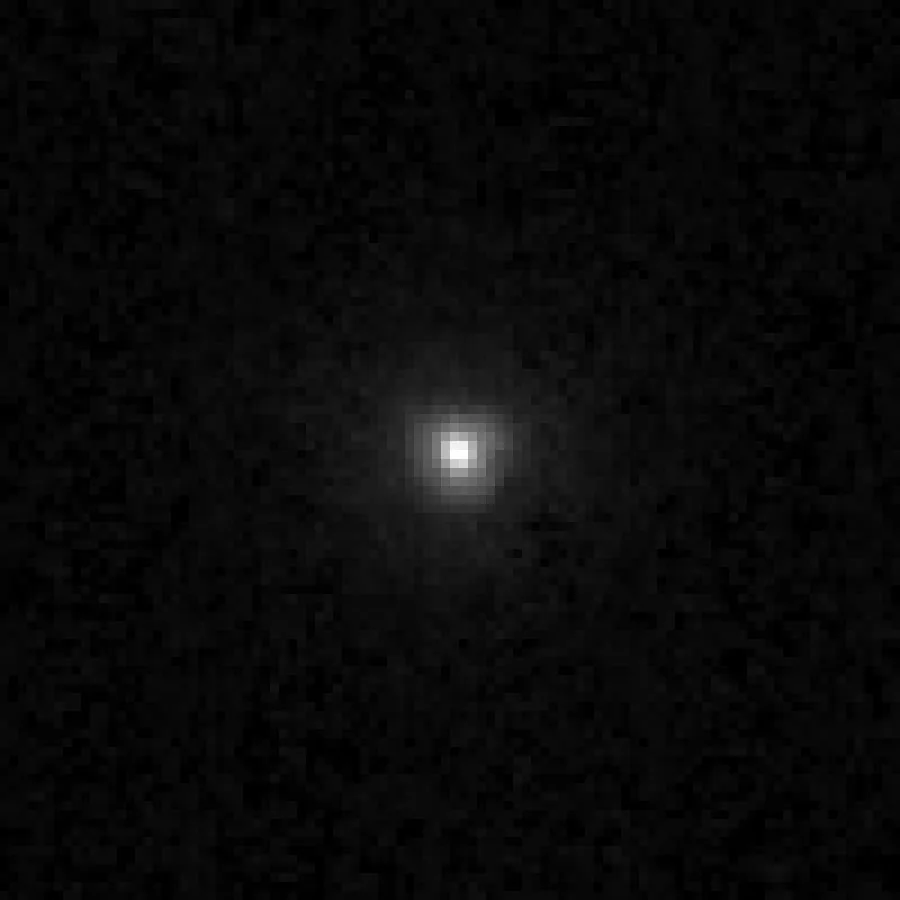
It does not “sit between Saturn and Uranus”, as is usually written: its perihelion, at 8.5 astronomical units, lies INSIDE Saturn's orbit, which means Chiron crosses it. Around the year 720 AD, Chiron passed within roughly thirty million kilometers of Saturn.
Chiron is a good test of the formula: it is not one of the objects the law of the octave was worked out on, and its period of 50.39 years honestly gives 172.86 Hz, exactly the number stamped on Planetware and Meinl forks. ⚠ On their forks specifically. The green Chiron fork of the Acutonics school is a different instrument: the school publishes no hertz for any of its forks, but it does publish the note and the interval, and for Chiron they are D sharp and a major second with Om, whereas 172.86 Hz is F and a major third. The tone the school's fork actually sounds is covered below, in the section on the two values.
★ The history of this number is worth knowing in full. Until May 2014, the Chiron fork was made at 171.80 Hz, because its period, 50.7 years, was taken from a NASA fact sheet. A seller noticed that the Jet Propulsion Laboratory listed 50.39, wrote to the author of the fact sheet, the author CORRECTED it, and the fork was retuned. In other words, there was no new measurement: two sources were brought into agreement.
And the story has a sequel that tuning fork websites leave out. The figure 50.39 is the osculating orbit for January 1996, a snapshot of one particular moment. The same laboratory's current solution gives 50.62 years, and that yields 172.07 Hz: literally the “Zodiac” fork at 172.06, the very mix-up we warn about on the Zodiac fork's page.
There is no need to change the fork because of this: it is physically tuned to 172.86, and that is its frequency. But the conclusion is more honest said out loud: for a planetary tuning fork, the hertz depend on which table the period comes from and for which epoch. For Chiron that choice moves the tone by a whole hertz, more than the distance to its nearest neighbor in the set.
⚠ A separate note on the source: the NASA fact sheet that gave 50.39 no longer opens at its address. That part of the site was moved, and the page can only be read in the web archive. A section built on the promise that “the numbers can be checked” has to say this too.
How this number is obtained
Octave ladder
Two values, and both are “official”
which fork is called Chiron: 172.86 Hz, note F, from a period of 50.39 years (Planetware and Meinl forks; this page is about that one) and about 151 Hz, note D sharp, a major second with Om, green paint (the Acutonics school's fork: the school publishes the note, interval and color but not the frequency; about 151 Hz is our measurement from Acutonics Canada recordings).
These are not two values of one frequency but two different instruments with the same name. The 172.86 Hz tone is computed from the orbit. The green Acutonics Chiron fork sounds noticeably lower: recordings of its low and high octaves, brought to the middle octave, give about 151 Hz, and the note and interval the school itself publishes roughly agree with that, while they do not agree with 172.86 Hz. The school does not say which period its tone was derived from, so there is no calculation for it here, and the green paint does not belong to 172.86 Hz.
the school's Chiron Middle fork · Acutonics Canada: color and note · recording of the low fork · recording of the high forkfrequency: 172.86 Hz, from a period of 50.39 years (NASA fact sheet for the 1996 epoch; Planetware has tuned its forks to it since May 2014) and 171.80 Hz, from a period of 50.7 years (the earlier value in the same fact sheet; Planetware tuned its forks to it until 2014).
The orbit was not “refined”: a seller noticed that the NASA fact sheet disagreed with the Jet Propulsion Laboratory's catalog, wrote to the author, the author corrected the fact sheet, and the fork was retuned. ⚠ With today's orbital elements (50.62 years), Chiron's tone comes out at 172.07 Hz, landing on the “Zodiac” fork at 172.06, the very mix-up people are usually warned about.
Advertisement
What tradition ascribes
Working with old emotional wounds, a bridge between body and spirit. ⚠ The image of the “wounded healer” came not from astrology but from Jungian psychology, and it existed long before Chiron was discovered in 1977: astrology took a ready-made name.
This is a system of correspondences, not the result of a measurement: controlled studies of planetary frequencies do not exist. We present the tradition because it exists and the practice is built on it — but we call it tradition.