Tuning forks: design, alloys and tuning
A tuning fork is the simplest instrument in this subject and the most predictable one: its frequency follows from its dimensions by a single formula. Let us look at what affects it, what does not affect it at all, and why choosing a metal is not choosing a NOTE — though it very much is choosing a sound.
What decides the frequency
The frequency of a tuning fork depends on two dimensions: the thickness of the prong and its length. A thicker prong gives a higher tone, in direct proportion. A longer prong gives a lower tone, and by the square: twice as long means four times lower.
The width of the prong does not enter the formula at all — it has no effect on the frequency. Neither does the handle: its length and thickness change how comfortable the grip is and barely change the tone. But doubling all the dimensions at once lowers the sound by exactly one octave — which is why a set of forks in different octaves looks like the same fork at different scales.
The formula is computed right on this page — the table below is not copied but calculated.
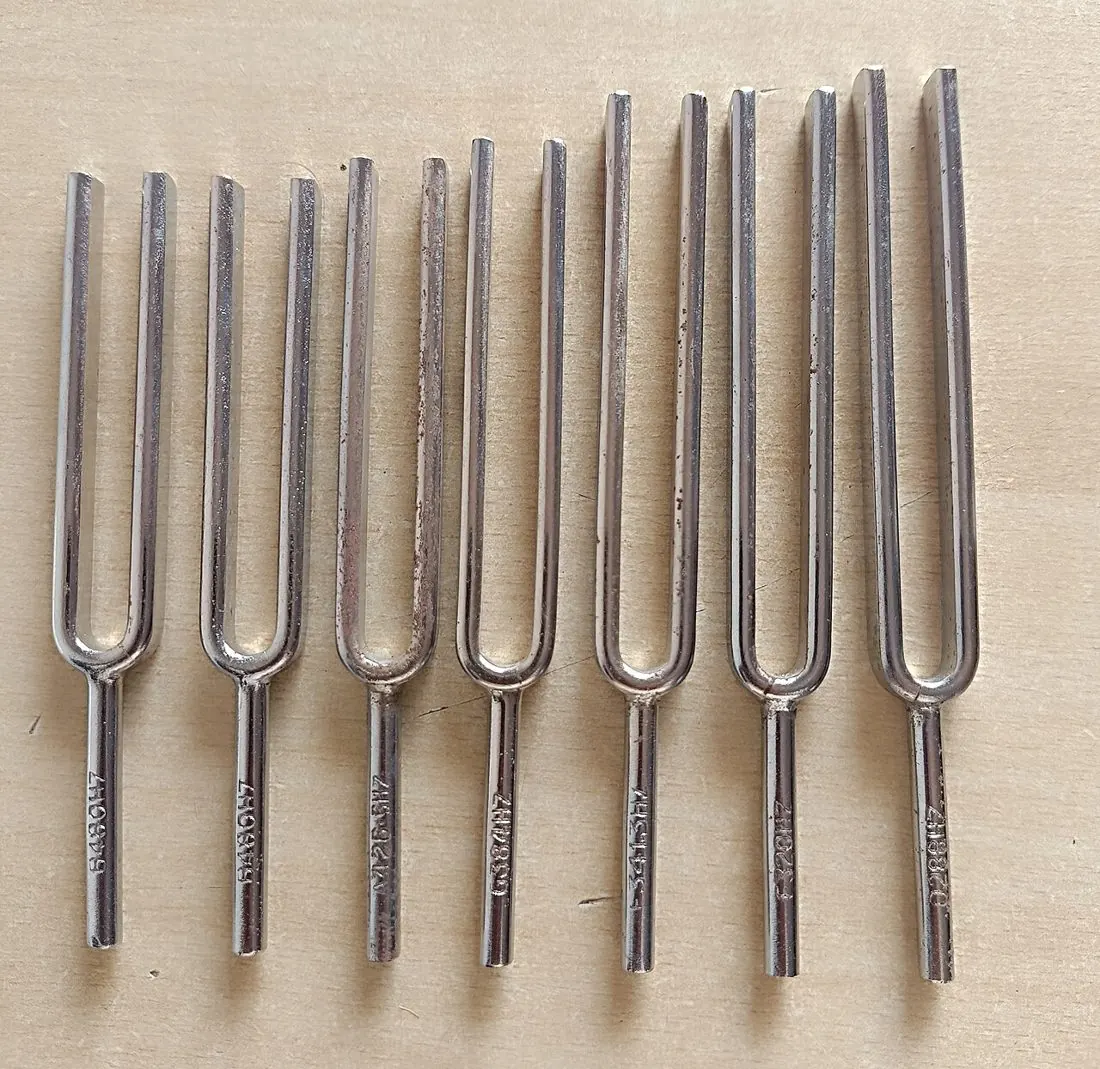
Ordinary laboratory tuning forks are the same ones you find in school physics classrooms. Planetary forks differ from them only in the number they are tuned to: the physics is the same, and that is perhaps the most important thing to understand about the instrument.
Three octaves of one tuning fork — and each is used differently
The same object comes in a set in several octaves: low, middle and high. It is literally one note taken lower or higher — but they are used differently, and the difference lies not in symbolism but in physics.
The rule is simple: the lower the octave, the more BODY there is in it, and the higher, the more HEARING. That is why the same “Om” on the sacrum and above the head are two different instruments, even though they share one note.
★ A tuning fork placed on bone also passes the octave above into it
This is the most unexpected thing about how the instrument works, and guides to sound practice almost never mention it. While a tuning fork sounds in the air, you hear its own tone. But press the handle against a hard surface — a table, a bone, a soundboard — and what passes into that surface is the doubled frequency, often louder than the fundamental tone.
The reason is simple and elegant: the prongs swing together and apart, and the center of mass of the fork dips TWICE in a single period of vibration — once when the prongs are furthest apart and once when they are closest together. The handle feels exactly this motion, and so it passes on a push twice as frequent.
A practical conclusion that changes the usual wording. An “Om” at 136.10 Hz placed handle-down on bone also sends 272.20 Hz into the bone — the upper octave of the same tone, often more strongly than the fundamental. So the phrase “the frequency of the Earth sounds in the body” is only half true: the tone is the same, but in the bone the octave is often a different one.
This is also the published reason for weights: mass at the ends of the prongs reduces this octave at the handle, so what goes into the bone is mostly the tone itself. In other words, weights do not only “amplify the vibration”, as people usually write — they also clean it up.
Metal barely changes the pitch — but it changes everything else
Look at steel and aluminum: their constants differ by a few percent — less than the reference values of the elastic modulus vary for each metal on its own. The reason is elegant: steel is three times stiffer than aluminum but also three times denser, and the formula uses the ratio of the two — so the difference almost cancels out.
And this is not just arithmetic. In a published measurement, forks of identical dimensions made of 6061-T6 aluminum and of stainless steel gave the same frequency, 260 Hz; a different grade of steel in the same measurement came out at 267 Hz — a quarter-tone off, and that is the honest limit of the rule.
Everything else, though, the metal changes a lot. In the same measurement, the ringing time of the different alloys ranged from “dies away in seconds” to “rings long and loud”, and the overtones from “none” to distinct harmonics. So choosing a metal means choosing not a note but a character: the weight in the hand, how long it rings, its brightness, how the vibration passes into bone. Brass changes the geometry as well: at the same frequency the prong comes out about one-sixth shorter.
What the Acutonics school says about its alloy — and what of it can be checked
The school describes its tuning forks as made of a “proprietary aerospace non-magnetic aluminum alloy” and warns separately that cheap alloys supposedly give an inaccurate tone and “leach into the body”. Let us go through this calmly, word by word.
- Aluminum and paint — checkable and true.
- “Non-magnetic” — true, but it says nothing: all aluminum is non-magnetic, and so are the stainless steels that competing tuning forks are made of.
- “Aerospace” — not a technical term but a word. Ordinary 6061, which costs next to nothing, fits it too.
- The alloy grade is not disclosed, so the claim cannot be checked in principle — not by us and not by anyone else.
- “A cheap alloy gives an inaccurate tone” — not true: pitch is set by dimensions and tuning, not by the grade of metal. That is exactly what the formula above shows.
- “Leaches into the body” — no measurements exist. A tuning fork touches the skin for a few seconds and does not dissolve into it.
This does not mean their tuning forks are bad: a painted, balanced, precisely tuned instrument is worth its price. It means you pay for the making and the quality control, not for a secret metal — and that difference is worth knowing before buying a set that costs several hundred dollars.
How long the prong should be
Calculated for 6061-T6 aluminum with a prong thickness of 8 mm. ⚠ The formula describes an ideally clamped straight prong, while a real fork has an elastic curve at the bottom — and because of it, it sounds slightly LOWER than calculated. That is why the blank is made to these dimensions and then tuned upward by filing down the tips.
Advertisement
How to check that a tuning fork is in tune
How does a weighted tuning fork differ from an unweighted one?
How does a weighted tuning fork differ from an unweighted one?
Weights at the ends of the prongs make the vibrating part heavier: the tone drops, the sound in the air becomes quieter and shorter, but the vibration in the hand and on the body is noticeably stronger. Weighted forks are placed on the body; ordinary unweighted ones ring longer and louder and are used in the air — by the ear, above the body. Different jobs, not “better and worse”.
Why strike it gently?
Why strike it gently?
Besides its fundamental tone, a tuning fork has higher modes of vibration, and they are not harmonic with the fundamental: the second one is roughly six and a quarter times higher. A hard strike excites them, and instead of a clean tone you get a metallic clang that then slowly dies away. Hence the rule: strike against a rubber activator puck or your knee, not against anything hard and not with all your strength.
How do you adjust the frequency?
How do you adjust the frequency?
File metal off the ends of the prongs and the tone goes up; file it off near the base and the tone goes down. Remove metal symmetrically from both prongs and a little at a time: you cannot put it back. Check at room temperature — warming by ten degrees Celsius shifts the frequency by roughly a quarter of a percent, and in a cold workshop you will tune the fork to something other than what you will hear at home.
Do you have to buy brand-name forks?
Do you have to buy brand-name forks?
No — but “they are all the same” would not be true either. Only the PITCH is the same: a fork tuned to 136.10 Hz sounds at 136.10 Hz whatever the brand. The character of the sound, however, varies a lot, and the spread between individual forks is larger than the difference between metals: in a measurement of eleven used aluminum forks of the same model, the ringing time ranged from five seconds to forty-one. You can check the frequency yourself with the methods in the table above, and that is wiser than trusting the engraving.
Comments
Comments are temporarily closed — the site is in development.