Tarotalyze

Full Moon tuning fork — 227.43 Hz

227.43 Hz is the tone of the sidereal lunar month: the 27.32 days it takes the Moon to come back to the same star. The school named this fork “Full Moon”, and that name deserves a closer look.
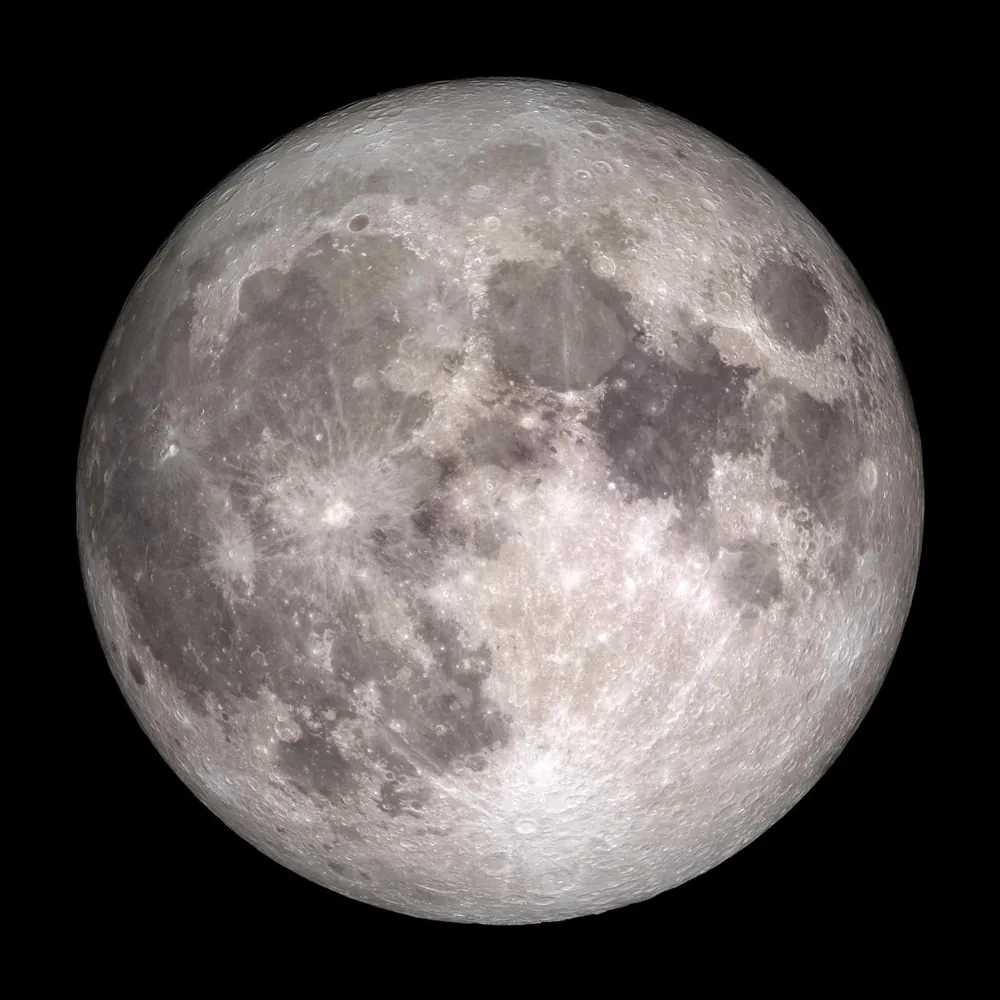
The full Moon. ⚠ 227.43 Hz is the sidereal month, not the full moon: the fork's name is symbolic
The full Moon. ⚠ 227.43 Hz is the sidereal month, not the full moon: the fork's name is symbolic · NASA/GSFC, public domain
Frequency (middle octave)227.43 Hz
NoteA# · −42 cents from standard tuning A = 440 Hz
Tuning in which this is an exact noteA = 429.33 Hz
Cyclesidereal lunar month, the Moon's orbit relative to the stars27.32 days
Doublings from the cycle's frequency29
Color (the same frequency as light)yellow-orange · 599 nm
Paint on the Acutonics tuning forkwhiteshade measured from photos in the school's catalog — this is NOT the computed colorcolor name “White” — school page · Acutonics Canada
What can be checkedReproducible

A full moon is an event of the synodic cycle, the same one that gives 210.42 Hz. The sidereal month does not count full moons at all. So 227.43 Hz is not the “frequency of the full moon” in any physical sense: it is a symbolic assignment made by the school, and it is more honest to know that than to repeat an appealing phrase.

The number itself is real and verifiable: the sidereal month really does give 227.43 Hz. What is open to question is not the number but its name.

How this number is obtained

middle fork band, 120–240 Hzstart8 doublings16 doublings24 doublings227.43 Hz0.000 000 424 Hz: the frequency of the cycle itself29 doublings → note A#
The axis is logarithmic: each doubling raises the sound by exactly one octave. The pitch goes up, the note stays the same.
Given: the period of the sidereal month (Full Moon)
27.32 days = 2 360 591 seconds
1The frequency of the cycle itself: how many times it repeats per second
1 ÷ 2 360 591 = 0.000 000 423 62the same in short form: 4.24 × 10⁻⁷ Hz

A tiny number that cannot be heard: human hearing starts at about 20 Hz. But it is a real frequency, and we can keep working with it.

2Raising it into the audible range: each doubling is one octave up
0.000 000 423 62 × 2 = 0.000 000 847 251st doubling
0.000 000 847 25 × 2 = 0.000 001 694 52nd doubling
0.000 001 694 5 × 2 = 0.000 003 389 03rd doubling
⋮25 more doublings just like these
113.72 × 2 = 227.4329th doubling: now it is in the middle fork band
Or, in a single line:
0.000 000 423 62 × 2²⁹ = 227.43 Hz
where 2²⁹ = 536 870 912, the number of times the frequency has grown

The value Cousto published is 227.43 Hz. It matches.

3Which note it is
12 × log₂(227.43 ÷ 440) = −11.42semitones from A
nearest whole number: −11 = A#and that is the note
remainder: −0.42 of a semitone = −42 centshow far the tone is from the note

One hundred cents make one semitone. Planetary frequencies almost never land exactly on a note: orbits know nothing about musical tuning.

4In which tuning it would be an exact note
227.43 ÷ 2^(−11 ÷ 12) = 429.33 Hz

An ordinary piano is tuned to A = 440 Hz. Here the tone gets a tuning of its own, and for the Om tone it is exactly the much-discussed 432 Hz.

5Color: the same frequency raised all the way to light
227.43 × 2⁴¹ = 500 125 353 635 705 Hzthat is 5.00 × 10¹⁴ Hz, already visible light
299 792 458 ÷ 500 125 353 635 705 = 599 nmwavelength → yellow-orange

Divide the speed of light by the frequency and you get the wavelength. This is a model, not the measured color of a planet, but the arithmetic is exactly the same as for sound.

Octave ladder

OctaveFrequencyHow it is used
2^2628.43 Hzbelow or at the edge of hearing
2^2756.86 Hzbelow or at the edge of hearing
2^28113.72 Hzlow: stronger vibration on the body
2^29227.43 Hzthe main tuning fork
2^30454.86 Hzhigh: work in the field above the body
2^31909.72 Hzhigh: work in the field above the body

Two values, and both are “official”

why it is the “full moon”: 227.43 Hz is the sidereal month (astronomy) and named the “full moon” (Acutonics).

A full moon is an event of the synodic cycle, not the sidereal one. The name is symbolic, and it is more honest to say so plainly than to pretend that 227.43 Hz “sounds at the full moon”.

Advertisement

What tradition ascribes

Tradition

Fullness, nourishment, emotional fulfillment.

This is a system of correspondences, not the result of a measurement: controlled studies of planetary frequencies do not exist. We present the tradition because it exists and the practice is built on it — but we call it tradition.

Intervals with this tone

IntervalPairRatioDifference
Full Moon 6Om + Full Moon1.67191.33 Hz